
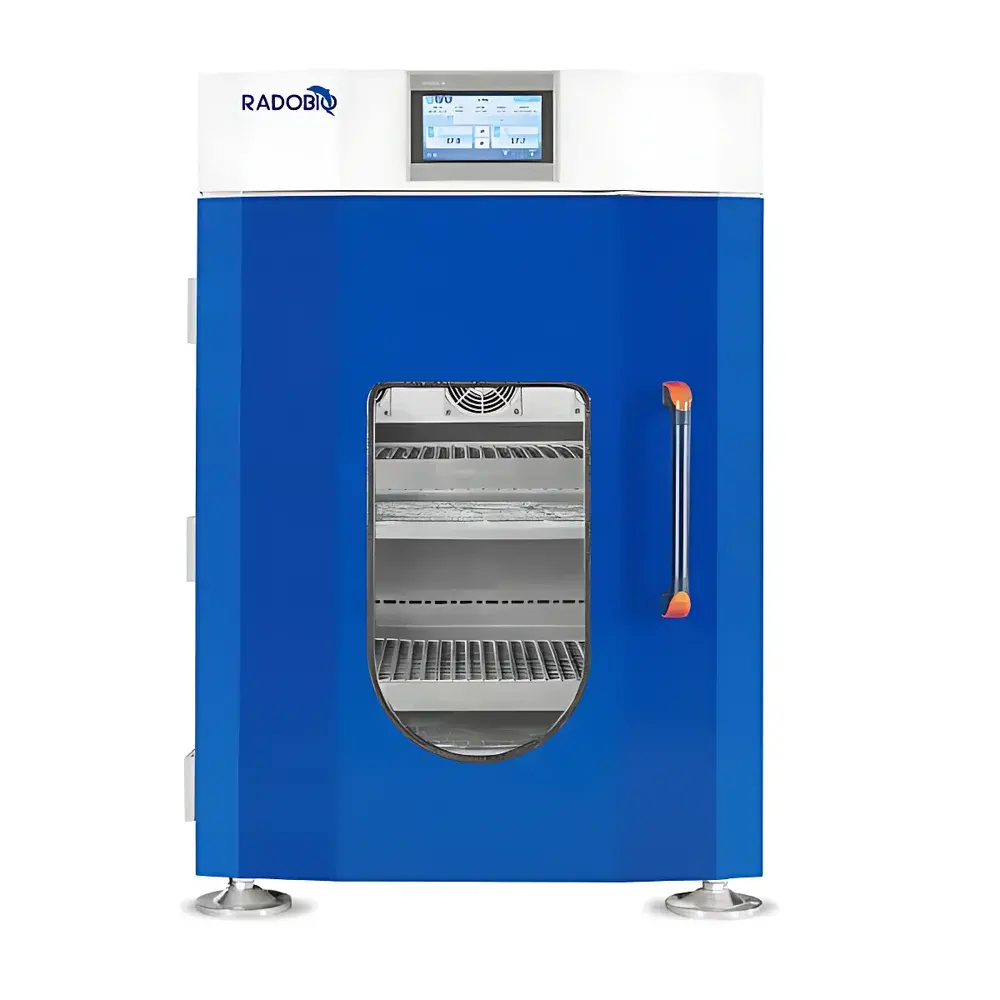
RADOBIO Herocell Max Vertical Dual-Layer CO₂ Orbital Shaker Incubator
| Brand | RADOBIO |
|---|---|
| Origin | Shanghai, China |
| Manufacturer Type | Authorized Distributor |
| Product Category | Domestic |
| Model | Herocell Max |
| Instrument Type | CO₂-Controlled Temperature-Shaking Incubator |
| Timer Range | 0–999.9 h |
| Oscillation Amplitude Options | 25 mm / 26 mm / 50 mm (custom amplitudes available) |
| Temperature Control Range | 4 °C to 60 °C |
Overview
The RADOBIO Herocell Max Vertical Dual-Layer CO₂ Orbital Shaker Incubator is an engineered platform for simultaneous or independent temperature-, CO₂-, and humidity-controlled shaking and static culture of mammalian cells, microbial suspensions, and suspension-based bioprocesses. It integrates orbital shaking mechanics with precise CO₂ regulation via non-dispersive infrared (NDIR) sensing and proportional control, enabling physiologically relevant in vitro environments—particularly for adherent and suspension cell lines requiring controlled gas exchange, mechanical stimulation, and thermal stability. The vertical dual-layer architecture optimizes footprint efficiency while supporting flexible experimental configurations: either dual-layer orbital shaking, or hybrid operation with one layer actively agitated and the other maintained under static incubation conditions. This design supports scalable process development—from early-stage screening in flasks and deep-well plates to intermediate-volume bioreactor mimicry—without compromising environmental uniformity or operational safety.
Key Features
- Dual independent stainless-steel oscillating platforms (500 × 500 mm each), configurable for synchronized or decoupled operation; upper tray supports selectable orbital agitation or static incubation
- 7-inch capacitive LCD touchscreen interface with multi-segment programmability: up to 5 stored protocols, each containing up to 30 user-defined steps for temperature, CO₂ concentration, RPM, amplitude, and duration
- Optimized thermal management system featuring PID-controlled heating/cooling, door-heating anti-fog function, and heat-free waterproof centrifugal fan ensuring ±0.3 °C temperature uniformity at 37 °C
- NDIR-based CO₂ monitoring and feedback control (0–20% range, ±0.1% accuracy) with recommended supply pressure of 0.05–0.1 MPa; integrated CO₂ sensor auto-calibration routine
- Full stainless-steel interior with seamless arc-corner construction, IPX4-rated water resistance, external mounting of motors and electronics, and bottom-mounted drain port (optional)
- UV-C germicidal lamp (254 nm) with interlocked door switch—automatically deactivates upon door opening; cycle timing and activation status logged in audit trail
- Patented monolithic stainless-steel clamping system: CNC-machined from solid stock, polymer-coated contact surfaces to prevent tube abrasion and operator injury
- Acoustically damped drive mechanism with precision-ground bearings; noise emission <55 dB(A) at 1 m during full-load operation at 300 rpm
Sample Compatibility & Compliance
The Herocell Max accommodates standard laboratory vessels including Erlenmeyer flasks (25–5000 mL), deep-well microplates (96-/384-well), tube racks (15 mL, 50 mL), and cell culture bottles—configurable via interchangeable fixtures (universal spring nets, fixed-bottle clamps, deep-well plate holders). Its internal volume (300 L) and dual-tray layout support high-density parallel experiments without cross-contamination risk. The system complies with ISO 13485 design controls for medical device-related R&D environments and meets essential requirements of IEC 61010-1 for laboratory equipment safety. While not certified for GMP manufacturing, its data logging capabilities—including timestamped parameter history (800,000 entries), USB export, and optional password-protected access—support GLP-aligned workflows and FDA 21 CFR Part 11 readiness when deployed with validated procedures.
Software & Data Management
All operational parameters—including real-time temperature, CO₂ concentration, RPM, and elapsed time—are continuously sampled at user-selectable intervals (30 s to 9999 s) and stored internally with millisecond-level timestamps. Historical datasets are retrievable via front-panel USB-A port and exportable as CSV files compatible with Excel, MATLAB, or LIMS integration. The interface supports audit-trail-enabled user authentication (lockout after three failed attempts), session-based parameter locking, and configurable alarm thresholds with visual (LED flash) and audible (85 dB) alerts. Firmware updates are performed locally via USB; no cloud dependency or remote telemetry is implemented—ensuring data sovereignty and network isolation per institutional IT policies.
Applications
- Mammalian cell expansion under controlled hypoxia or normoxia (e.g., CHO, HEK293, iPSC-derived lineages)
- Suspension culture optimization for monoclonal antibody production and viral vector manufacturing
- Microbial growth kinetics studies (E. coli, P. pastoris, S. cerevisiae) requiring dissolved CO₂ modulation
- Stem cell differentiation assays involving mechanical stimulation combined with gas-regulated niches
- Biopharmaceutical process development: shake flask-to-bioreactor bridging, media screening, and feeding strategy validation
- Environmental microbiology: soil slurry agitation under defined atmospheric composition
FAQ
What is the maximum flask capacity per tray when operating in dual-shaking mode?
Up to 50 × 250 mL flasks, 32 × 500 mL flasks, or 18 × 1000 mL flasks per tray—subject to mechanical balance and vessel geometry.
Is CO₂ calibration required by the user?
The NDIR sensor includes automatic baseline compensation; however, annual verification using certified gas standards (e.g., 5% CO₂ in N₂) is recommended per ISO/IEC 17025 guidelines.
Can the unit maintain humidity without external humidification?
Relative humidity is passively stabilized via internal water reservoir and fan-assisted vapor distribution; active humidification is not integrated but compatible with third-party inline humidifiers.
Does the system support 21 CFR Part 11 compliance?
Out-of-the-box functionality provides electronic records and audit trails; formal Part 11 compliance requires site-specific validation documentation, role-based access configuration, and digital signature implementation per organizational SOPs.
What maintenance intervals are specified for UV lamp replacement?
UV-C lamps are rated for 8,000 hours of cumulative operation; replacement is advised after 12 months of typical lab use or upon intensity decay below 70% of initial output, verifiable with a calibrated radiometer.






