
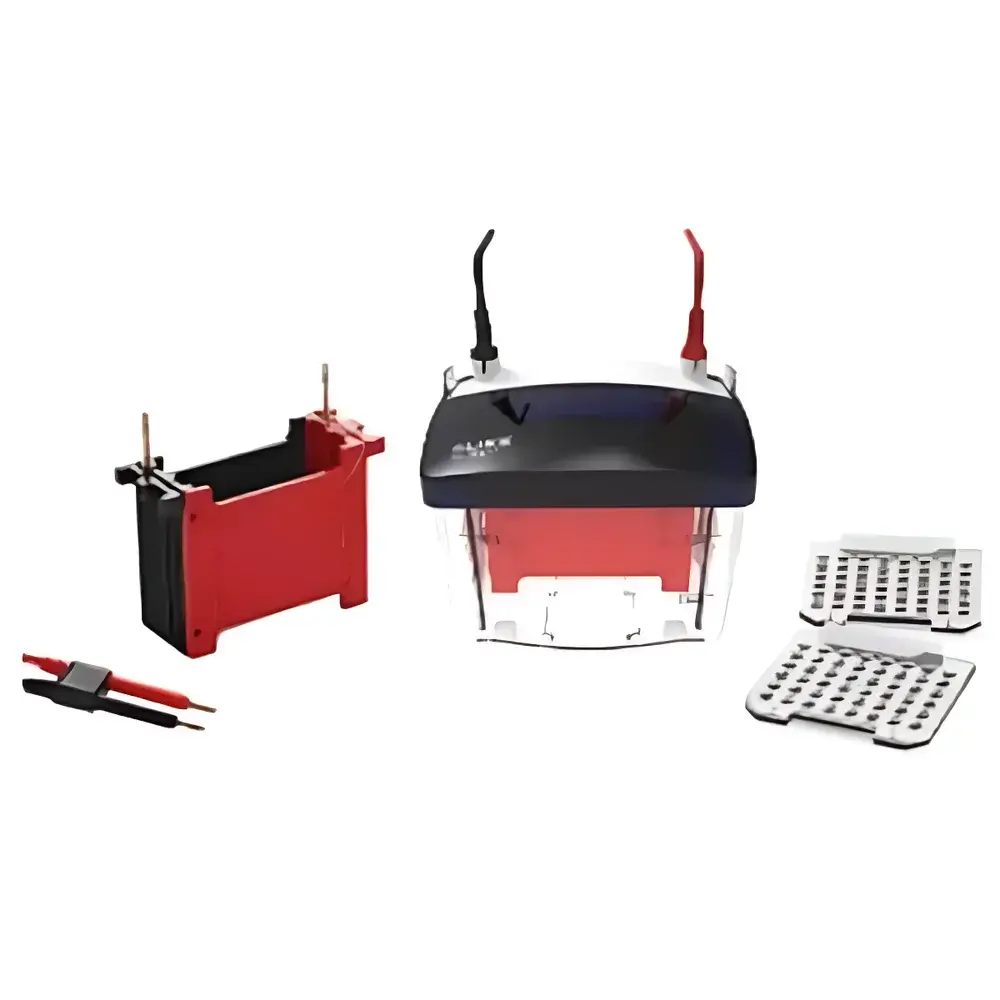
Clinox XinBLOT Mini Western Blot Transfer Tank
| Brand | Clinox |
|---|---|
| Origin | Shanghai, China |
| Manufacturer Type | Authorized Distributor |
| Country of Origin | China |
| Model | XinBLOT |
| Instrument Type | Acetate Membrane Protein Electrophoresis System |
| Primary Unit | Electrophoresis Transfer Tank |
| Gel Dimensions | 100 mm × 110 mm |
| Sample Capacity | 2 transfer sandwiches |
| Input Voltage | 220 V AC |
| External Dimensions | 160 mm × 120 mm × 180 mm |
| Cooling | Dual integrated Peltier cooling modules |
Overview
The Clinox XinBLOT Mini Western Blot Transfer Tank is a compact, benchtop electrophoretic transfer system engineered for reliable and reproducible protein transfer from polyacrylamide gels to solid-phase membranes—including nitrocellulose (NC), polyvinylidene difluoride (PVDF), and other supported blotting matrices. Based on standard wet-tank electroblotting principles, the XinBLOT applies a controlled direct current across a buffer-filled chamber to drive negatively charged proteins from the gel matrix onto the membrane surface via electrophoretic migration. Its design adheres to widely accepted transfer protocols described in key methodological references such as Sambrook & Russell’s *Molecular Cloning* and the *Current Protocols in Protein Science*. Optimized for both high-efficiency short-duration transfers (e.g., 30–60 min at elevated current) and low-current overnight protocols, the system supports consistent transfer performance across diverse molecular weight ranges—from small peptides (250 kDa)—without requiring external chillers or ice baths.
Key Features
- Compact footprint (160 × 120 × 180 mm) designed for space-constrained laboratories and shared core facilities.
- Dual independent Peltier-based cooling modules integrated into the tank base—enabling continuous thermal management during high-current operation and eliminating buffer temperature drift beyond ±1.5 °C over 90-minute runs.
- Simultaneous processing of two standard transfer cassettes (each accommodating one 100 mm × 110 mm gel/membrane assembly), improving throughput without cross-contamination risk.
- Adjustable voltage/current input (220 V AC, compatible with standard laboratory outlets in China and other 220–240 V regions); current output regulated to maintain stability under variable load conditions.
- Chemically resistant ABS housing and corrosion-resistant stainless-steel electrodes ensure long-term durability in Tris-glycine, CAPS, or SDS-containing transfer buffers.
Sample Compatibility & Compliance
The XinBLOT accommodates standard mini-gel formats up to 100 mm × 110 mm, compatible with common precast and hand-cast SDS-PAGE gels (8–20% T). It supports all conventional blotting membranes: nitrocellulose (0.2 µm and 0.45 µm pore sizes), PVDF (activated and non-activated), and positively charged nylon. Transfer efficiency has been validated using Coomassie-stained marker proteins and immunodetection of endogenous β-actin, GAPDH, and histone H3 across multiple replicates. While not certified to ISO/IEC 17025, the system meets functional requirements outlined in ASTM E2912–13 (Standard Guide for Electrophoretic Transfer of Proteins) and supports GLP-compliant documentation when used with traceable power supplies and calibrated thermometers. No FDA 21 CFR Part 11 compliance features are embedded; users implementing electronic records must integrate external audit-trail-capable software.
Software & Data Management
The XinBLOT operates as a standalone hardware unit with no embedded microcontroller or digital interface. All operational parameters—including voltage, current, time, and temperature—are monitored externally using standard laboratory-grade multimeters, timers, and digital thermometers. Users are advised to log transfer conditions manually or via LIMS-integrated spreadsheets. For protocol standardization, Clinox provides printable SOP templates aligned with ISO 9001 documentation practices, including fields for operator ID, lot numbers of membranes/buffers, ambient lab temperature, and post-transfer QC verification steps (e.g., Ponceau S staining intensity scoring).
Applications
- Western blotting workflows for qualitative and semi-quantitative detection of target proteins in cell lysates, tissue homogenates, and purified fractions.
- Validation of CRISPR/Cas9 knockout efficiency via loss-of-signal assessment.
- Assessment of post-translational modifications (e.g., phosphorylation, ubiquitination) using modification-specific antibodies.
- Preparative transfer prior to N-terminal sequencing or mass spectrometry analysis.
- Teaching laboratory implementation—ideal for undergraduate biochemistry and molecular biology courses due to its mechanical simplicity, safety profile (no high-voltage generation), and visual clarity of cassette loading.
FAQ
What membrane types are compatible with the XinBLOT?
Nitrocellulose (NC), polyvinylidene difluoride (PVDF), and positively charged nylon membranes—all within standard thickness and pore-size specifications (0.2–0.45 µm)—are fully supported.
Can I run the XinBLOT continuously for >2 hours?
Yes, provided ambient lab temperature remains ≤25 °C and the dual Peltier modules are functioning; extended runs require periodic visual inspection of buffer level and electrode integrity.
Is pre-wetting of PVDF membranes required before use?
Yes—standard methanol activation (15 sec immersion) followed by equilibration in transfer buffer is mandatory to ensure uniform protein binding capacity.
Does the XinBLOT include a built-in timer or display?
No—timing and current monitoring must be performed externally using standard laboratory instrumentation.
What maintenance is recommended for long-term reliability?
Rinse electrodes and tank interior with deionized water after each use; inspect Peltier module thermal paste annually and replace if visibly degraded or cracked.




