
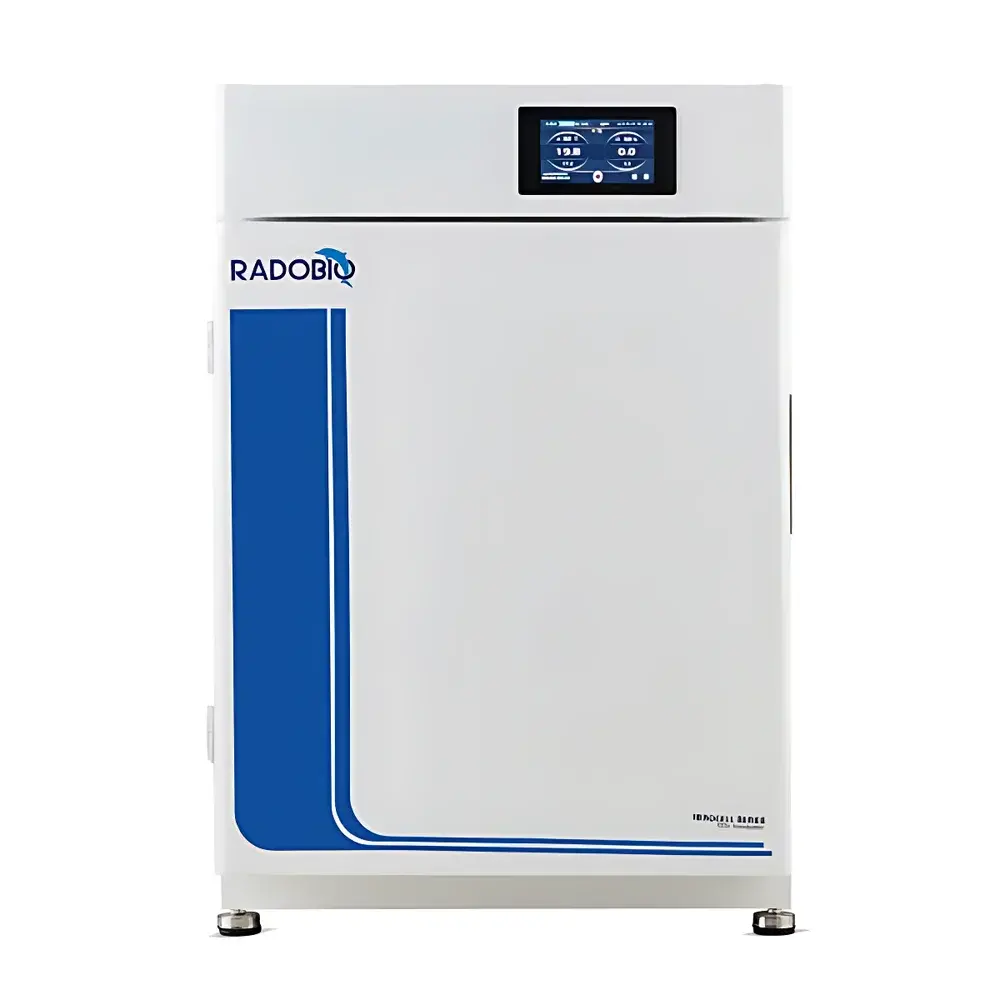
RADOBIO HC80 Medical-Grade CO₂ Incubator
| Brand | RADOBIO |
|---|---|
| Origin | Shanghai, China |
| Instrument Type | Air-Jacketed CO₂ Incubator |
| CO₂ Detection | Infrared (IR) Sensor |
| Temperature Control Range & Accuracy | Ambient +4°C to 60°C, ±0.1°C setpoint resolution |
| Temperature Uniformity | ±0.2°C (at 37°C, empty chamber, ambient 25°C) |
| CO₂ Concentration Control Range & Accuracy | 0–20%, ±0.1% setpoint resolution |
| Chamber Capacity | 85 L |
| Internal Dimensions (L×W×H) | 440 × 400 × 500 mm |
| External Dimensions (L×W×H, including base) | 567 × 528 × 832 mm |
| Key Configuration | PID temperature control, 6-sided direct-heating air-jacketed design, 140°C dry-heat sterilization cycle |
Overview
The RADOBIO HC80 Medical-Grade CO₂ Incubator is an ISO 13485-aligned, CE-marked (Class IIa medical device per MDR 2017/745), and China NMPA-registered incubation system engineered specifically for clinical laboratories, GMP-compliant cell therapy facilities, and diagnostic sample processing environments. It operates on the fundamental principle of maintaining a tightly regulated triad of environmental parameters—temperature, CO₂ concentration, and relative humidity—to replicate physiological conditions essential for mammalian cell culture, stem cell expansion, and primary tissue maintenance. The HC80 employs a true air-jacketed architecture with independent 6-sided heating elements embedded directly into the chamber walls, eliminating thermal lag and minimizing vertical/horizontal gradients. Its infrared (IR) CO₂ sensor delivers real-time, cross-sensitive compensation for humidity and temperature fluctuations—critical for applications involving frequent door access or multi-user workflows. Designed to meet stringent regulatory expectations, the HC80 supports full audit trails, data integrity compliance (aligned with FDA 21 CFR Part 11 Annex 11 principles), and routine validation protocols required under GLP, GCP, and ISO/IEC 17025 frameworks.
Key Features
- 6-Sided Direct-Heating Air-Jacket System: Uniform thermal distribution across all chamber surfaces ensures ±0.2°C temperature uniformity at 37°C (empty, ISO 19934-1 test conditions), reducing positional variability in cell growth kinetics.
- 140°C Dry-Heat Sterilization Cycle: Fully automated, validated high-temperature decontamination eliminates bacterial endospores, mycoplasma, fungi, and viruses without chemical residues—validated per ISO 14644-1 Class 5 cleanroom recovery requirements.
- In-Chamber HEPA Filtration (ISO 14644-1 Class 5): Recirculating 0.3 µm HEPA filter provides continuous air purification; achieves >99.99% particle removal efficiency and restores chamber air quality to baseline within ≤5 minutes post-door opening.
- IR-Based CO₂ Sensing with Cross-Compensation: Non-dispersive infrared detection maintains ±0.1% CO₂ accuracy across 0–20% range—even during transient humidity shifts or repeated door interventions—eliminating drift common in thermal conductivity (TC) sensors.
- Passive Humidity Management: 4 L stainless steel (304) water pan enables stable ≥95% RH at 37°C without condensation formation on chamber ceiling or optical components—validated via dew-point mapping per ASTM E2763.
- Touch-Enabled 5″ Capacitive LCD Interface: Displays real-time and historical trend curves (temperature, CO₂, humidity); supports configurable logging intervals (30–9999 s); stores up to 250,000 timestamped records with immutable USB export (FAT32-formatted drive).
Sample Compatibility & Compliance
The HC80 accommodates standard T-flasks (up to T225), multi-well plates (6–96-well), Petri dishes, roller bottles, and cryovial racks via adjustable 304 stainless steel shelving. Its polished, radius-cornered interior eliminates crevices where biofilm may accumulate—facilitating cleaning validation per USP Analytical Instrument Qualification. All wetted surfaces are electropolished 304 stainless steel, compliant with ISO 8573-1:2010 Class 2 for compressed gas compatibility. The unit meets IEC 61010-1 safety standards for laboratory equipment and includes dual redundant temperature limiters (mechanical and electronic) plus over-temperature alarm with audible/visual notification. Regulatory documentation—including Design History File (DHF), Risk Management File (ISO 14971), and Installation/Operational/Performance Qualification (IQ/OQ/PQ) templates—is supplied with each unit.
Software & Data Management
No proprietary software installation is required. All operational data—including setpoints, actual values, alarms, and sterilization logs—are stored onboard and exportable via USB 2.0 interface in CSV format. Each record contains ISO 8601 timestamps, operator ID field (manual entry), and digital signature verification metadata. Data immutability is enforced through write-once firmware logic; no record may be edited or deleted post-acquisition. Audit trail functionality complies with ALCOA+ principles (Attributable, Legible, Contemporaneous, Original, Accurate, Complete, Consistent, Enduring, Available) as interpreted in MHRA and EMA guidance documents. Optional integration with LIMS via Modbus RTU (RS-485 port, optional module) supports centralized monitoring in multi-incubator installations.
Applications
The HC80 serves critical roles in clinical diagnostics (e.g., lymphocyte proliferation assays, HLA typing cultures), regenerative medicine (mesenchymal stromal cell expansion under cGMP), IVF laboratories (embryo culture pre-implantation), and pharmaceutical QC (cell-based potency assays per USP ). Its stability profile supports long-term culture of sensitive lines—including iPSCs, neural progenitors, and primary endothelial cells—where microenvironmental deviation directly impacts differentiation fidelity and genomic stability. The rapid recovery performance (≤4 min temperature, ≤5 min CO₂ after 30-sec door opening) makes it suitable for high-throughput core facilities with shared instrument access policies.
FAQ
Does the HC80 comply with FDA 21 CFR Part 11 requirements?
Yes—the system implements electronic signature controls, audit-trail logging, and data immutability features aligned with Part 11 Subpart B expectations for closed systems. Full validation documentation is provided.
Is the 140°C sterilization cycle validated per ISO 14644 or EN 285?
While not a steam sterilizer, the dry-heat cycle has been verified per ISO 14644-1 Annex B for microbial reduction (≥6-log reduction of Geobacillus stearothermophilus spores) and included in the PQ protocol.
Can the incubator operate continuously at 41°C for fever-model studies?
Yes—temperature range extends to 60°C with sustained stability; thermal uniformity remains within ±0.3°C at 41°C per internal qualification reports.
What CO₂ supply pressure is recommended?
0.05–0.1 MPa (0.5–1.0 bar) inlet pressure is specified; integrated pressure regulator ensures consistent flow regardless of upstream fluctuations.
Is remote monitoring supported natively?
Not via built-in Ethernet/WiFi—but RS-485 Modbus output enables third-party SCADA or building management system (BMS) integration with appropriate gateway hardware.
Related Products




