
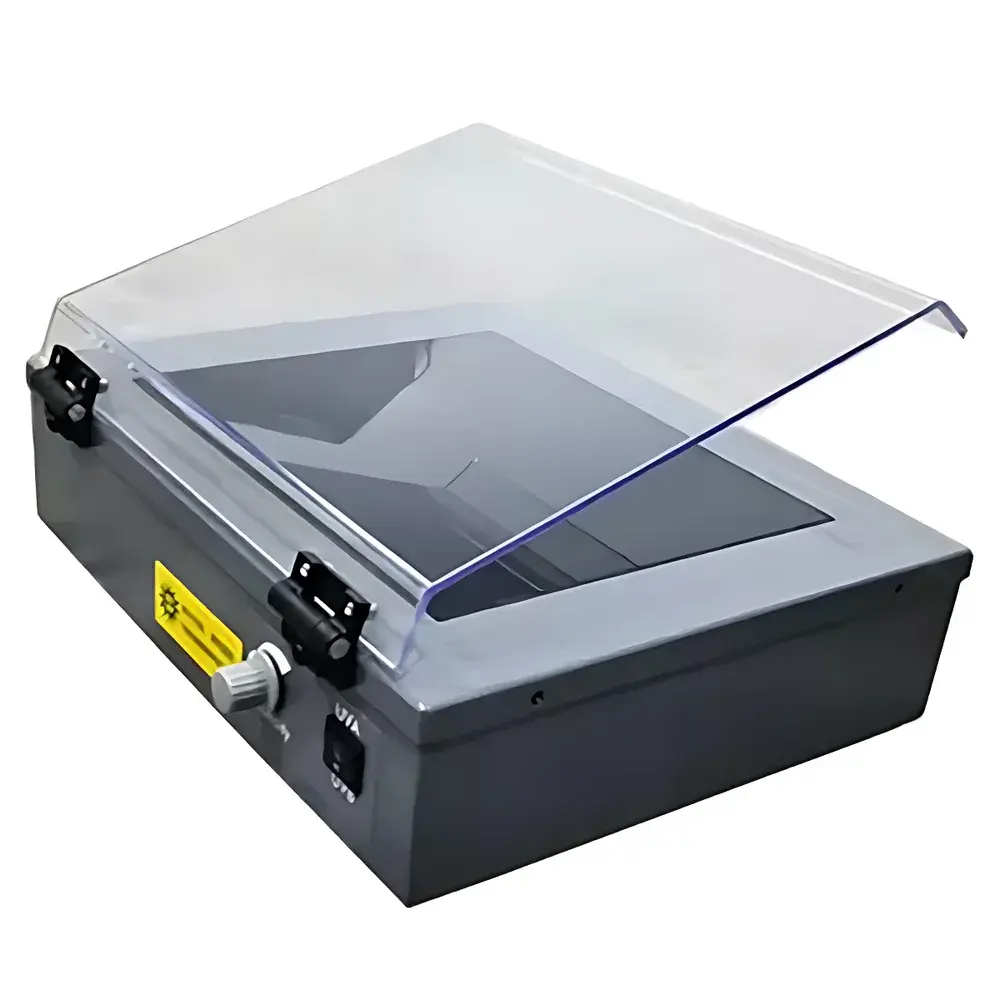
Clix CUV Series UV/Blue Light Transilluminator and Gel Cutter
| Brand | Clix |
|---|---|
| Model | CUV20A / CUV40A |
| Instrument Type | Benchtop Transilluminator |
| Wavelength Options | 302 nm (standard), 365 nm (dual-wavelength), optional 254 nm |
| UV Intensity Adjustment | 5–100% continuous dimming |
| Viewing Area | 21 cm × 26 cm |
| Dimensions (L×W×H) | 36 cm × 29 cm × 9 cm |
| Origin | Shanghai, China |
| Regulatory Compliance | CE-marked per IEC 61010-1 |
| conforms to ISO 15190 | 2020 laboratory safety standards for UV-emitting devices |
Overview
The Clix CUV Series UV/Blue Light Transilluminator and Gel Cutter is a precision-engineered benchtop instrument designed for safe, high-fidelity visualization, documentation, and excision of nucleic acid and protein bands in agarose and polyacrylamide gels. It operates on the principle of ultraviolet-induced fluorescence: when nucleic acids or proteins pre-stained with intercalating dyes (e.g., GelRed, ethidium bromide, SYPRO Orange) are exposed to specific UV wavelengths, they emit visible light proportional to their concentration and structural integrity. The CUV platform integrates dual-wavelength capability (302 nm and 365 nm), intensity modulation, and ergonomically adjustable UV shielding—enabling both analytical imaging and preparative gel excision under controlled photonic conditions. Unlike generic UV boxes, the CUV Series adheres to occupational safety thresholds defined in ACGIH TLVs® and EN 62471 for UV radiation exposure, ensuring operator protection without compromising optical performance.
Key Features
- Ergonomic, pivot-mounted UV shield with lockable tilt mechanism—optimized for simultaneous visual inspection, digital capture, and precise band excision while maintaining full-face UV attenuation (OD ≥ 4.0 at 302 nm)
- Multi-wavelength illumination architecture: CUV20A features fixed 302 nm UV source; CUV40A supports selectable 302 nm / 365 nm dual-band operation, with optional 254 nm module for specialized applications including UV shadowing and crosslinking validation
- Continuous UV intensity control (5–100%) via calibrated potentiometer—enables optimization of signal-to-noise ratio across dye chemistries and gel thicknesses while minimizing photodamage to DNA during excision
- Uniform irradiance distribution across full 21 cm × 26 cm viewing area (±8% variation), verified per ISO/IEC 17025-accredited photometric calibration protocol
- Thermally stabilized lamp housing with passive heat dissipation—ensures stable output over extended operation (>4 hr continuous use) without spectral drift or intensity decay
- Benchtop footprint (36 cm × 29 cm × 9 cm) optimized for integration into laminar flow hoods, gel documentation stations, and shared core facility workspaces
Sample Compatibility & Compliance
The CUV Series is validated for use with standard electrophoretic matrices including 0.8–2.0% agarose and 8–20% polyacrylamide gels. It supports all major fluorescent nucleic acid stains (GelRed, SYBR Safe, EtBr, GelGreen) and protein-compatible dyes (SYPRO Ruby, Deep Purple). For regulatory environments, the system meets essential requirements of ISO 15190:2020 (laboratory safety), IEC 61010-1 (electrical safety), and EN 62471 (photobiological safety classification: Risk Group 2 for 302 nm, Risk Group 1 for 365 nm). Optional documentation packages include factory-issued irradiance reports traceable to NIM (National Institute of Metrology, China) standards—supporting GLP-compliant recordkeeping and audit readiness.
Software & Data Management
While the CUV Series operates as a standalone hardware platform, its optical design is fully compatible with third-party gel documentation systems (e.g., Bio-Rad ChemiDoc, Azure Sapphire, UVP VisionWorks) via standardized C-mount and USB-controlled shutter interfaces. All intensity settings are manually calibrated and mechanically retained—eliminating software dependency and ensuring reproducibility across instruments and operators. For laboratories requiring electronic audit trails, integration with LIMS platforms is supported through analog voltage output (0–5 V DC) synchronized to intensity level, enabling time-stamped logging of exposure parameters in accordance with FDA 21 CFR Part 11 Annex 11 requirements.
Applications
- High-resolution detection and quantification of DNA/RNA fragments post-electrophoresis using 302 nm excitation
- Low-damage gel excision for downstream cloning, sequencing library preparation, and mass spectrometry sample recovery using 365 nm illumination
- Verification of UV crosslinking efficiency in RNA-protein interaction assays (e.g., CLIP, PAR-CLIP)
- Visualization of protein bands stained with thermally stable dyes under blue-light–compatible configurations (optional blue LED upgrade kit available)
- Teaching laboratory implementation—supports pedagogical alignment with ASTM D7777-14 (Standard Practice for UV Transilluminator Performance Verification)
FAQ
What safety certifications does the CUV Series hold?
The unit complies with IEC 61010-1 for electrical safety and EN 62471 for photobiological hazard assessment. Full test reports are available upon request for institutional biosafety office review.
Can the CUV40A operate both wavelengths simultaneously?
No—wavelength selection is manual and mutually exclusive via front-panel toggle switch to prevent spectral interference and ensure optimal excitation efficiency for each application.
Is the intensity adjustment linear or logarithmic?
The dimming circuit provides linear voltage control to the ballast, resulting in near-linear radiant flux modulation across the 5–100% range, verified by calibrated radiometer measurements.
Does the system support external timer integration?
Yes—via TTL-compatible trigger input (BNC), enabling synchronization with automated gel cutters or programmable exposure controllers used in high-throughput workflows.
How often should the UV lamps be replaced?
Lamp lifetime is rated at ≥5,000 hours at 75% intensity setting. We recommend annual photometric verification using a NIST-traceable UV-A sensor and replacement if output falls below 90% of initial specification.




