
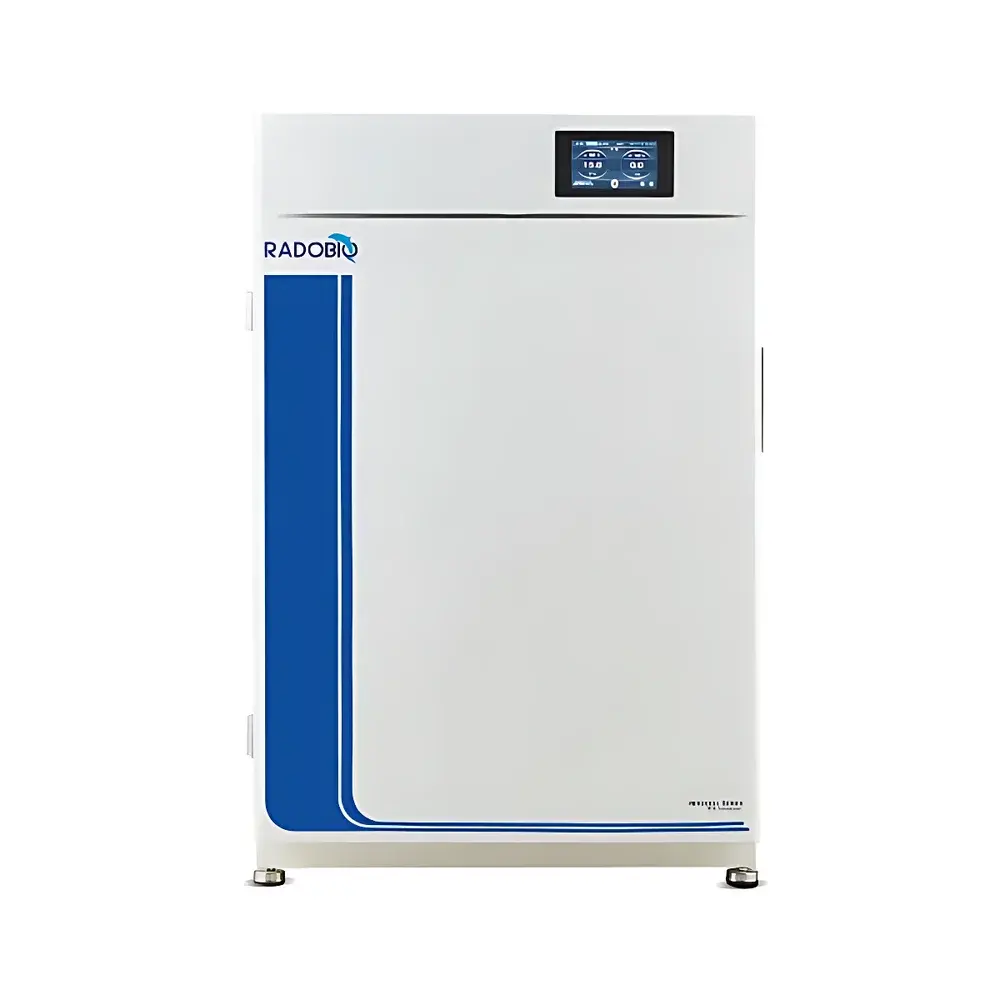
RADOBIO Celstar 185 Six-Sided Heated CO₂ Incubator
| Brand | RADOBIO |
|---|---|
| Origin | Shanghai, China |
| Instrument Type | Air-Jacketed CO₂ Incubator |
| CO₂ Detection | Infrared (IR) Sensor (Imported) |
| Temperature Range & Accuracy | Ambient +5°C to 60°C, ±0.1°C setpoint resolution |
| Temperature Uniformity | ±0.3°C (at 37°C, ambient 25°C, empty chamber) |
| CO₂ Concentration Range & Control Accuracy | 0–20%, ±0.1% |
| Chamber Volume | 185 L |
| External Dimensions (L×W×H) | 660 × 652 × 1000 mm (including base) |
| Heating Method | Six-Sided Direct-Heating Air Jacket |
| Sterilization | 140°C Dry-Heat Decontamination Cycle |
| Humidification | Removable 304 Stainless Steel Water Pan (4 L capacity) |
| Air Filtration | Internal HEPA Filter System (99.99% @ 0.3 µm) |
| Control Interface | 5-inch Capacitive Touch LCD Display |
| Data Logging | 250,000 entries, USB export, tamper-proof timestamped records |
| Power Supply | 220–240 V, 50–60 Hz |
| Weight | 108 kg |
Overview
The RADOBIO Celstar 185 is a precision-engineered, air-jacketed CO₂ incubator designed for demanding cell culture applications in academic research laboratories, biopharmaceutical QC/QA environments, and clinical cell therapy facilities. It operates on the fundamental principle of maintaining physiologically relevant conditions—stable temperature, controlled CO₂ partial pressure (to buffer bicarbonate-based media), and high relative humidity—to support optimal proliferation and viability of mammalian cells, stem cells, primary isolates, and sensitive co-cultures. Unlike water-jacketed systems, its six-sided direct-heating architecture delivers rapid thermal recovery (<10 min after a 30-second door opening at 37°C), superior spatial uniformity (±0.3°C), and reduced condensation risk through laminar, fan-assisted airflow over a stainless-steel humidified chamber. The integrated IR-based CO₂ sensor—sourced from a globally recognized OEM supplier—ensures long-term stability and immunity to drift caused by humidity fluctuations or frequent access, meeting the metrological requirements of ISO 13485-aligned workflows and GLP-compliant documentation practices.
Key Features
- Six-Sided Air-Jacketed Heating: Independent heating elements embedded across all interior surfaces—including door, floor, ceiling, and side walls—eliminate thermal gradients and deliver exceptional temperature homogeneity without relying on convection alone.
- 140°C Dry-Heat Decontamination Cycle: A validated, single-step sterilization protocol that eradicates bacteria, yeasts, molds, and mycoplasma from all internal stainless-steel surfaces (including corners and seams), eliminating the need for autoclaving removable parts or chemical disinfection.
- True HEPA Air Filtration System: An internally mounted Class H14 HEPA filter continuously recirculates and purifies chamber air, achieving >99.99% particle removal efficiency at 0.3 µm. Full chamber air exchange occurs within 5 minutes post-door opening, minimizing contamination exposure during routine handling.
- Stainless Steel Humidification Architecture: A removable 4 L 304 stainless steel water pan ensures consistent humidity up to 95% RH at 37°C while preventing cold-spot condensation via optimized cavity geometry and low-turbulence airflow design.
- IR-Based CO₂ Monitoring & Control: Dual-beam infrared detection provides real-time, drift-free CO₂ concentration feedback independent of ambient humidity or temperature transients—critical for labs with high-throughput access patterns or unstable environmental conditions.
- Regulatory-Ready Data Integrity: All operational parameters—including temperature, CO₂, humidity (optional), alarms, and sterilization cycles—are logged with immutable timestamps. Data export via USB adheres to ALCOA+ principles and supports audit readiness for FDA 21 CFR Part 11 and EU Annex 11 compliance.
Sample Compatibility & Compliance
The Celstar 185 accommodates standard T-flasks (up to T225), multi-well plates (6–96-well), Petri dishes, roller bottles, and custom bioreactor vessels within its 185 L chamber. Its polished 304 stainless-steel interior (with seamless, radius-corner construction) complies with ISO 14644-1 Class 5 cleanroom surface requirements when operated under HEPA filtration. The system meets IEC 61010-1 safety standards for laboratory equipment and is compatible with ISO/IEC 17025 calibration traceability protocols. Dry-heat sterilization validation reports (DQ/IQ/OQ documentation available upon request) align with USP and EP 5.1.5 guidelines for cell culture equipment qualification.
Software & Data Management
The 5-inch capacitive touch interface runs an embedded real-time operating system with intuitive navigation, multilevel password protection, and configurable alarm thresholds (audible + visual). Historical trend curves—temperature, CO₂, and optional humidity—are viewable directly on-screen with zoom and scroll functionality. Data logging intervals are user-selectable (30 s to 9999 s), supporting up to 250,000 timestamped entries stored in non-volatile memory. Exported .CSV files include metadata headers compliant with LIMS integration standards. No proprietary software installation is required; raw data is human-readable and compatible with Excel, GraphPad Prism, and electronic lab notebook (ELN) platforms.
Applications
- Mammalian cell line maintenance (HEK293, CHO, HeLa, etc.)
- Stem cell expansion and differentiation assays
- Primary neuron and organoid culture under low-oxygen priming conditions (when paired with optional O₂ module)
- Biological safety level (BSL)-2 compliant viral propagation and titer determination
- Regulatory submission-supporting stability studies per ICH Q5C
- Cell banking and cryopreservation workflow staging
FAQ
What CO₂ supply pressure is recommended for optimal performance?
A regulated inlet pressure of 0.05–0.1 MPa (0.5–1.0 bar) is required; higher pressures may cause valve instability, while lower pressures extend gas recovery time.
Can the incubator be validated for GMP use?
Yes—the Celstar 185 supports full DQ/IQ/OQ/PQ execution with documented protocols, sensor calibration certificates (NIST-traceable), and change control logs suitable for FDA and EMA inspections.
Is humidity monitoring included as standard?
Relative humidity sensing is optional; the base configuration maintains humidity passively via the stainless steel water pan, with accuracy verified per ASTM E2807-22 for incubator humidity performance testing.
How often must the HEPA filter be replaced?
Under continuous operation in ISO Class 7 environments, the HEPA filter is rated for 12 months or 8,000 operating hours—whichever occurs first—with replacement tracked automatically in the system log.
Does the dry-heat cycle affect sensor longevity?
No—the IR CO₂ sensor and PT100 temperature probes are thermally isolated during sterilization and resume operation immediately post-cycle without recalibration.



