
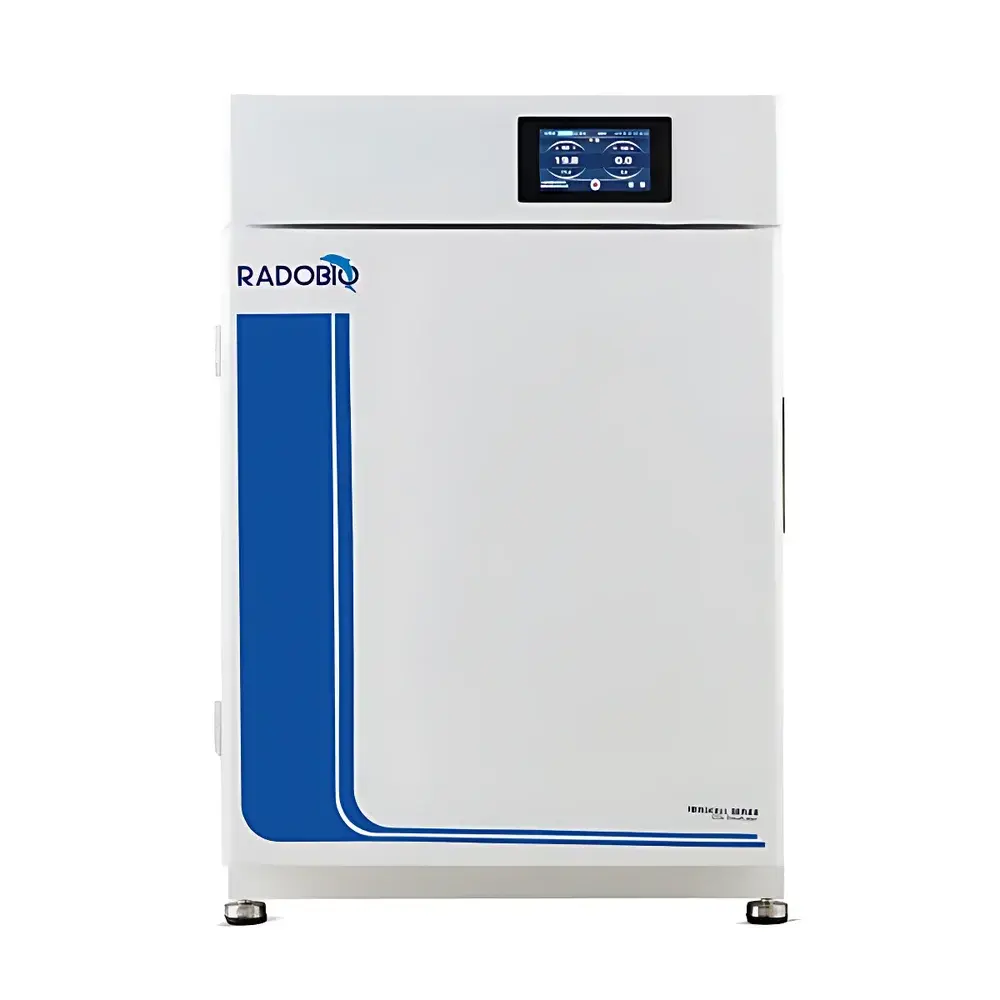
RADOBIO Herocell 80P Carbon Dioxide Incubator
| Brand | RADOBIO |
|---|---|
| Origin | Shanghai, China |
| Manufacturer Type | Authorized Distributor |
| Product Category | Domestic |
| Model | Herocell 80P |
| Instrument Type | Air-jacketed CO₂ Incubator |
| CO₂ Detection | Infrared (IR) Sensor |
| Temperature Control Range & Accuracy | Ambient +4°C to 60°C, ±0.1°C |
| Temperature Uniformity | ±0.2°C (at 25°C ambient, 37°C setpoint, empty chamber) |
| CO₂ Concentration Control Range & Accuracy | 0–20%, ±0.1% |
| Chamber Capacity | 85 L |
| External Dimensions (L×W×H) | 567 × 528 × 832 mm (including base) |
| Standard Configuration | PID control algorithm, 6-surface direct-heating air jacket, 180°C dry-heat sterilization |
Overview
The RADOBIO Herocell 80P is a precision-engineered air-jacketed carbon dioxide incubator designed for demanding mammalian cell culture applications in academic research laboratories, biopharmaceutical development facilities, and quality control environments. It operates on the fundamental principle of maintaining a tightly regulated triad of environmental parameters—temperature, CO₂ concentration, and relative humidity—to replicate physiological conditions essential for robust, reproducible cell proliferation. The unit employs a 6-surface direct-heating air jacket architecture to eliminate thermal gradients across the chamber, while an infrared (IR) CO₂ sensor ensures stable, drift-free gas monitoring independent of humidity fluctuations—a critical advantage during frequent door access or long-term unattended operation. Its ISO Class 5 HEPA filtration system continuously recirculates and purifies internal air, achieving cleanroom-grade particulate removal (<0.3 µm at ≥99.995% efficiency) within five minutes post-door-opening. This combination of thermal stability, gas fidelity, and airborne contamination control aligns with internationally recognized cell culture best practices outlined in ISO 13408-1 (Aseptic processing of health products) and supports compliance with GLP and GMP documentation requirements.
Key Features
- 6-surface direct-heating air jacket system delivering exceptional temperature uniformity (±0.2°C at 37°C, empty) and rapid thermal recovery (≤5 min after 30-sec door opening at 25°C ambient)
- High-stability infrared (IR) CO₂ sensor with 0.1% resolution and immunity to cross-sensitivity from water vapor or temperature transients
- Integrated 180°C dry-heat sterilization cycle—fully programmable, validated, and traceable—eliminating need for autoclaving removable components and reducing microbial risk from bacteria, yeasts, molds, and mycoplasma
- ISO Class 5 HEPA filtration system with continuous recirculation; achieves certified cleanroom air quality within 5 minutes after door closure
- Polished stainless-steel interior with seamless, radius-corner construction and tool-free removable shelves for efficient cleaning and validation
- Capacitive 5-inch LCD touchscreen interface with real-time trend visualization, configurable data logging intervals (30 s–9999 s), and tamper-proof USB export of up to 250,000 data points
- Active airflow management via low-turbulence internal fan ensures homogeneous distribution of temperature, CO₂, and humidity without desiccation of peripheral cultures
Sample Compatibility & Compliance
The Herocell 80P accommodates standard T-flasks (up to 175 cm²), multiwell plates (6–96-well), Petri dishes, roller bottles, and custom bioreactor vessels within its 85 L working volume. Its design conforms to IEC 61010-1 safety standards for laboratory equipment and incorporates dual redundant overtemperature protection circuits. The IR CO₂ sensor meets ASTM E2912–22 specifications for gas sensing accuracy in biological incubators. Data integrity features—including non-volatile memory storage, audit-trail-capable event logging, and immutable USB-exported datasets—support alignment with FDA 21 CFR Part 11 requirements for electronic records and signatures when deployed in regulated QC/QA workflows. The 180°C sterilization protocol is compatible with ISO 14644-1 cleanroom validation methodologies and facilitates routine requalification per ISO/IEC 17025 guidelines.
Software & Data Management
The embedded firmware implements a secure, menu-driven operating system with password-protected administrator mode. All operational parameters—including setpoints, sterilization cycles, alarm thresholds, and data logging configurations—are stored in EEPROM with write-protection logic. Historical data (temperature, CO₂, humidity, alarms, door events) is timestamped with millisecond precision and retained onboard for up to 12 months at default 1-minute intervals. Exported CSV files include device ID, firmware version, calibration certificate ID, and digital signature metadata—enabling full traceability during regulatory inspections. Optional Ethernet or RS-485 interfaces (available via factory configuration) allow integration into centralized facility monitoring systems compliant with BMS or SCADA architectures.
Applications
- Long-term maintenance and expansion of primary human and murine cell lines under physiologically relevant conditions (e.g., 37°C, 5% CO₂, >95% RH)
- Stem cell differentiation protocols requiring strict environmental consistency across multi-day timelines
- Transfection and viral vector production workflows where sterility assurance and minimal parameter drift are critical
- Regulatory-compliant stability studies for biologics manufacturing under ICH Q5D and Q5A frameworks
- High-throughput screening platforms integrating automated plate handlers and environmental feedback loops
FAQ
What is the maximum allowable CO₂ pressure input for safe operation?
The recommended inlet pressure range is 0.05–0.1 MPa (0.5–1 bar); exceeding this may compromise solenoid valve longevity and calibration stability.
Does the unit support remote monitoring via network connection?
Standard configuration includes USB data export only; Ethernet or RS-485 connectivity requires optional factory-installed communication module and firmware upgrade.
How often must the HEPA filter be replaced?
Under typical usage (10–15 door openings/day), replacement is recommended every 12 months; filter life is extended when used with external CO₂ gas purification systems.
Is the 180°C sterilization cycle validated per ISO 17665?
While the cycle delivers lethal thermal dose (F₀ ≥ 15 min at 180°C), formal validation must be performed onsite using thermocouple mapping and biological indicators per user-defined SOPs.
Can humidity be actively controlled, or is it passively maintained via water pan?
Humidity is passively sustained using a stainless-steel water reservoir; active humidification is not implemented to avoid condensation-related contamination risks and simplify qualification.
Related Products



