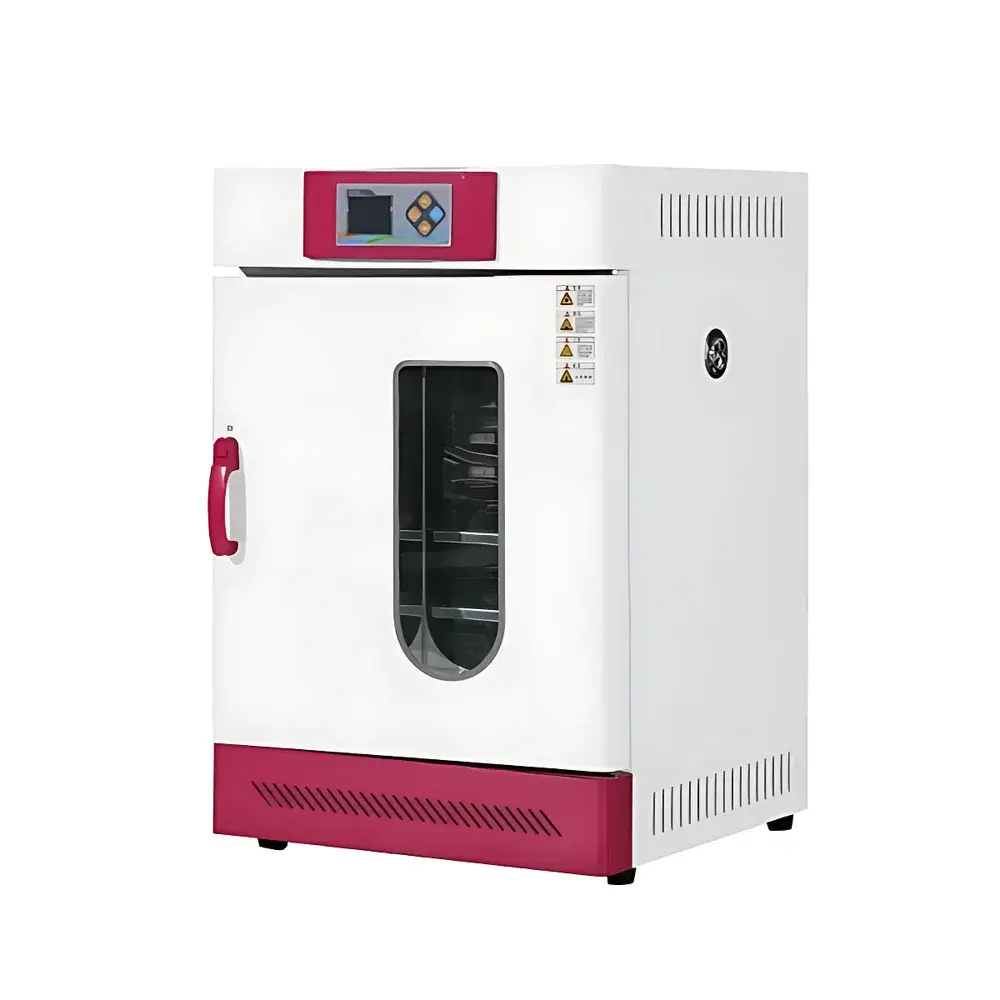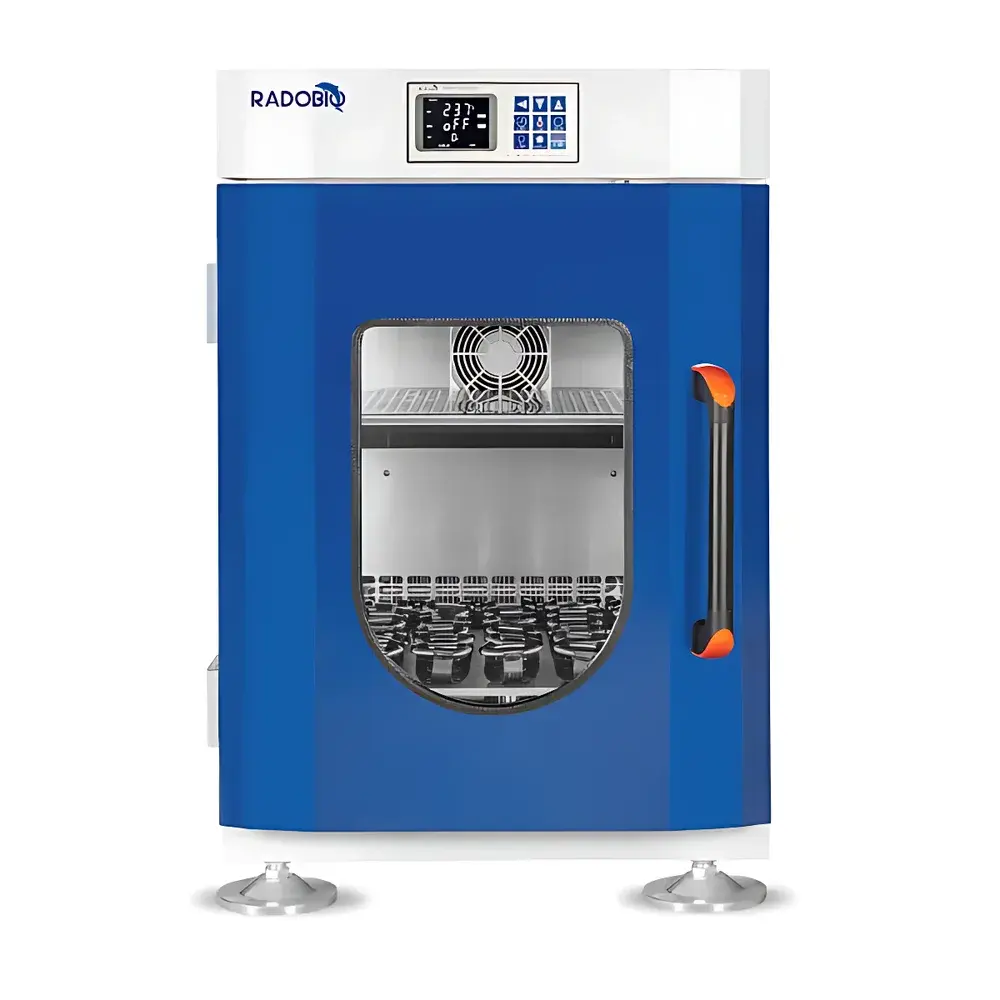
RADOBIO Stab MiniR Full-Temperature Orbital Shaker Incubator
| Brand | RADOBIO |
|---|---|
| Origin | Shanghai, China |
| Model | Stab MiniR |
| Instrument Type | Full-Temperature Orbital Shaker Incubator |
| Timer Range | 0–999.9 hours |
| Orbit Amplitude Options | 25 mm / 26 mm / 50 mm (custom amplitudes available) |
| Temperature Range | 4 °C to 60 °C |
| Speed Range | 2–300 rpm |
| Speed Accuracy | ±1 rpm |
| Temperature Setting Resolution | 0.1 °C |
| Temperature Uniformity | ±0.5 °C at 37 °C |
| Tray Dimensions | 370 × 400 mm |
| Max Load Capacity | 15 kg |
| Internal Volume | 127 L |
| Power Consumption | ≤1000 W |
| Net Weight | 85 kg |
| External Dimensions (Single Unit) | 550 × 657 × 860 mm (L×W×H, including base) |
| Door Opening | Left-hinged double-glazed door |
| Lighting | 30 W fluorescent lamp |
| Sterilization | Integrated UV-C germicidal lamp (254 nm) |
Overview
The RADOBIO Stab MiniR Full-Temperature Orbital Shaker Incubator is an engineered solution for controlled microbial growth, cell culture expansion, enzyme assays, and biochemical reaction kinetics under precisely regulated temperature and orbital agitation conditions. Based on Couette-flow orbital motion mechanics—where platform rotation induces uniform shear and mixing without vortex formation—the system delivers reproducible suspension dynamics across a wide thermal envelope (4 °C to 60 °C), enabled by an integrated compressor-based refrigeration module and PID-controlled heating circuit. Unlike ambient-only shakers, the Stab MiniR bridges the operational gap between standard incubators and refrigerated shakers, eliminating the need for external cold rooms or auxiliary chillers in applications requiring low-temperature aerobic cultivation (e.g., psychrophilic bacteria, cold-adapted enzymes) or thermally sensitive protein expression protocols. Its compact footprint (550 × 657 × 860 mm) and modular stacking architecture support high-density lab deployment while maintaining full functional autonomy per unit—each layer operates with independent parameter control, real-time monitoring, and fault-isolated power management.
Key Features
- Compact dual-purpose design: Combines precise orbital shaking (2–300 rpm, ±1 rpm accuracy) with active refrigeration and heating (4–60 °C, 0.1 °C resolution) in a single benchtop or under-bench unit.
- Modular vertical scalability: Supports up to two independently operating layers (Stab MiniR + Stab MiniR-D2); total height remains ergonomic at 1670 mm, enabling safe access without step stools.
- Dual-pane safety glass door with anti-fog heating element (optional): Prevents condensation during low-temperature operation, ensuring uninterrupted visual monitoring of cultures.
- UV-C sterilization system (254 nm): Automatically activates during idle periods to decontaminate interior surfaces, supporting GLP-compliant workflows and reducing cross-contamination risk between runs.
- Full stainless-steel seamless chamber: Radius-cornered, IPX4-rated interior with bottom drain port; all electronics and drive mechanisms are externally mounted to prevent moisture ingress and simplify cleaning with autoclavable agents.
- Low-noise drive architecture: Patented bearing assembly and balanced eccentric drive deliver <52 dB(A) acoustic output at 250 rpm—even under full 15 kg load—and eliminate resonant vibration during stacked operation.
- Intuitive LCD interface: Large-digit display showing real-time temperature, speed, and timer status; tactile membrane keys allow glove-compatible parameter adjustment without training.
Sample Compatibility & Compliance
The Stab MiniR accommodates standard microbiological and bioprocessing vessels—including Erlenmeyer flasks (250 mL × 16, 500 mL × 9, or 1000 mL × 8 per tray), deep-well microplates, test tube racks, and custom fixtures—via interchangeable stainless-steel clamping systems (spring mesh, fixed bottle clamps, plate holders). All internal materials comply with ISO 10993-5 cytotoxicity standards and meet RoHS Directive 2011/65/EU requirements. The system supports audit-ready documentation through optional USB data export (CSV format) and adheres to temperature uniformity specifications outlined in ASTM E145-22 (Standard Specification for Gravity-Convection and Forced-Ventilation Ovens) when validated per IQ/OQ protocols. While not certified for IEC 61010-1:2012 Annex BB (biological safety), its UV subsystem conforms to IEC 62471 photobiological safety classification for UV-C sources.
Software & Data Management
The base configuration features a non-programmable yet highly responsive LCD controller with event logging (power loss, door open, alarm trigger). Optional touchscreen upgrade adds timestamped parameter history (≥30 days), USB 2.0 data export, and configurable alarm thresholds for temperature deviation (>±1.5 °C), speed drift (>±5 rpm), or UV cycle completion. Data files include metadata (user ID, session ID, ambient temp/humidity if external sensor connected) and conform to ALCOA+ principles for traceability. No cloud connectivity or remote access is implemented—ensuring compliance with institutional firewalls and FDA 21 CFR Part 11 requirements for closed-system integrity when used in regulated QC environments.
Applications
- Aerobic cultivation of mesophilic and psychrophilic microorganisms (e.g., E. coli, Pseudomonas fluorescens, Arthrobacter spp.) across physiological temperature ranges.
- Inducible protein expression in E. coli BL21(DE3) with temperature-shift protocols (e.g., 37 °C induction → 16 °C folding).
- Enzyme kinetic assays requiring constant agitation and thermal stabilization (e.g., lipase activity at 40 °C, cellulase hydrolysis at 50 °C).
- Seed train expansion for mammalian cell lines (CHO, HEK293) in serum-free media under low-shear orbital motion.
- Environmental microbiology studies involving soil slurry respiration or biofilm dispersion under controlled thermal stress.
- Pharmaceutical stability testing per ICH Q1A(R2), where simultaneous agitation and temperature control simulate transport or storage conditions.
FAQ
Does the Stab MiniR support validation documentation (IQ/OQ)?
Yes—RADOBIO provides a validation support package including factory calibration certificates, traceable NIST-standard temperature and speed verification reports, and customizable protocol templates aligned with ISO/IEC 17025 and ASTM E2500-13.
Can the UV sterilization cycle be scheduled independently of main operation?
Yes—the UV lamp operates on a separate timer and can be activated manually or set to auto-cycle during unattended periods (e.g., overnight or weekends) without affecting temperature or shaking parameters.
Is the refrigeration system suitable for continuous operation at 4 °C?
Yes—the sealed compressor system is rated for indefinite duty at minimum setpoint, with thermal load compensation verified at 30% relative humidity and 25 °C ambient per EN 60068-2-1/2 testing standards.
What maintenance intervals are recommended for long-term reliability?
Compressor oil inspection every 24 months; UV lamp replacement every 8000 hours; door gasket integrity check quarterly; stainless-steel chamber wipe-down with 70% ethanol after each use.
Are third-party vessel adapters supported?
Yes—RADOBIO offers CAD-based custom fixture design services and provides mechanical drawings (STEP/IGES) for integration with proprietary bioreactor vessels or microfluidic carriers.