
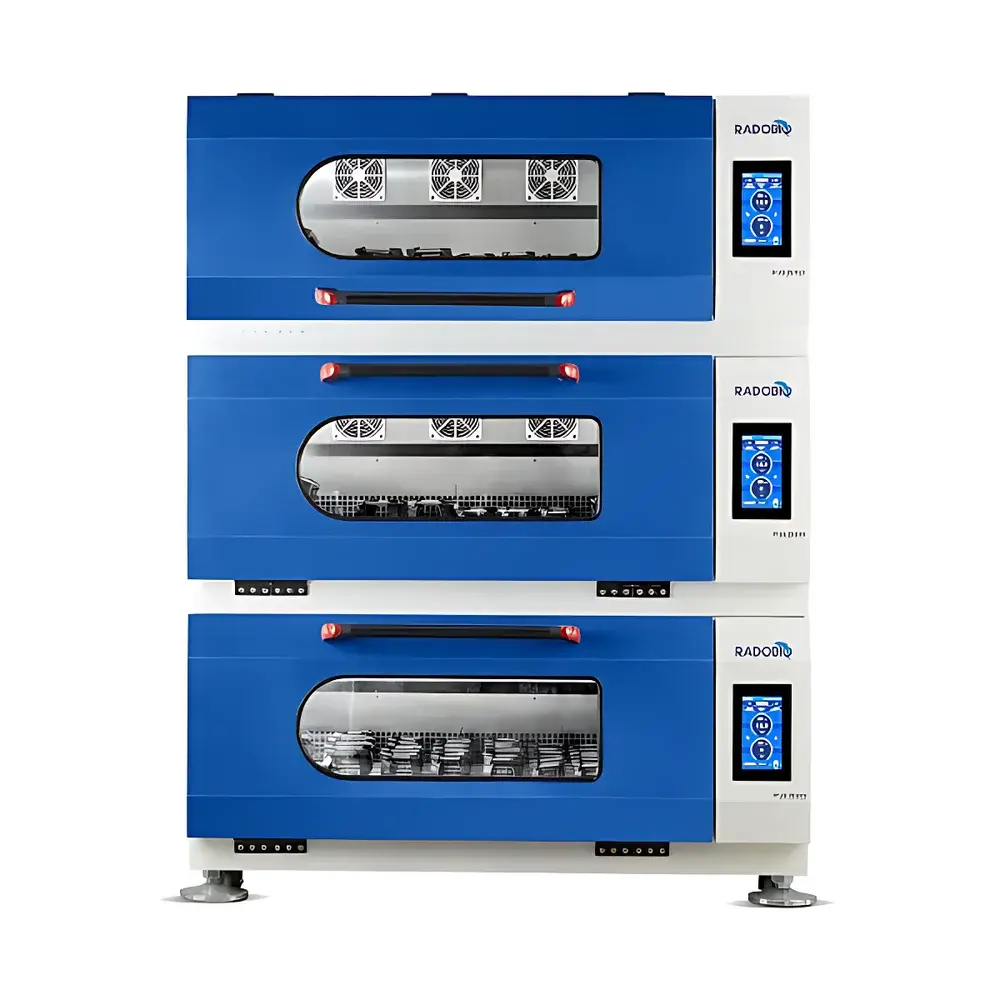
RADOBIO Stab M1T Stackable Full-Temperature Orbital Shaker Incubator
| Brand | RADOBIO |
|---|---|
| Origin | Shanghai, China |
| Model | Stab M1T |
| Instrument Type | Full-temperature orbital shaker incubator |
| Timer Range | 0–999.9 h |
| Oscillation Amplitude | 25 / 26 / 50 mm (customizable) |
| Temperature Range | 4°C to 60°C |
| Control Interface | 7-inch vertical LCD touch screen |
| Speed Range | 2–300 rpm |
| Speed Accuracy | ±1 rpm |
| Temperature Setting Resolution | 0.1°C |
| Temperature Uniformity | ±0.5°C at 37°C |
| Tray Dimensions | 520 × 880 mm |
| Max Load Capacity (per layer) | 50 kg |
| Internal Volume | 370 L |
| Power Consumption | 1400 W max |
| Data Storage | 250,000 records |
| Programmable Segments | Up to 30 per program (5 programs total) |
| Data Export | USB port |
| Noise Level | <55 dB(A) |
| Construction | Seamless brushed 304 stainless steel interior chamber |
| Safety Features | Door-interlocked UV lamp, soft-start/stop oscillation, auto-restart after power failure, over-temp/over-speed alarm |
Overview
The RADOBIO Stab M1T Stackable Full-Temperature Orbital Shaker Incubator is an engineered solution for scalable, high-integrity cell culture, microbial growth, and biochemical reaction studies under precisely controlled temperature and agitation conditions. Utilizing orbital shaking mechanics—where the platform rotates in a horizontal circular motion with defined amplitude—the system ensures homogeneous suspension of cultures while minimizing shear stress on sensitive biological samples. Unlike fixed-angle or reciprocating shakers, the Stab M1T’s orbital motion supports consistent oxygen transfer and nutrient distribution across a wide range of vessel formats—from microtiter plates to 2 L flasks—without vortex formation or splashing. Its full-temperature capability (4°C to 60°C), combined with PID-driven thermal regulation and active condensation prevention, enables applications spanning cold-adapted enzyme assays, mesophilic bacterial fermentation, and thermophilic protein expression—all within a single, modular platform.
Key Features
- Modular stackability: Supports up to three independently operating layers (Stab M1T, M1T-2, M1T-3), each configurable with distinct temperature, speed, and timing parameters—ideal for parallel condition screening or workflow scaling without footprint expansion.
- 7-inch vertical LCD touchscreen interface: Intuitive graphical navigation with multi-segment programmability; users can define up to 30 time-temperature-speed transitions per program, with automatic seamless transition between segments and real-time display of live curves (temperature, RPM, elapsed time).
- Optimized thermal architecture: Dual-pane safety glass door with optional anti-fog heating element; insulated chamber walls and heat-isolated blower prevent parasitic heating, enabling stable low-temperature operation (down to 4°C) even under high-humidity conditions.
- UV sterilization module: Germicidal UVC lamp (254 nm) integrated into the ceiling, automatically deactivated upon door opening per IEC 61000-4-2 interlock compliance—ensuring operator safety during routine access.
- Robust mechanical design: One-piece 304 stainless steel interior with radius-rounded corners and IPX4-rated waterproofing; all electronics and drive motors mounted externally to eliminate moisture exposure risk and simplify decontamination.
- Noise-attenuated oscillation system: Precision-ground bearings and balanced eccentric drive deliver stable operation at 300 rpm with vibration isolation compliant with ISO 20484-1; measured acoustic emission <55 dB(A) at 1 m distance—even during triple-layer stacking.
Sample Compatibility & Compliance
The Stab M1T accommodates standard laboratory vessels including Erlenmeyer flasks (125–2000 mL), deep-well microplates, test tube racks (15 mL and 50 mL), and custom bioreactor bags via interchangeable clamping systems (spring mesh, fixed bottle clamps, deep-well plate holders). Its 520 × 880 mm tray surface and 340 mm internal height support high-volume cultivation without compromising mixing efficiency. All materials contacting the sample environment meet USP Class VI biocompatibility requirements. The system operates within environmental limits defined by IEC 61010-1 (safety of laboratory equipment) and complies with electromagnetic compatibility per EN 61326-1. Optional configurations support GLP/GMP workflows through audit-trail-enabled data logging (timestamped, user-ID tagged), USB-exportable CSV files, and configurable data sampling intervals (30 s to 9999 s).
Software & Data Management
No proprietary software installation is required: onboard firmware handles all control logic, parameter storage, and data recording. Historical operational data—including temperature setpoint vs. actual, RPM deviation, door-open events, and alarm triggers—is stored locally in non-volatile memory (250,000 records capacity). Each entry includes UTC timestamp, operator ID (if enabled), and event severity level. Data export occurs via standard USB-A interface to FAT32-formatted drives; exported logs are compatible with Excel, MATLAB, and LIMS platforms. For regulated environments, optional firmware upgrade provides 21 CFR Part 11–compliant electronic signatures, role-based access control, and immutable audit trails—fully traceable to individual user actions and system-generated events.
Applications
- Mammalian and insect cell suspension culture under controlled hypothermic (e.g., 30°C) or normothermic (37°C) conditions.
- High-yield recombinant protein expression in E. coli and Pichia pastoris, leveraging precise oxygen transfer optimization via amplitude and speed tuning.
- Microbial strain adaptation studies requiring gradient temperature–agitation matrices across stacked units.
- Enzyme kinetics assays where thermal stability and mixing homogeneity directly impact Vmax and Km reproducibility.
- Biopharmaceutical process development, including seed train expansion and media optimization under GMP-aligned documentation protocols.
- Environmental microbiology: soil slurry enrichment, biofilm dispersion, and anaerobic culture maintenance with optional light-blocking curtain.
FAQ
Can the Stab M1T operate at 4°C while shaking at 250 rpm?
Yes. Its refrigeration system and heat-isolated blower maintain stable sub-ambient temperatures during continuous agitation, verified per ISO 8573-1 clean air standards for lab-grade cooling performance.
Is UV sterilization validated against ISO 15883 or EN 17172?
While not certified to those specific washer-disinfector standards, the 254 nm UVC source delivers ≥400 µW/cm² irradiance at 10 cm distance—sufficient for >3-log reduction of Bacillus atrophaeus spores per ASTM E2197 protocols when operated for ≥30 minutes in empty chamber mode.
How does the system ensure temperature uniformity across the full tray area?
Through dual axial airflow channels, symmetric heater placement, and PID-controlled feedback from three independent NTC sensors—one central and two corner-mounted—achieving ±0.5°C uniformity at 37°C per ISO 13580 testing methodology.
What happens during unexpected power loss?
All active parameters are retained in EEPROM. Upon restoration, the unit resumes operation at original settings and logs a timestamped “power interruption” event in the audit trail.
Are third-party calibration certificates available?
Yes. RADOBIO provides optional NIST-traceable calibration reports for temperature (±0.1°C accuracy) and rotational speed (±0.5% full scale), issued by ISO/IEC 17025-accredited laboratories upon request.





