
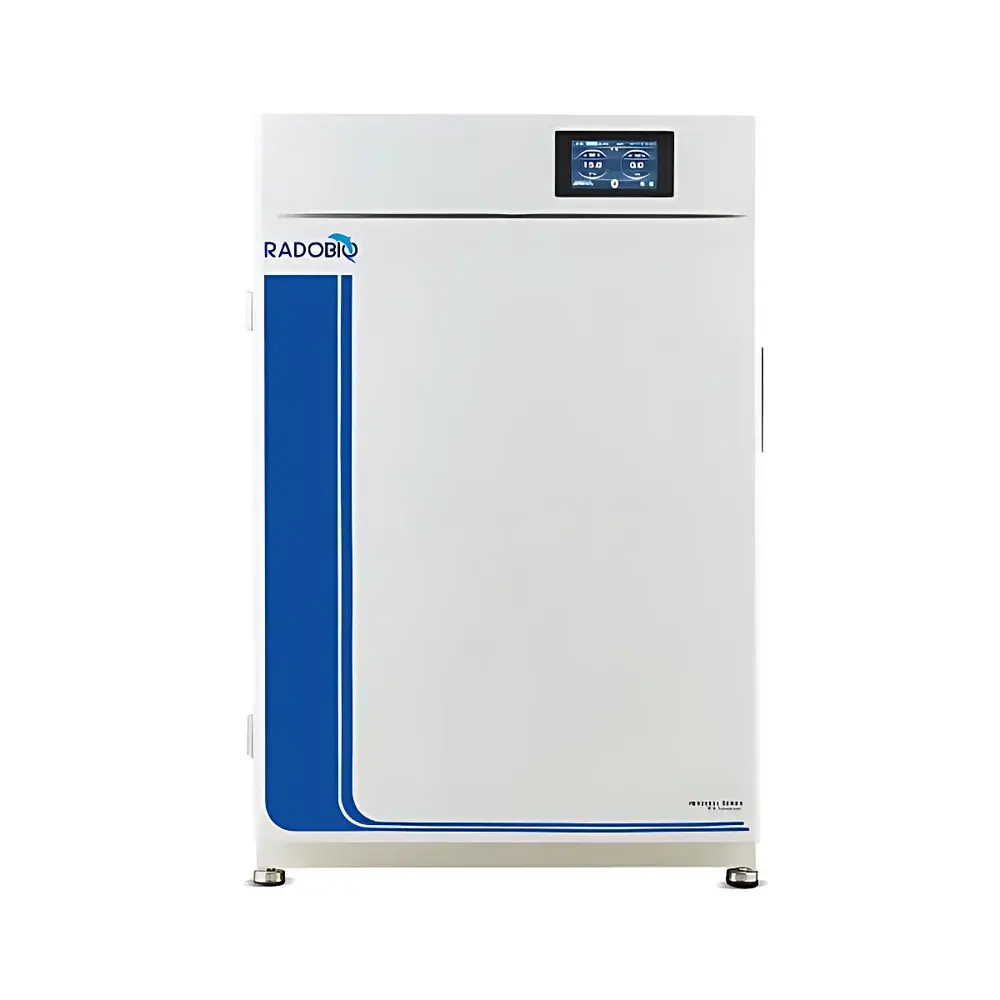
RADOBIO Herocell 180 CO₂ Incubator
| Brand | RADOBIO |
|---|---|
| Origin | Shanghai, China |
| Model | Herocell 180 |
| Type | Air-jacketed CO₂ Incubator |
| CO₂ Detection | Infrared (IR) Sensor |
| Temperature Range & Accuracy | Ambient +4°C to 60°C, ±0.1°C setpoint resolution |
| Temperature Uniformity | ±0.2°C (at 37°C, empty chamber, ambient 25°C) |
| CO₂ Concentration Range & Accuracy | 0–20%, ±0.1% setpoint resolution |
| Chamber Volume | 185 L |
| Internal Dimensions (L×W×H) | 535 × 526 × 675 mm |
| External Dimensions (L×W×H) | 660 × 652 × 1000 mm (incl. base) |
| Standard Configuration | PID temperature control, 6-sided direct-heating air jacket, 140°C dry-heat sterilization cycle |
Overview
The RADOBIO Herocell 180 CO₂ Incubator is an air-jacketed, microprocessor-controlled environmental chamber engineered for precision cell culture applications in academic research laboratories, biopharmaceutical QC/QA facilities, and clinical cell therapy workflows. It maintains physiologically relevant conditions—stable temperature, tightly regulated CO₂ concentration (0–20%), and high relative humidity—through a combination of six-sided direct heating, infrared CO₂ sensing, and continuous HEPA-filtered internal air recirculation. Unlike water-jacketed designs, the air-jacket architecture enables rapid thermal recovery (<5 min after a 30-second door opening at 25°C ambient), consistent across the full 185 L working volume. The incubator operates on a closed-loop feedback system: IR-based CO₂ measurement ensures long-term stability without drift, even under frequent access or variable ambient humidity; PID-controlled heating delivers ±0.1°C setpoint resolution with uniformity validated at ±0.2°C (37°C, empty, ISO 13408-1 compliant test conditions). Its stainless steel (AISI 304) interior features seamless, radius-rounded corners and removable shelves—designed not only for ease of cleaning but also to minimize microbial harborage points during GLP- or GMP-aligned operations.
Key Features
- Six-sided direct-heating air jacket system delivering uniform thermal distribution across the entire chamber volume, verified per ISO 13408-1 methodology
- 140°C dry-heat sterilization cycle—fully automated, no disassembly required—validated to eliminate bacteria, yeasts, molds, and mycoplasma from all internal surfaces
- Infrared (IR) CO₂ sensor with cross-sensitivity compensation for humidity and temperature fluctuations, ensuring stable gas control during high-frequency access
- Integrated HEPA filtration (≥99.99% @ 0.3 µm) with automatic post-door-open re-filtration completed within 5 minutes
- Passive humidification via removable AISI 304 stainless steel water pan; supports >95% RH at 37°C without condensation formation on upper chamber surfaces
- Capacitive 5-inch LCD touchscreen interface with real-time and historical trend visualization, alarm logging, and intuitive menu navigation
- USB data export capability supporting audit-trail-compliant record retention: 250,000 timestamped entries (temperature, CO₂, humidity if equipped), stored at user-defined intervals (30 s to 9999 s)
- Over-temperature safety cutoff with redundant platinum RTD probe and independent mechanical thermostat
Sample Compatibility & Compliance
The Herocell 180 accommodates standard tissue culture formats—including T-flasks (up to T225), multi-well plates (6–96-well), Petri dishes, roller bottles, and bioreactor vessels—without airflow turbulence or localized desiccation. Its fan-assisted, low-velocity air circulation ensures homogeneous distribution of temperature, CO₂, and moisture regardless of load configuration or shelf position. The chamber meets essential performance benchmarks referenced in ISO 13408-1 (sterility assurance), ASTM E1267 (incubator verification), and USP (cell culture environment qualification). While not pre-certified to FDA 21 CFR Part 11, its immutable USB-exported data logs—paired with operator ID tagging (via optional network integration)—support validation pathways for regulated environments requiring electronic record integrity.
Software & Data Management
The embedded firmware implements deterministic real-time control logic with non-volatile memory for parameter persistence across power cycles. All operational data—including setpoints, sensor readings, alarm events, and sterilization cycle logs—are time-stamped and stored locally. Historical curves (temperature, CO₂, optional RH) are viewable directly on the touchscreen with zoom/pan functionality. Data export via USB flash drive produces CSV-formatted files compatible with LIMS, ELN, or statistical process control platforms. Exported records include metadata (instrument ID, operator tag, firmware version) and cannot be edited post-export—ensuring raw data integrity per ALCOA+ principles. Optional Ethernet connectivity (not standard) enables remote monitoring via secure HTTP(S) API, supporting integration into centralized facility management systems.
Applications
- Mammalian cell line maintenance (HEK293, CHO, HeLa, iPSCs) under defined atmospheric conditions
- Stem cell expansion and differentiation protocols requiring strict environmental reproducibility
- Primary cell isolation and short-term culture where contamination risk must be minimized
- Microbial co-culture studies involving pH-sensitive organisms dependent on CO₂ buffering
- Bioprocess development support—including inoculum preparation and seed train expansion
- Regulatory submission-supporting studies conducted under GLP or GMP-aligned SOPs
FAQ
What CO₂ supply pressure is recommended for optimal operation?
A regulated inlet pressure of 0.05–0.1 MPa (0.5–1 bar) is required; higher pressures may compromise solenoid valve longevity and gas mixing accuracy.
Is the 140°C sterilization cycle validated against specific microbial strains?
Yes—the cycle achieves ≥6-log reduction of Bacillus atrophaeus spores (ISO 14644-1 Class 5 equivalent challenge) when executed per manufacturer instructions on clean, dry surfaces.
Can humidity be monitored and logged in real time?
Humidity sensing is available as a factory-installed option (capacitive RH sensor); when equipped, it displays and logs RH alongside temperature and CO₂.
Does the incubator support multi-user access control?
The base firmware does not include role-based authentication; however, exported data files contain operator identifiers, and third-party middleware can enforce access policies via network-enabled configurations.
How often should the HEPA filter be replaced?
Under typical laboratory use (≤5 door openings/day), replacement is recommended every 12 months—or immediately following any visible soiling, performance deviation, or post-sterilization verification failure.





