
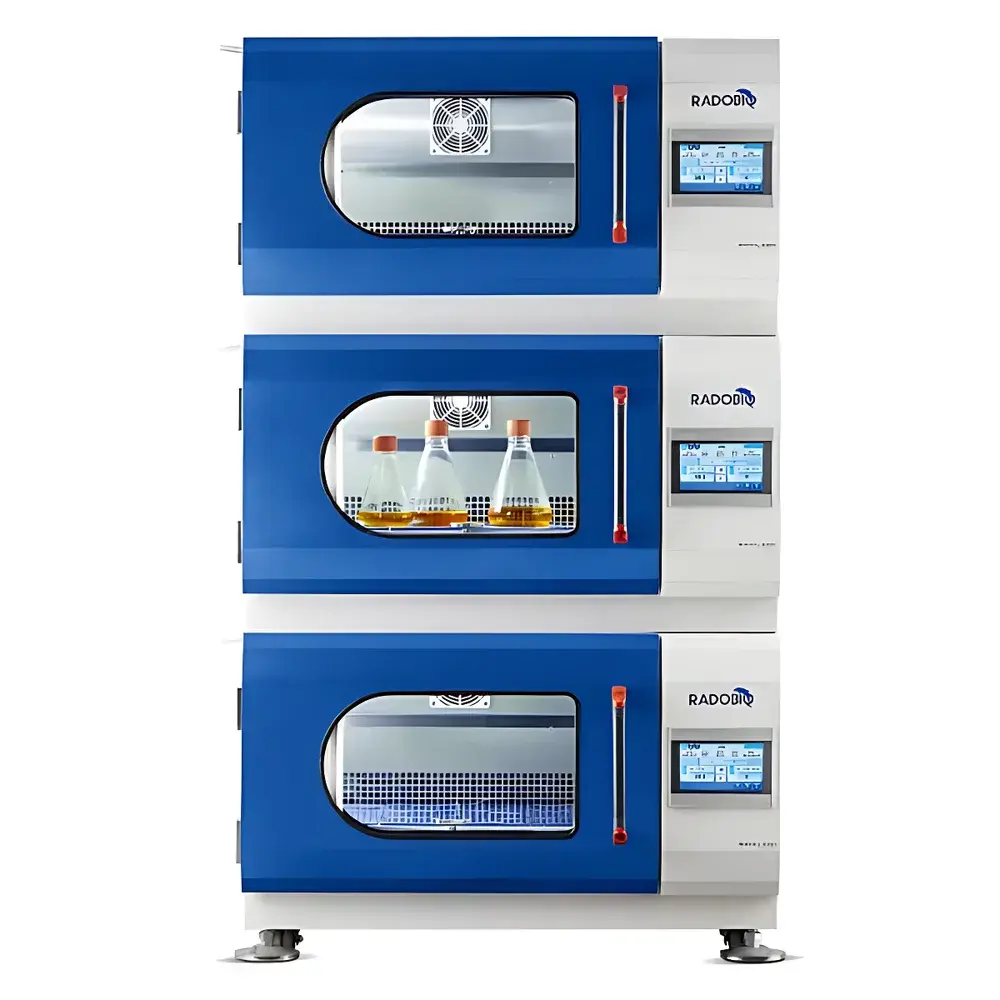
RADOBIO Herocell C1S Compact CO₂ Incubated Orbital Shaker
| Brand | RADOBIO |
|---|---|
| Model | Herocell C1S |
| Instrument Type | CO₂-Controlled Orbital Incubator Shaker |
| Temperature Range | 4–60 °C |
| Timing Range | 0–999.9 h |
| Orbit Diameter Options | 25 mm / 26 mm / 50 mm (customizable) |
| CO₂ Control Range | 0–20% (IR sensor-based) |
| CO₂ Accuracy | ±0.1% |
| Temperature Uniformity | ±0.3 °C at 37 °C |
| Speed Range | 2–300 rpm |
| Speed Accuracy | ±1 rpm |
| Display | 7-inch LCD touchscreen |
| Max Load Capacity | 35 kg per deck |
| Internal Volume | 215 L |
| Power Supply | 220–240 V, 50–60 Hz |
| Max Power Consumption | 1300 W |
| Data Storage | 800,000 records (configurable interval: 30–9999 s) |
| Optional Features | Remote monitoring module, humidity control, pull-out light-shielding curtain, heated glass door, liquid drain port |
Overview
The RADOBIO Herocell C1S is a compact, high-precision CO₂-incubated orbital shaker engineered for scalable, physiologically relevant cell culture under controlled gas, temperature, and agitation conditions. It operates on the principle of orbital shaking—generating uniform circular motion to suspend cells in liquid media while maintaining optimal gas exchange—combined with real-time infrared (IR) CO₂ sensing and PID-regulated thermal control. Designed specifically for pre-bioreactor expansion workflows, the Herocell C1S supports suspension cultures of CHO, hybridoma, mammalian, and insect cell lines under tightly regulated 4–60 °C temperature and 0–20% CO₂ environments. Its modular stackable architecture enables up to three independent decks within a footprint of just 1000 × 725 mm, making it ideal for space-constrained GMP-adjacent labs, QC facilities, and academic core facilities where reproducibility, audit readiness, and operational flexibility are critical.
Key Features
- 7-inch capacitive touchscreen interface with multilingual support, intuitive icon-driven navigation, and password-protected parameter locking for shared-lab security
- Triple-layer safety architecture: door-interlocked UV sterilization (with automatic lamp cutoff upon opening), soft-start/stop motor control to prevent centrifugal shock during lid access, and uninterruptible parameter retention after power failure
- Patented low-heat, waterproof circulation fan system—eliminates thermal drift from airflow, enhances CO₂ and humidity homogeneity, and extends temperature range without refrigeration assist
- Full stainless-steel, radius-cornered interior chamber (IPX4-rated water resistance) with externalized drive motor and electronics—enabling full wet cleaning, autoclave-compatible surface disinfection, and spill resilience
- Modular aluminum shaker deck (8 mm thick, brushed chrome finish) with slide-out design for ergonomic vessel loading; compatible with both reusable eco-adhesive pads and precision-machined stainless steel clamps
- Dual-pane heated glass door with anti-fog heating element—ensures uninterrupted visual monitoring under high-humidity or low-ambient-temperature conditions
- Multi-segment programmable protocol engine: up to 5 stored methods, each supporting 30 user-defined phases with independent setpoints for temperature, speed, CO₂, and duration—executed with seamless transition logic
Sample Compatibility & Compliance
The Herocell C1S accommodates standard tissue culture vessels—including Erlenmeyer flasks (125–2000 mL), roller bottles, and multi-well plates—via configurable mounting options. Its 590 × 465 mm deck supports up to 48 × 125 mL flasks or 15 × 60-tube racks (15 mL), with load distribution optimized to minimize harmonic resonance across stacked configurations. All materials contacting the chamber interior comply with ISO 10993-5 (cytotoxicity) and USP Class VI standards. The IR-based CO₂ sensor meets ASTM D6193 calibration traceability requirements, and temperature control adheres to ISO 13408-2 (aseptic processing) thermal uniformity thresholds. Optional remote monitoring modules support 21 CFR Part 11-compliant electronic signatures and audit trail generation for GLP/GMP environments.
Software & Data Management
Embedded firmware logs 800,000 timestamped data points—including actual vs. setpoint values for temperature, CO₂, speed, and elapsed time—with user-configurable sampling intervals (30 s to 9999 s). Data export occurs via USB-A port in CSV format, preserving column headers, UTC timestamps, and metadata (e.g., active program ID, operator tag). The system maintains an immutable event log covering door openings, alarm triggers, UV cycle activation, and power interruptions. Optional Ethernet/WiFi-enabled remote modules provide TLS-encrypted web-based access to live parameters, historical trend plots (exportable as PNG/PDF), and configurable email/SMS alerts—fully compatible with laboratory information management systems (LIMS) via RESTful API integration.
Applications
- Seed train expansion for upstream bioprocessing—particularly for monoclonal antibody and recombinant protein production
- Transient transfection optimization and stable pool generation under physiological CO₂ tension
- Stem cell differentiation studies requiring precise oxygen-CO₂ interplay and shear-sensitive agitation
- Virus propagation (e.g., AAV, lentivirus) in suspension-adapted HEK293 or Sf9 cultures
- Microcarrier-based adherent cell culture using dynamic suspension protocols
- QC release testing of cell banking materials under ICH Q5D-recommended conditions
FAQ
What CO₂ supply pressure is required for stable operation?
A regulated supply of 0.05–0.1 MPa (0.5–1 bar) is recommended; higher pressures may cause valve wear, while lower pressures risk insufficient gas replenishment during rapid consumption phases.
Can the Herocell C1S maintain humidity without optional humidification?
The base model relies on evaporation from culture media and internal condensation recycling; for applications requiring >80% RH (e.g., long-term primary neuron culture), the factory-installed humidification module is required.
Is the UV sterilization cycle validated per ISO 15883?
While the multi-point UV array delivers ≥100 mJ/cm² irradiance at all chamber surfaces (per internal mapping), formal validation per ISO 15883-1 must be performed by the end user using biological indicators appropriate for their risk assessment.
How does the system handle thermal recovery after door opening?
PID tuning includes adaptive recovery algorithms that prioritize temperature re-stabilization over CO₂ or speed control; typical recovery to ±0.5 °C at 37 °C takes ≤4.2 minutes following a 15-second door opening.
Are firmware updates available, and how are they deployed?
Yes—RADOBIO releases quarterly security and feature updates delivered via encrypted USB stick; update installation requires administrator authentication and triggers automatic backup of current configuration prior to flash programming.




