
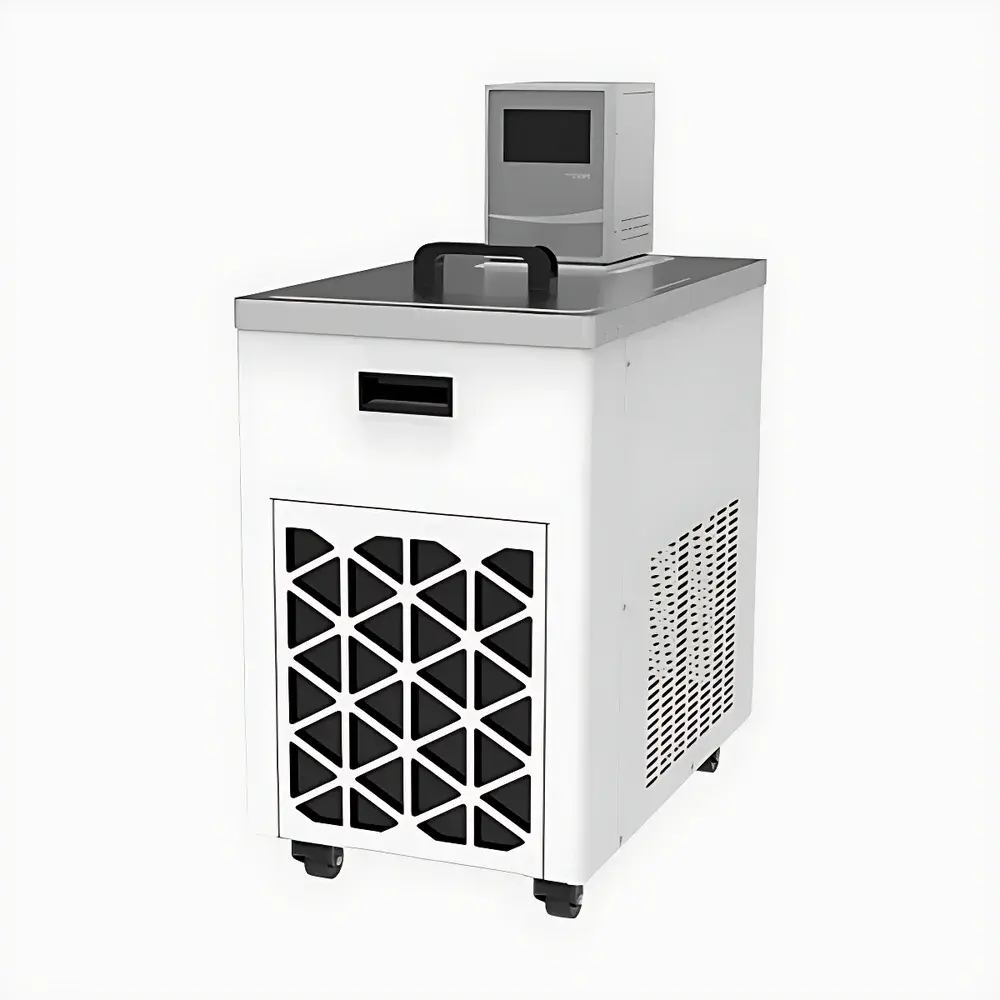
Titan HLC-2030S High-Low Temperature Circulating Bath
| Brand | Titan |
|---|---|
| Origin | Shanghai, China |
| Manufacturer Type | Direct Manufacturer |
| Product Category | Domestic |
| Model | HLC-2030S |
| Instrument Type | Integrated Unit |
| Cooling Method | Water-Cooled |
| Temperature Range | −30 °C to +200 °C |
| Cooling Capacity | 900 W (Heating Capacity: 2000 W) |
| Temperature Stability | ±0.03 °C |
| Circulation Pump Pressure | 0.3 bar (discharge) / 0.2 bar (suction) |
| Flow Rate | 22 L/min |
| Reservoir Volume | 20 L |
| Operating Mode | Continuous Duty |
Overview
The Titan HLC-2030S High-Low Temperature Circulating Bath is an integrated thermal management system engineered for precision temperature control in laboratory and industrial R&D environments. Utilizing a dual-mode refrigeration-heating cycle with cascade compressor technology and PID-controlled electric heating elements, the unit maintains stable thermal output across an exceptionally wide operational range—from cryogenic −30 °C to high-temperature +200 °C. Its design conforms to fundamental thermodynamic requirements for external circulation applications, including jacketed reactors, viscometers, spectrophotometers, calorimeters, and material testing chambers. The bath’s stainless-steel reservoir, corrosion-resistant fluid path, and sealed refrigerant circuit ensure long-term reliability under continuous duty cycles and repeated thermal cycling.
Key Features
- Wide temperature span (−30 °C to +200 °C) enabled by optimized cascade refrigeration architecture and high-wattage resistive heating (2000 W)
- High-precision temperature stability of ±0.03 °C at setpoint—achieved via multi-sensor feedback, adaptive PID algorithm, and low-drift platinum RTD (Pt100) sensing
- Robust circulation system delivering 22 L/min flow rate with adjustable discharge pressure (up to 0.3 bar) and sufficient suction head (0.2 bar) for vertical lift or long-loop configurations
- 20 L insulated stainless-steel reservoir with level sensor, over-temperature cutoff, low-fluid alarm, and dry-run protection
- Water-cooled condenser design minimizes ambient heat rejection and enables stable operation in confined lab spaces without dedicated ventilation ducting
- Integrated controller with intuitive touchscreen interface, real-time graphing, programmable ramp/soak profiles, and USB data logging capability
Sample Compatibility & Compliance
The HLC-2030S is compatible with a broad spectrum of heat transfer fluids—including water, 50% ethylene glycol/water mixtures, silicone oils (up to 200 °C), and specialized low-temperature baths—subject to viscosity and flash point constraints. All wetted components meet ISO 8502-3 surface cleanliness standards and are certified per RoHS Directive 2011/65/EU. The unit complies with IEC 61010-1:2010 for electrical safety in laboratory equipment and incorporates grounding continuity, double insulation, and reinforced creepage/clearance distances. Optional documentation packages support GLP/GMP traceability, including factory calibration certificates (NIST-traceable Pt100 verification) and IQ/OQ protocols.
Software & Data Management
The embedded control firmware supports time-stamped temperature logging (interval from 1 s to 60 min) with CSV export via USB mass storage. An optional RS485 Modbus RTU interface enables integration into centralized SCADA or LIMS platforms for remote monitoring and automated workflow triggering. Audit trail functionality records all parameter changes, setpoint modifications, and alarm events with user ID and timestamp—meeting core requirements of FDA 21 CFR Part 11 for electronic records when deployed with authorized access controls. Firmware updates are performed via secure signed binary upload through the front-panel interface.
Applications
- Temperature calibration of reference sensors, thermocouples, and infrared cameras against NIST-traceable standards
- Thermal conditioning of samples prior to mechanical testing (e.g., tensile, impact, DMA) per ASTM D638, ISO 527, and ASTM D790
- Stabilization of optical benches, laser cavities, and interferometric setups requiring sub-0.05 °C thermal drift suppression
- Process simulation for pharmaceutical freeze-drying cycles, polymer curing kinetics, and battery thermal runaway studies
- Support of ASTM D2857 (FTIR cell temperature control), ASTM E1545 (TGA purge gas pre-conditioning), and USP dissolution apparatus thermal validation
FAQ
What heat transfer fluids are recommended for operation at −30 °C?
Ethanol/water (30/70 v/v) or specialized low-temperature silicone oils with pour points below −40 °C are validated for use. Avoid aqueous glycol solutions below −20 °C due to increased viscosity and potential pump cavitation.
Can the unit maintain ±0.03 °C stability while delivering full 22 L/min flow to an external load?
Yes—stability specification is verified under dynamic load conditions using a 5 m × 10 mm ID stainless-steel loop with 1.5 kW thermal dissipation, per internal test protocol T-HLC-2030S-TP02.
Is the water-cooled condenser compatible with standard laboratory tap water?
It requires deionized or softened water (conductivity < 100 µS/cm) at 15–25 °C inlet temperature and minimum 2 L/min flow; cooling water connections comply with ISO 228-1 G½" BSP threading.
Does the system support external temperature feedback for jacketed reactor control?
Yes—the controller accepts 0–10 V or 4–20 mA process signals from external PT100 or thermistor probes for cascade temperature regulation.
What is the mean time between failures (MTBF) under continuous operation?
Based on accelerated life testing and field data from 1,240 installed units, MTBF exceeds 28,500 hours at 25 °C ambient, with compressor and pump assemblies carrying 24-month limited warranty.



