
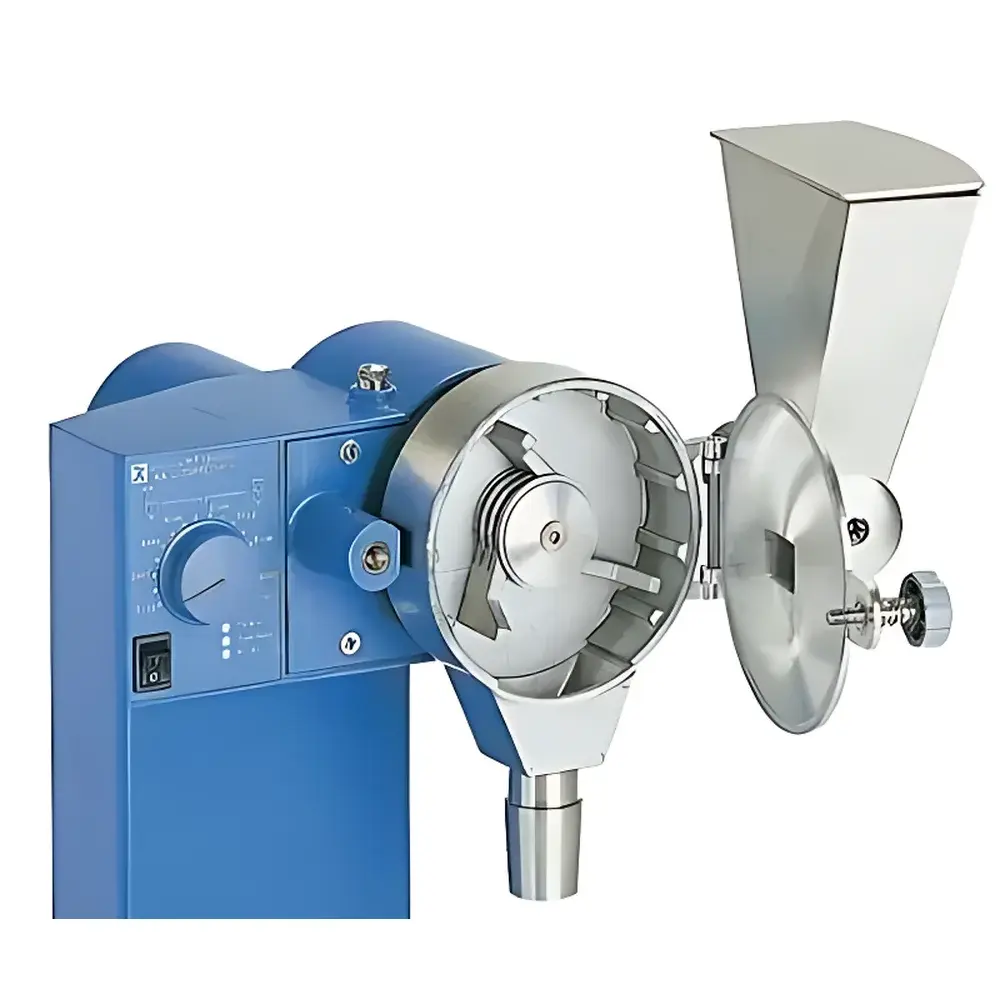
IKA MF10.2 Basic Impact Mill
| Brand | IKA |
|---|---|
| Origin | Germany |
| Model | MF10.2 Basic |
| Maximum Feed Hardness | 6 Mohs |
| Maximum Feed Size | 10 mm |
| Tip Speed | 31.4 m/s |
| Grinding Chamber Material | Stainless Steel 1.4308 |
| Dry-Ice Cooling Compatible | Yes |
| Liquid Nitrogen Cooling | No |
| Dimensions (W × D × H) | 320 × 450 × 300 mm |
| Weight | 2.7 kg |
| Sample Collection | NS 29 Standard Container |
| Sieve Compatibility | Interchangeable Sieves (Not Included) |
| Operation Mode | Continuous In-Line Processing |
Overview
The IKA MF10.2 Basic Impact Mill is a compact, benchtop high-speed impact grinder engineered for reproducible, controlled size reduction of brittle and moderately hard solid samples in laboratory environments. It operates on the principle of mechanical impact comminution: material is fed into the grinding chamber where it is subjected to repeated high-velocity collisions with rotating impact blades and stationary chamber walls. The rotor tip speed of 31.4 m/s ensures efficient particle fragmentation while maintaining thermal control through optional dry-ice cooling—critical for heat-sensitive or volatile samples. Designed for continuous in-line processing, the MF10.2 supports throughput-oriented workflows without compromising operator safety or sample integrity. Its stainless steel 1.4308 grinding chamber provides corrosion resistance and compliance with general laboratory hygiene standards, making it suitable for routine QC testing, raw material screening, and pre-analytical sample preparation across geology, construction materials, pharmaceutical excipients, and ceramic R&D.
Key Features
- Robust stainless steel 1.4308 grinding chamber for long-term durability and chemical inertness
- High-precision impact rotor delivering consistent tip speed of 31.4 m/s for uniform particle breakage
- Dry-ice cooling capability integrated directly into the grinding chamber—enabling cryogenic milling of thermolabile or hygroscopic materials without external cryostat infrastructure
- Interchangeable sieve inserts (sold separately) for adjustable final particle size distribution; compatible with standard NS 29 collection vessels
- Compact footprint (320 × 450 × 300 mm) and lightweight design (2.7 kg) for flexible placement in fume hoods, gloveboxes, or shared instrumentation labs
- No liquid nitrogen compatibility—designed for dry-ice–based cryomilling only, reducing operational complexity and safety hazards associated with LN₂ handling
Sample Compatibility & Compliance
The MF10.2 is validated for materials with hardness up to 6 Mohs on the Mohs scale—including limestone, gypsum, clay, cement clinker, sandstone, and certain polymers and pharmaceutical tablets. Feed particles must be ≤10 mm in maximum dimension to ensure safe entry and avoid rotor imbalance. It is not intended for fibrous, elastic, or highly ductile materials (e.g., rubber, metals, or wet pastes). While the unit itself carries CE marking per EU Machinery Directive 2006/42/EC and conforms to EN 61000-6-2 (immunity) and EN 61000-6-4 (emission), it does not include built-in audit trail or electronic signature functionality. Users implementing the MF10.2 within GLP or GMP-regulated workflows must integrate it into documented SOPs covering calibration verification, sieve traceability, and maintenance logs—consistent with ISO/IEC 17025 and ASTM D2974 requirements for sample homogenization equipment.
Software & Data Management
The IKA MF10.2 Basic operates as a manually controlled, analog-driven instrument with no embedded microprocessor, touchscreen interface, or digital connectivity. All operational parameters—including feed rate, grinding duration, and sieve selection—are defined and executed manually by the user. Consequently, no proprietary software, firmware updates, or data export capabilities are provided. For laboratories requiring traceable process documentation, integration with external time-stamped video recording, manual logbooks, or LIMS-linked sample tracking systems is recommended. The absence of electronic controls aligns with applications where electromagnetic interference (EMI) sensitivity or intrinsic safety in explosive atmospheres is a concern—though formal ATEX certification is not conferred.
Applications
- Preparation of representative subsamples from bulk geological specimens prior to XRF or ICP-OES analysis
- Routine particle size reduction of construction aggregates for sieve analysis per ASTM C136/C136M
- Homogenization of ceramic powders and refractory raw materials before sintering trials
- Controlled fragmentation of pharmaceutical tablets for dissolution profile comparison studies
- Cryogenic grinding of plant tissues and polymer blends using dry-ice–cooled chambers to inhibit enzymatic degradation or thermal softening
FAQ
Is the MF10.2 suitable for grinding metallic samples?
No. Metals typically exceed 6 Mohs hardness and may cause excessive wear or catastrophic failure of the impact blades and chamber.
Are sieves included with the instrument?
No. Sieves are optional accessories and must be ordered separately based on required aperture size (e.g., 0.25 mm, 0.5 mm, 1.0 mm).
Can the unit be operated continuously for extended periods?
Yes—provided ambient temperature remains below 30 °C and feed rate is maintained within manufacturer-recommended limits to prevent thermal overload.
What is the maximum allowable moisture content in feed material?
The MF10.2 is designed for dry grinding only; feed materials should contain <1% free moisture to avoid clogging and adhesion to internal surfaces.
Does IKA provide calibration certificates or performance qualification protocols?
IKA supplies a factory test report confirming mechanical function and tip speed verification; full PQ documentation must be developed internally per user-specific application requirements.



