
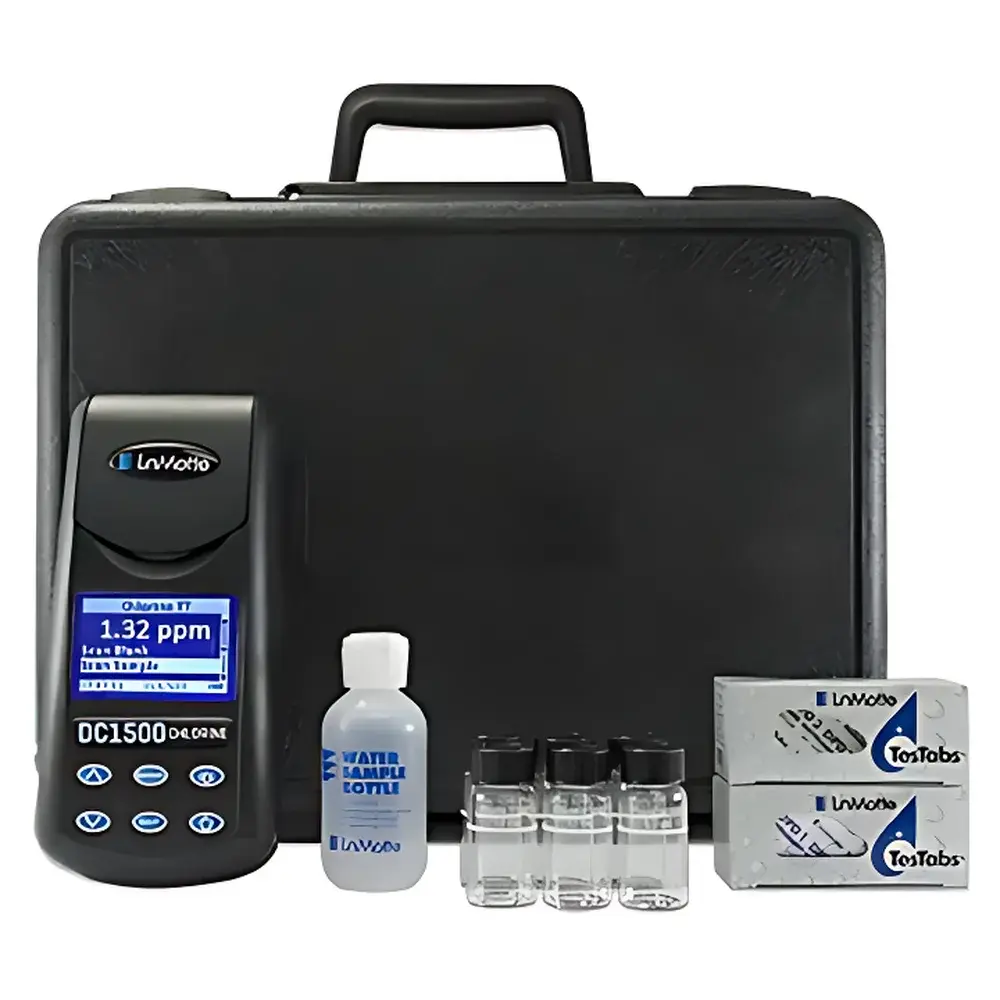
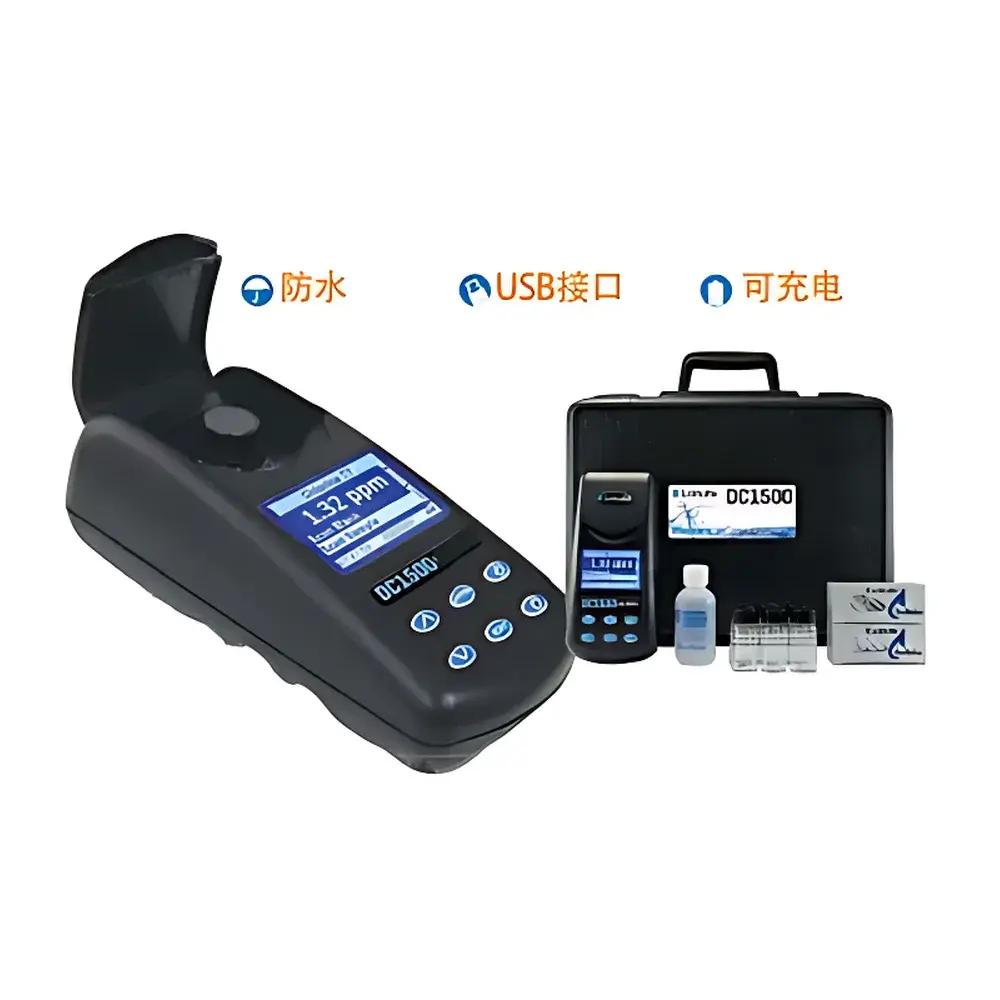
Lamotte DC1500 Series Free & Total Chlorine / Chlorine Dioxide Colorimeter
| Brand | Lamotte |
|---|---|
| Origin | USA |
| Model | DC1500 |
| IP Rating | IP67 |
| Display | 160 × 100 backlit graphical LCD (20 × 6 character lines) |
| Wavelength Accuracy | ±2% FS |
| Bandwidth | 10 nm (typical) |
| Light Source | LED |
| Detector | Silicon photodiode with integrated interference filter |
| Measurement Modes | Pre-programmed methods, Absorbance, % Transmittance |
| Languages | English, Spanish, French, Portuguese, Italian |
| Sample Cell | 25 mm diameter flat-bottom cuvette |
| Interface | Mini-USB |
| Power | Rechargeable lithium-ion battery (3.7 V, 2.5 Ah) |
| Battery Life | ~380 tests with backlight enabled |
| Auto-off Options | Disabled, 5, 10, or 50 minutes |
| Compliance | CE Marked |
| Test Kits Supported | DPD-based free/total chlorine (e.g., catalog #3240-DC1500-CL0, range 0–4.00 mg/L, LOD 0.05 mg/L), chlorine dioxide (e.g., #3240-DC1500-CLO2-LI, liquid reagent format) |
Overview
The Lamotte DC1500 Series Colorimeter is a portable, microprocessor-controlled photometric instrument engineered for rapid, field-deployable, and laboratory-grade quantification of free chlorine, total chlorine, and chlorine dioxide in drinking water, wastewater, swimming pools, cooling towers, and process water systems. It operates on the principle of visible-light absorbance spectroscopy using pre-calibrated DPD (N,N-diethyl-p-phenylenediamine) chemistry—where oxidants react with DPD to form a stable pink-colored complex proportional to concentration. The instrument employs a fixed-wavelength LED light source centered at the optimal absorption peak (~515 nm for chlorine/DPD), coupled with a silicon photodiode detector and temperature-compensated signal processing to ensure high reproducibility across ambient operating conditions (0–40 °C). Designed to meet routine compliance requirements under U.S. EPA Method 334.0 and Standard Methods 4500-Cl G, the DC1500 delivers traceable, method-specific results without requiring spectral scanning or manual wavelength selection.
Key Features
- IP67-rated rugged housing for dust-tight and immersion-resistant operation—validated for submersion up to 1 meter for 30 minutes.
- High-contrast 160 × 100 pixel backlit graphical LCD with intuitive icon-driven menu navigation—supporting six international languages for multilingual field teams.
- Integrated rechargeable lithium-ion battery (3.7 V, 2.5 Ah) enabling >380 consecutive measurements with backlight active; USB-mini port supports both data export and simultaneous charging via AC adapter or PC.
- Precision optical path optimized for 25 mm diameter flat-bottom cuvettes—minimizing path-length variability and eliminating the need for cell orientation alignment.
- Factory-preloaded calibration curves for over 30 common water quality parameters—including free/total chlorine (0–4.00 mg/L, LOD 0.05 mg/L), chlorine dioxide (0–5.00 mg/L), and bromine—each traceable to NIST-traceable standards.
- Automatic zeroing and dark-current compensation before each measurement cycle to mitigate drift from ambient light or detector thermal noise.
Sample Compatibility & Compliance
The DC1500 is validated for use with Lamotte’s certified DPD tablet (e.g., #3240-DC1500-CL0) and liquid reagent kits (e.g., #3240-DC1500-CL-LI, #3240-DC1500-CLO2-LI), all manufactured under ISO 9001-certified processes and supplied with lot-specific certificate of analysis. It complies with CE marking requirements for electromagnetic compatibility (EN 61326-1) and safety (EN 61010-1). While not a GLP/GMP-regulated analytical instrument per se, its audit-ready features—including timestamped result logging, user ID assignment, and non-editable test history—support adherence to internal QA/QC protocols aligned with ISO/IEC 17025 Clause 7.7 and U.S. EPA Guidance for Field Instruments (EPA 815-B-09-001). All supported test methods conform to APHA/AWWA/WEF Standard Methods and are compatible with state primacy program reporting formats.
Software & Data Management
Data capture and transfer are facilitated via Lamotte’s free LogBook™ PC software (Windows-compatible), which enables secure download of measurement histories—including date/time stamps, operator IDs, sample IDs, raw absorbance values, and pass/fail flags against user-defined action limits. Each exported CSV file contains embedded metadata required for regulatory submissions (e.g., SDWA reporting). The device stores up to 500 test records onboard with automatic overwrite protection when memory is full. Firmware updates are delivered via USB and include version-locked calibration verification to prevent unauthorized parameter modification—supporting basic 21 CFR Part 11 readiness through electronic signature logging and audit trail generation within the desktop application.
Applications
- Drinking water distribution system validation—daily residual chlorine monitoring at entry points, storage tanks, and endpoint taps.
- Wastewater disinfection process control—real-time verification of chlorine contact time (CT) value compliance prior to discharge.
- Recreational water safety management—routine testing of public pools, spas, and splash pads per CDC Model Aquatic Health Code (MAHC) thresholds.
- Pharmaceutical facility purified water (PW) and water-for-injection (WFI) system verification—non-destructive screening between formal TOC/chlorine analyzers.
- Educational laboratory instruction—hands-on training in colorimetric analysis principles, Beer-Lambert law applications, and method validation fundamentals.
FAQ
Is the DC1500 suitable for regulatory reporting under the Safe Drinking Water Act (SDWA)?
Yes—when used with EPA-compliant DPD reagents and following Method 334.0 protocol, its output meets the performance criteria for field screening and routine compliance monitoring as specified in 40 CFR Part 141.
Can I customize calibration curves or add new test methods?
No—calibration curves are factory-loaded and locked to maintain method integrity; only Lamotte-authorized service centers may perform firmware-level updates.
What is the recommended maintenance schedule?
Clean the optical window weekly with lint-free tissue and isopropyl alcohol; verify zero stability monthly using deionized water; recalibrate annually using Lamotte’s Calibration Verification Kit (#3240-CAL-KIT).
Does the instrument support Bluetooth or Wi-Fi connectivity?
No—data transfer is USB-only to ensure electromagnetic isolation in electrically noisy environments such as pump stations or treatment plants.
How does temperature affect measurement accuracy?
The DC1500 incorporates solid-state thermal compensation; no manual correction is required between 5 °C and 35 °C—outside this range, results must be interpreted with reference to reagent stability data provided in kit inserts.
Related Products







