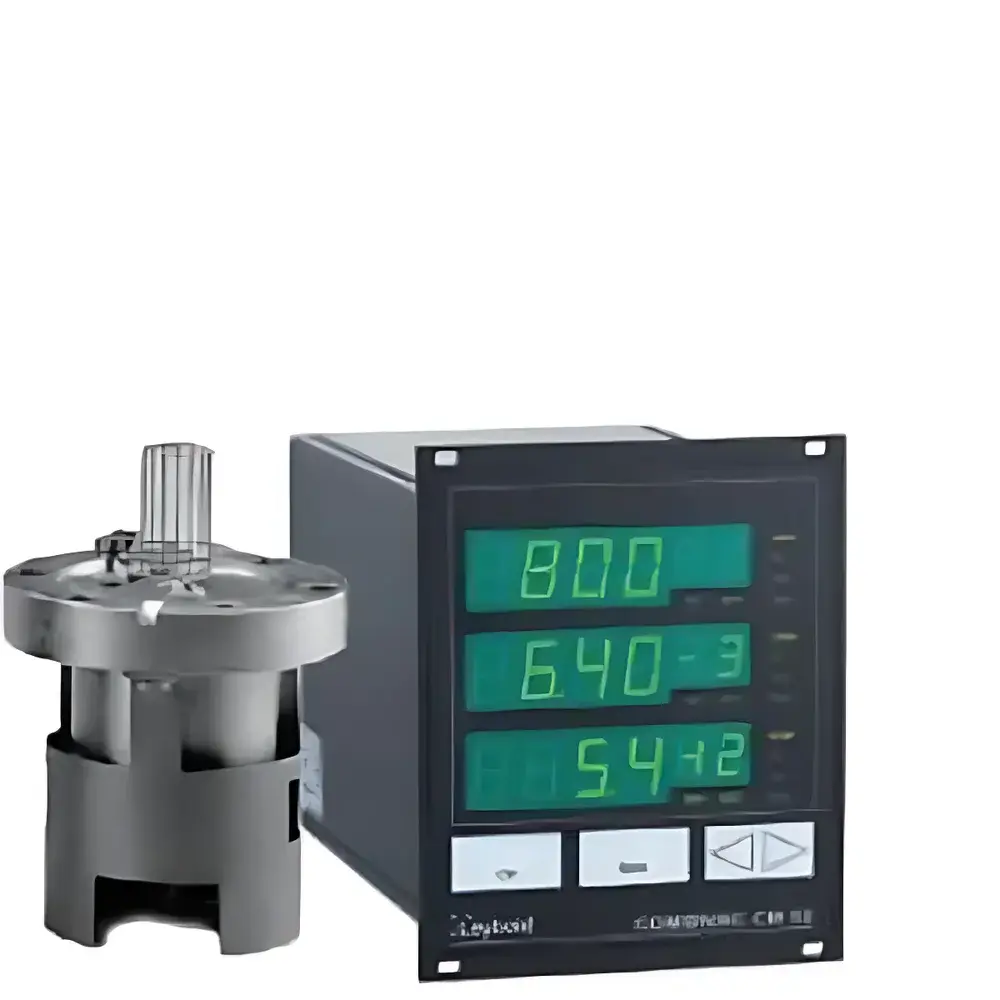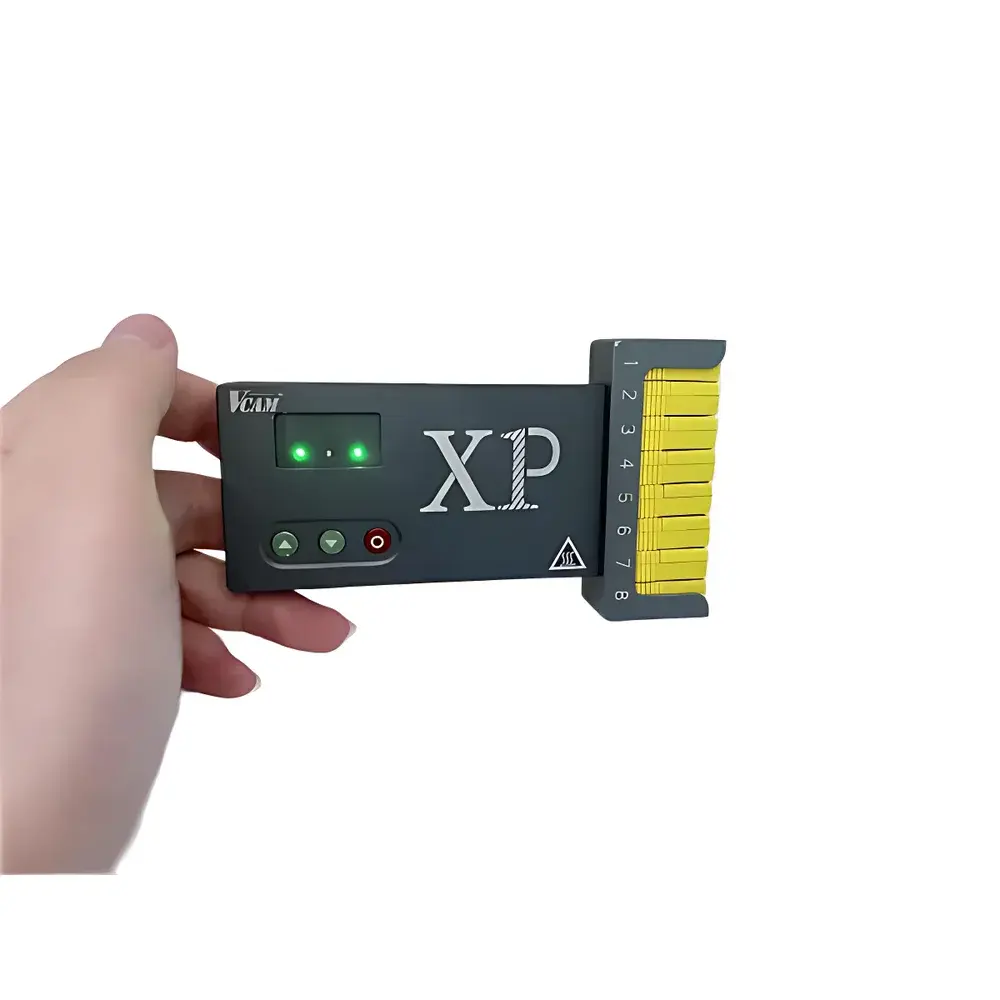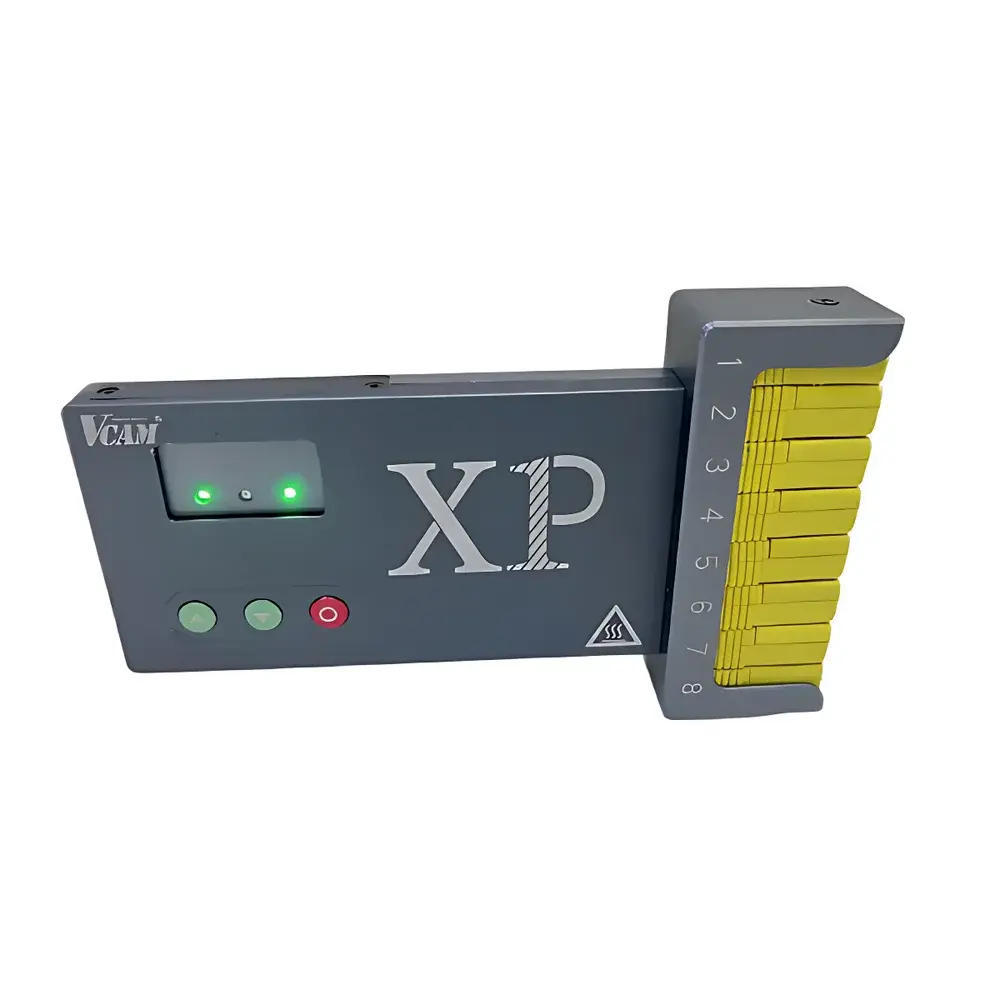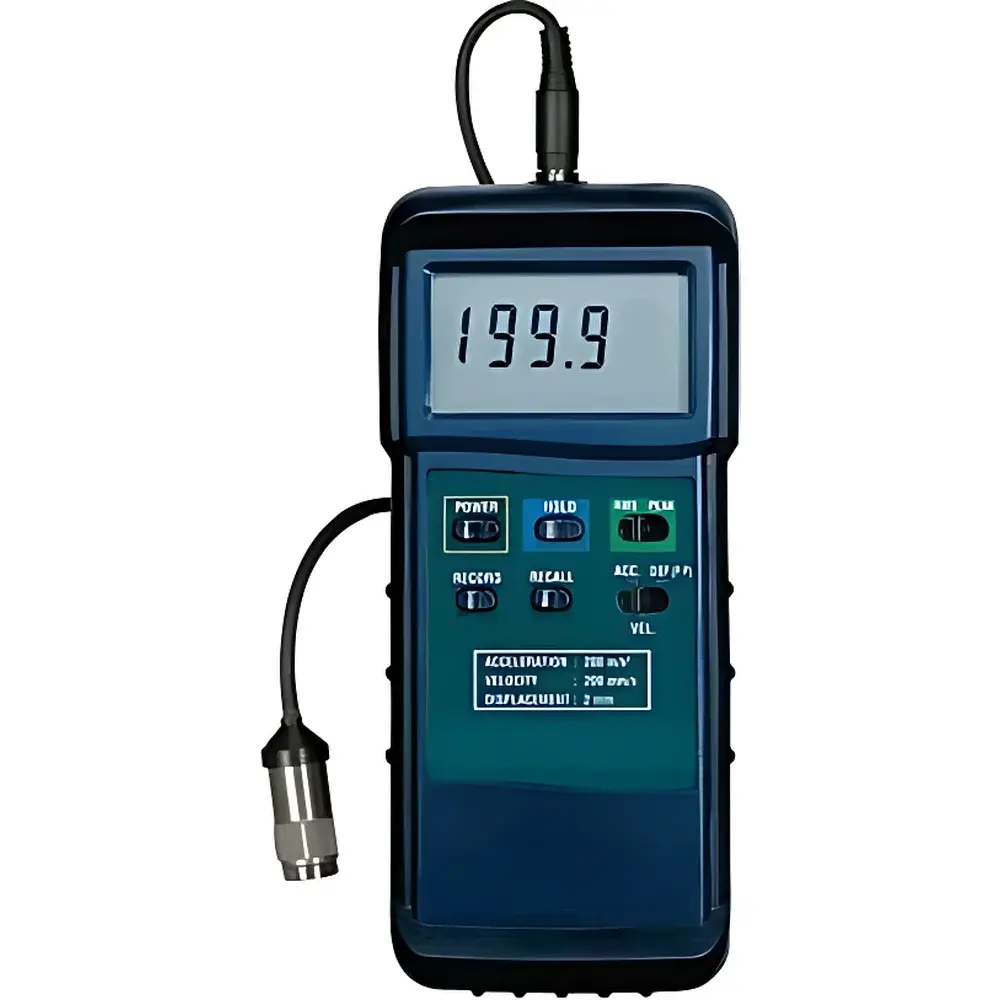
Portable Vibration Meter Model 899
| Origin | USA |
|---|---|
| Manufacturer Type | Authorized Distributor |
| Origin Category | Imported |
| Model | 899 |
| Price | Upon Request |
| Velocity Range | 0.078–200 mm/s (or 0.003–7.87 in/s) |
| Acceleration Range | 0.1–200 m/s² (or 0.33–656 ft/s²) |
| Displacement Range | 0.001–1.999 mm (or 0.00004–0.078 in) |
| Frequency Range | 10 Hz – 1 kHz |
| Basic Accuracy | ±5% of reading + 2 digits |
| Sensor Cable Length | 1 m (39 in) |
| Data Storage Capacity | Up to 500 readings (auto/manual) |
| Measurement Modes | True RMS or Peak |
| Functions | Max/Min Hold, Auto Power-Off, Data Hold |
| Included Accessories | Magnetic Mount, Carrying Case, Base Stand, Protective Housing, 9V Battery |
| Warranty | 3 Years |
| Calibration | NIST-Traceable Certificate Available (Optional) |
Overview
The Portable Vibration Meter Model 899 is a handheld, tri-axis capable instrumentation-grade device engineered for field and plant-floor measurement of mechanical vibration in rotating and reciprocating equipment. It operates on the principle of piezoelectric sensing, converting dynamic mechanical motion into proportional electrical signals for real-time quantification of velocity, acceleration, and displacement—three fundamental parameters defined in ISO 10816 and ISO 20816 for machinery condition monitoring. Designed for industrial maintenance engineers, reliability technicians, and predictive maintenance teams, the Model 899 delivers traceable, repeatable measurements across a broad operational bandwidth (10 Hz to 1 kHz), supporting routine screening, trending analysis, and baseline data collection without requiring external signal conditioning or oscilloscope integration.
Key Features
- Simultaneous measurement of vibration velocity (mm/s or in/s), acceleration (m/s² or ft/s²), and displacement (mm or in) — selectable per parameter via intuitive front-panel navigation.
- True RMS detection circuitry ensures accurate amplitude representation for non-sinusoidal waveforms commonly observed in bearing faults, misalignment, and imbalance scenarios.
- High-fidelity remote sensor with integrated 1-meter coaxial cable and neodymium magnetic base enables stable coupling to metallic surfaces—even on vertical or overhead machinery components.
- Onboard memory stores up to 500 timestamped readings with user-defined channel labeling; supports both automatic logging (at configurable intervals) and manual capture during transient events.
- Integrated USB interface (virtual COM port) allows direct connection to Windows-based PCs for bulk data export, spectral preview, and report generation using optional companion software compliant with ASTM E1226 and ISO 5347 standards.
- Robust housing rated to IP54 meets MIL-STD-810G requirements for shock, dust, and incidental moisture exposure during field deployment.
Sample Compatibility & Compliance
The Model 899 is compatible with standard industrial rotating equipment including electric motors (IEC 60034-14), gearboxes, pumps, fans, compressors, and belt-driven systems. Its frequency response envelope aligns with ISO 2954 for vibration severity evaluation and supports compliance with ANSI/HI 9.6.4 (pumps) and API RP 670 (turbomachinery). While the unit ships with NIST-traceable calibration documentation (optional certificate available upon request), end-users are responsible for periodic verification per ISO/IEC 17025-accredited procedures. The device does not require intrinsic safety certification but is intended for use in non-hazardous locations per IEC 60079-0.
Software & Data Management
A dedicated Windows application (v3.2+) is available for download, enabling CSV/Excel export, time-domain waveform visualization, FFT-based spectral analysis (up to 1024 lines), and customizable pass/fail threshold alerts. All stored readings include metadata: date/time stamp, measurement mode, sensor orientation flag, and operator ID field. Audit trails are preserved in accordance with FDA 21 CFR Part 11 requirements when used in regulated environments under validated workflows. Data integrity is enforced via checksum validation during transfer and read-only archive options to prevent accidental overwrites.
Applications
- Routine vibration screening of HVAC chillers and air handlers per ASHRAE Guideline 12-2020.
- Bearing defect identification through envelope spectrum analysis using peak amplitude trends at characteristic fault frequencies.
- Baseline vibration signature acquisition prior to commissioning of new assets or after major overhauls.
- Verification of balancing effectiveness following field dynamic balancing interventions.
- Supporting root cause analysis in failure investigations aligned with ISO 18436-2 Category I certification criteria.
- Integration into CMMS platforms (e.g., IBM Maximo, SAP PM) via exported CSV files for automated work order triggering based on threshold exceedances.
FAQ
Does the Model 899 include a factory calibration certificate?
No — a NIST-traceable calibration certificate is available as an optional add-on at time of order. Standard units ship with calibration verification data only.
Can the device measure vibration on non-ferrous surfaces?
Yes — the included magnetic mount may be replaced with adhesive pads or stud mounts (sold separately) for aluminum, stainless steel, or composite housings.
Is the USB interface compatible with macOS or Linux?
The native driver supports Windows 10/11 only; however, raw ASCII data output can be captured via terminal emulation on macOS/Linux using generic CDC-ACM protocols.
What is the battery life under continuous operation?
Approximately 12 hours with alkaline 9V battery; low-battery indicator activates at ≤6.2 V.
How is measurement uncertainty quantified for this instrument?
Total expanded uncertainty (k=2) is ±6.2% at 159.2 Hz reference frequency, derived from sensor sensitivity tolerance, amplifier linearity, and ADC resolution per ISO 16063-21.