
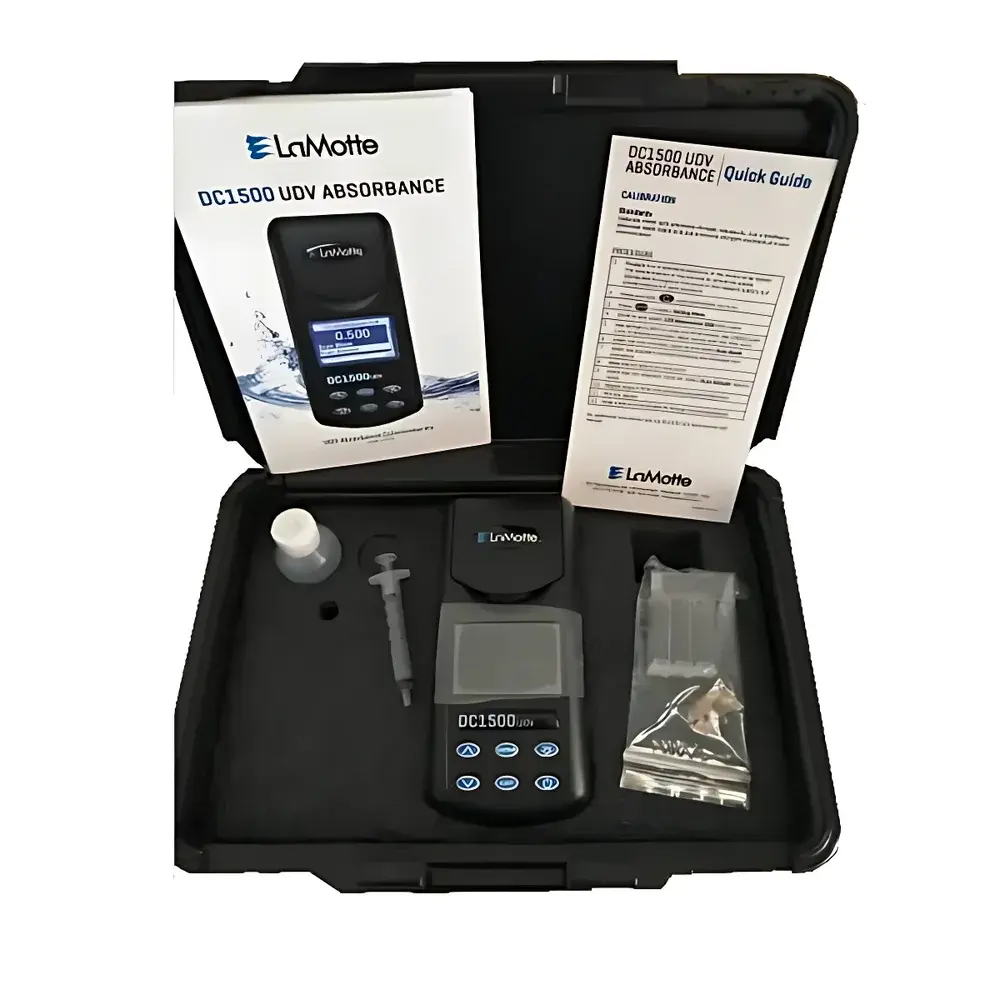
Lamotte DC-1500UDV Demoldant Concentration Analyzer
| Brand | Lamotte |
|---|---|
| Origin | USA |
| Model | DC-1500UDV |
| Type | UV-Vis Absorbance-Based Concentration Analyzer for Mold Release Agents |
| Compliance | Designed for industrial process control and QC labs in die-casting, composite manufacturing, and precision molding environments |
| Enclosure Rating | IP65-rated housing for splash resistance |
| Optical System | Fixed-wavelength UV-Vis photometer (254 nm and 546 nm dual-channel capability) |
| Detection Principle | Beer-Lambert law-based absorbance measurement calibrated for proprietary demoldant formulations |
| Calibration | Factory-calibrated with NIST-traceable standards |
| Sample Cell | Sealed, quartz-cuvette-style flow-through cell with O-ring sealing and chemical-resistant PTFE wetted surfaces |
| Power | 100–240 VAC, 50/60 Hz, internal switching power supply |
| Interface | Backlit LCD with tactile keypad |
| Data Storage | Internal memory for up to 500 test records with timestamp, operator ID, and calibration history |
Overview
The Lamotte DC-1500UDV Demoldant Concentration Analyzer is a purpose-engineered benchtop photometric instrument designed for rapid, repeatable quantification of mold release agent (MRA) concentration in aqueous process baths used across die-casting, injection molding, and composite tooling operations. Unlike generic spectrophotometers, the DC-1500UDV employs a dual-wavelength UV-Vis optical architecture optimized for the characteristic absorbance profiles of hydrocarbon- and silicone-based demoldants—particularly at 254 nm (aromatic ring absorption) and 546 nm (reference baseline correction). Its measurement principle adheres strictly to the Beer-Lambert law, with factory-installed calibrations traceable to NIST-standard reference materials. The analyzer delivers results in under 15 seconds per sample, eliminating manual dilution steps and reducing operator dependency. Engineered for production-floor durability, it features an IP65-rated enclosure, chemical-resistant fluid path components, and a sealed cuvette chamber that prevents aerosol ingress, cross-contamination, or degradation of optical elements during high-cycle operation.
Key Features
- Dual-channel fixed-wavelength photometry (254 nm + 546 nm) for matrix-compensated quantification of complex MRA emulsions
- Sealed, reusable quartz flow cell with integrated O-ring gasketing and PTFE-lined sample pathway—designed to withstand repeated exposure to alkaline cleaners, solvents, and high-solids suspensions
- Onboard calibration management supporting 1-point zero and 2-point span verification using certified standard solutions; full audit trail logged with date/time stamp and operator ID
- Backlit monochrome LCD interface with intuitive menu navigation and real-time display of absorbance, concentration (ppm or % v/v), and calibration status
- USB-B connectivity enabling direct export of test records—including raw absorbance values, calculated concentration, calibration metadata, and timestamps—to external PCs for LIMS integration or QA documentation
- No moving parts in optical train; solid-state LED light sources with >10,000-hour operational lifetime and minimal spectral drift
Sample Compatibility & Compliance
The DC-1500UDV is validated for use with water-based demoldant formulations commonly deployed in aluminum die-casting (e.g., Lamotte-certified MR-800 series, Chem-Trend A-300, Henkel Technomelt R-12), as well as semi-synthetic and silicone-emulsion types. It accommodates sample volumes from 2.5 mL to 10 mL without dilution in standard mode. The instrument meets IEC 61010-1 safety requirements for laboratory electrical equipment and complies with RoHS 2011/65/EU directives. While not classified as a medical device or regulated under FDA 21 CFR Part 11, its data export functionality and calibration logging support GLP-compliant recordkeeping when deployed in ISO/IEC 17025-accredited quality laboratories. All calibration standards are supplied with CoA referencing NIST SRM 930e (absorbance standards) and SRM 2363 (aqueous organic reference materials).
Software & Data Management
The DC-1500UDV operates independently without PC software but supports post-acquisition data handling via Lamotte’s free LogView Lite utility (Windows-compatible). This application enables sorting, filtering, and exporting of CSV-formatted datasets containing concentration values, measurement IDs, calibration events, and environmental parameters (ambient temperature logged at time of test). Each record includes a unique serial-numbered audit trail compliant with internal QA protocols requiring traceability per ISO 9001:2015 clause 8.5.2. No cloud connectivity or remote firmware updates are implemented—ensuring data sovereignty and alignment with ITAR-restricted manufacturing environments.
Applications
- Real-time monitoring of demoldant bath concentration in high-volume die-casting cells to prevent part sticking or surface defect formation
- Verification of bath replenishment accuracy following automated dosing system maintenance
- Root-cause analysis of premature mold fouling by correlating concentration excursions with tooling inspection logs
- Supporting PPAP submissions through documented measurement uncertainty budgets (calculated per GUM guidelines using manufacturer-provided repeatability specs)
- Integration into shop-floor SPC dashboards via periodic CSV pull scripts for X-bar/R chart generation
FAQ
What demoldant chemistries are supported out-of-the-box?
The DC-1500UDV ships with preloaded calibration curves for 12 common water-dilutable demoldants, including petroleum distillate-, ester-, and methyl siloxane-based formulations. Custom curve development services are available through Lamotte Technical Support.
Can the instrument measure turbid or colored process baths?
Yes—the dual-wavelength algorithm corrects for non-specific absorbance from suspended solids or bath discoloration, provided turbidity remains below 50 NTU and no particulate fouling occurs on the cuvette windows.
Is routine maintenance required beyond calibration?
Only periodic cleaning of the sample cell window with lint-free wipes and isopropyl alcohol is recommended; no lamp replacement or optical alignment is needed within the first five years of operation.
Does the analyzer meet EPA or ASTM methods for industrial coolant monitoring?
While not certified to a specific EPA method, its photometric methodology aligns with ASTM D5946 (Standard Test Method for Determining Oil Content in Aqueous Systems by UV Spectrophotometry) for analogous applications.







