
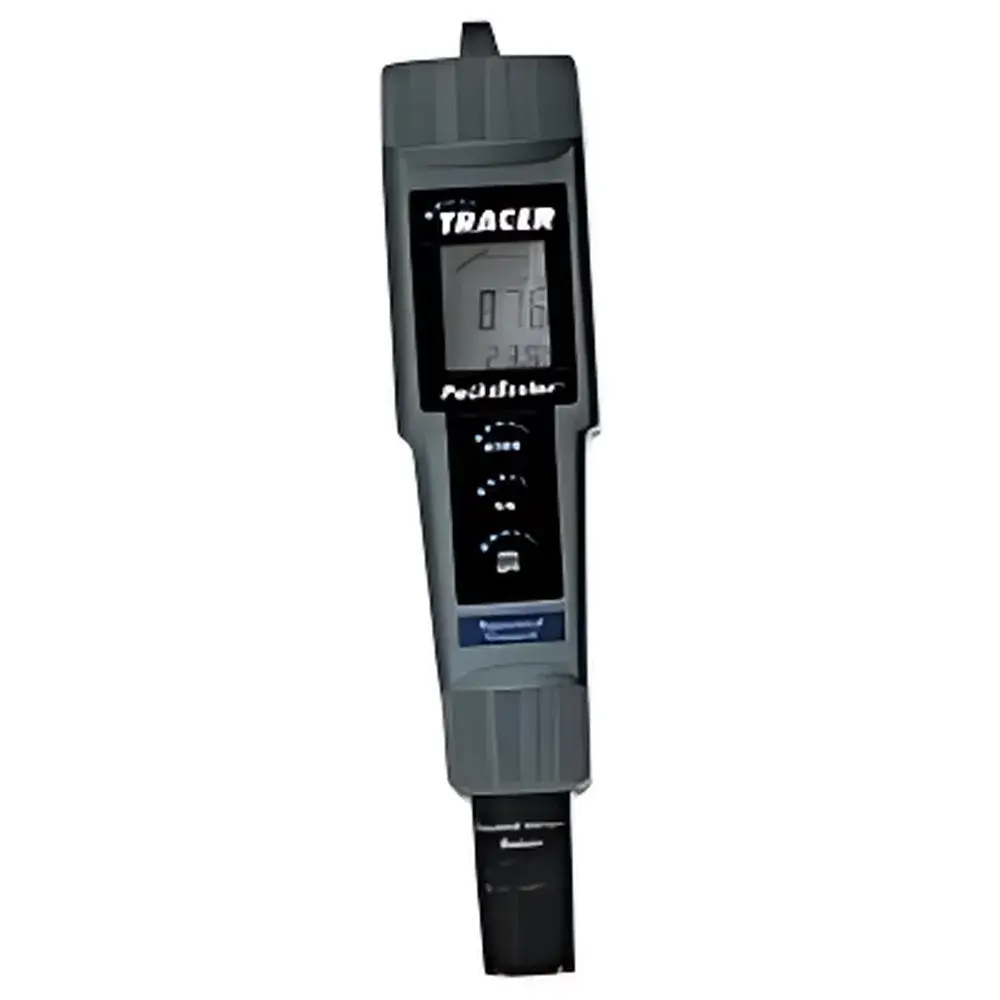
Lamotte 1761 Portable Dissolved Oxygen Meter
| Brand | Lamotte |
|---|---|
| Origin | USA |
| Model | 1761 |
| Instrument Type | Portable |
| Measurement Principle | Electrochemical Galvanic Cell Probe |
| Measurement Range | 0–20.00 ppm (mg/L) |
| Accuracy | ±2% FS (DO), ±1.8°F (±1°C) (Temperature) |
| Resolution | 0.01 ppm (DO), 0.1°F/°C (Temperature) |
| Repeatability | ±4% |
| Detection Limit | ±2% FS |
| Altitude Compensation | 0–20,000 ft (in 1,000-ft increments) |
| Salinity Compensation | 0–50 ppt |
| Data Storage | 25 DO + temperature datasets |
| Power | Four 1.5V SR44W batteries |
| Dimensions | 1.4 × 6.9 × 1.6 in (36 × 176 × 41 mm) |
Overview
The Lamotte 1761 Portable Dissolved Oxygen Meter is a field-deployable, galvanic cell-based instrument engineered for reliable, on-site measurement of dissolved oxygen (DO) concentration and temperature in natural waters, wastewater effluents, aquaculture systems, and drinking water distribution networks. Unlike polarographic sensors requiring external polarization voltage, the 1761 utilizes a self-powered galvanic probe—comprising a silver anode and lead cathode immersed in electrolyte—which generates a current proportional to oxygen partial pressure across the gas-permeable membrane. This electrochemical principle ensures stable zero-point behavior, minimal warm-up time, and reduced maintenance frequency compared to amperometric alternatives. Designed for environmental technicians, field biologists, and municipal water operators, the meter delivers traceable measurements compliant with standard methods including ASTM D888 (Standard Test Methods for Dissolved Oxygen in Water) and EPA Method 360.5 (Dissolved Oxygen by Membrane Electrode). Its compact form factor and integrated ergonomic neck strap enable extended use during stream surveys, lake profiling, or regulatory compliance sampling.
Key Features
- Galvanic cell probe technology with no warm-up delay and inherent zero stability
- Dual-mode display: simultaneous readout in % saturation (0–200.0%) and concentration (0–20.00 mg/L)
- Automatic altitude compensation (0–20,000 ft, adjustable in 1,000-ft steps) to correct for barometric pressure effects on saturation calculations
- Manual salinity compensation (0–50 ppt) for accurate DO reporting in estuarine, brackish, or coastal applications
- Onboard memory storing up to 25 timestamped data points—including DO value, temperature, and measurement mode
- Auto-power-off after 10 minutes of inactivity; low-battery indicator and data-hold function for field documentation
- Ruggedized housing rated for ambient operation between 0–50°C (32–122°F); IP67-rated probe connector interface
- Modular design supporting interchangeable probe lengths: standard (3 ft / 1 m) or extended (16 ft / 5 m) cable options (models 1763 and 1764)
Sample Compatibility & Compliance
The 1761 is validated for use with freshwater, seawater, treated effluent, and potable water matrices. Its galvanic sensor exhibits minimal interference from common ions (e.g., Cl⁻, NO₃⁻, SO₄²⁻) and is insensitive to hydrogen sulfide at concentrations typically encountered in aerobic surface waters. The instrument meets functional requirements outlined in ISO 5814:2012 (Water quality — Determination of dissolved oxygen — Electrochemical probe method) and supports GLP-compliant data acquisition when used with documented calibration procedures. While not equipped with electronic audit trails per FDA 21 CFR Part 11, its manual calibration log (via included calibration certificate templates) aligns with routine QA/QC protocols in municipal and academic laboratories operating under ISO/IEC 17025 frameworks.
Software & Data Management
The 1761 operates as a standalone field instrument without proprietary software dependency. All data are stored internally and retrieved manually via visual readout only—no USB, Bluetooth, or serial export capability is integrated. This architecture eliminates firmware update obligations and ensures long-term operational continuity in remote or low-infrastructure settings. Users are advised to record measurements directly into field notebooks or LIMS-compatible spreadsheets using standardized nomenclature (e.g., “DO_1761_[Date]_[Location]”). Optional accessories—including weighted sample holders (Cat. No. 1746), capped sample cups (Cat. No. 1745), and replacement membrane kits (Cat. No. 1761M)—facilitate repeatable, contamination-minimized sampling per Standard Methods 4500-O G.
Applications
- Regulatory monitoring of DO in NPDES permit compliance and TMDL assessments
- Seasonal hypolimnetic profiling in reservoirs and stratified lakes
- Process control in activated sludge basins and oxidation ditches
- Aquaculture health management—tracking DO thresholds for salmonid and crustacean species
- Educational field labs emphasizing Winkler titration cross-validation and sensor drift assessment
- Stormwater outfall screening prior to discharge authorization
FAQ
Does the 1761 require daily calibration?
No—calibration is recommended before each field session or after probe membrane replacement. A single-point air-saturation calibration (at local barometric pressure and salinity) suffices for most applications.
Can the probe be used in sediment pore water?
Not recommended. The galvanic sensor requires turbulent flow or stirring for equilibrium response; stagnant, high-organic-content pore water may cause membrane fouling and slow response.
What is the expected service life of the DO membrane?
Under typical field use, membranes last 2–4 months. Replacement frequency increases in high-turbidity or high-H₂S environments. Each 1761M kit contains six membranes and electrolyte solution.
Is temperature measurement compensated automatically during DO calculation?
Yes—the built-in thermistor continuously measures sample temperature and applies real-time correction to saturation calculations per the APHA/AWWA/WEF standard equations.
How does altitude compensation affect % saturation readings?
Altitude adjustment modifies the theoretical 100% saturation point based on local atmospheric pressure; it does not alter the raw current signal but recalculates the % value referenced to site-specific equilibrium conditions.







