
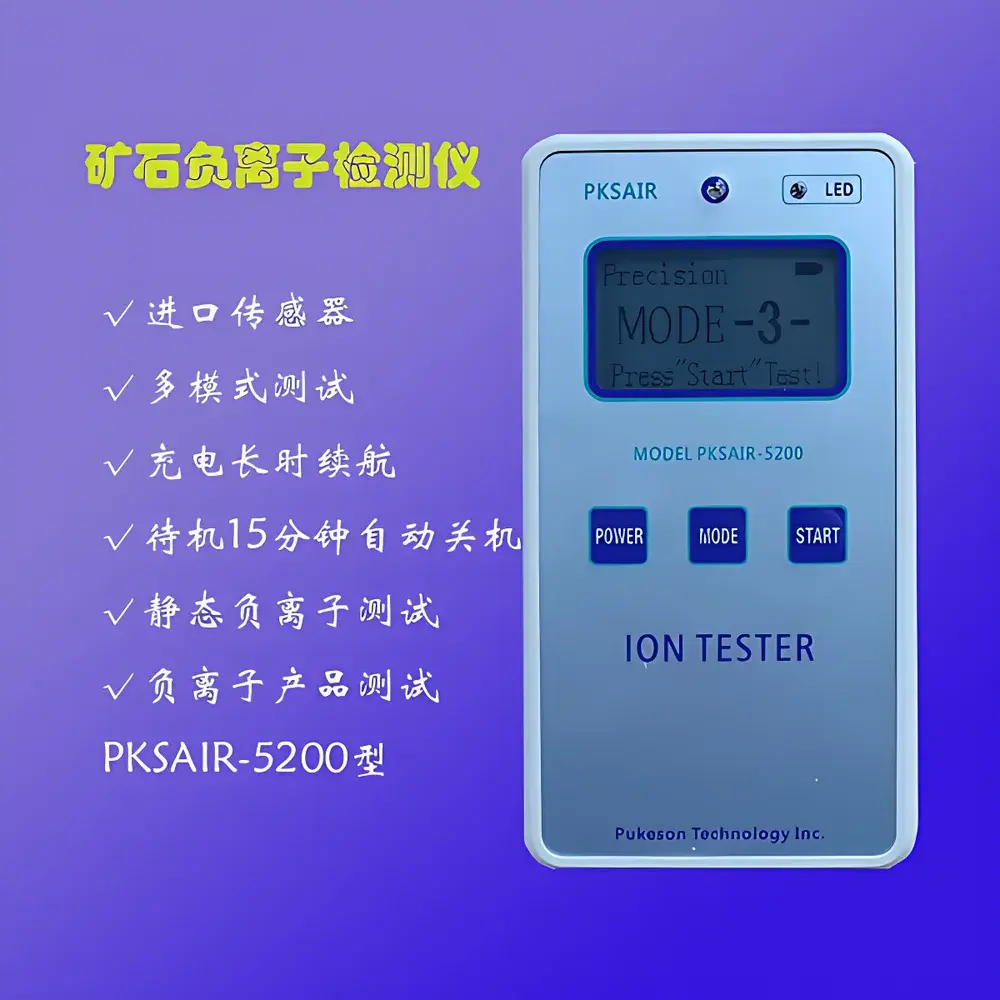
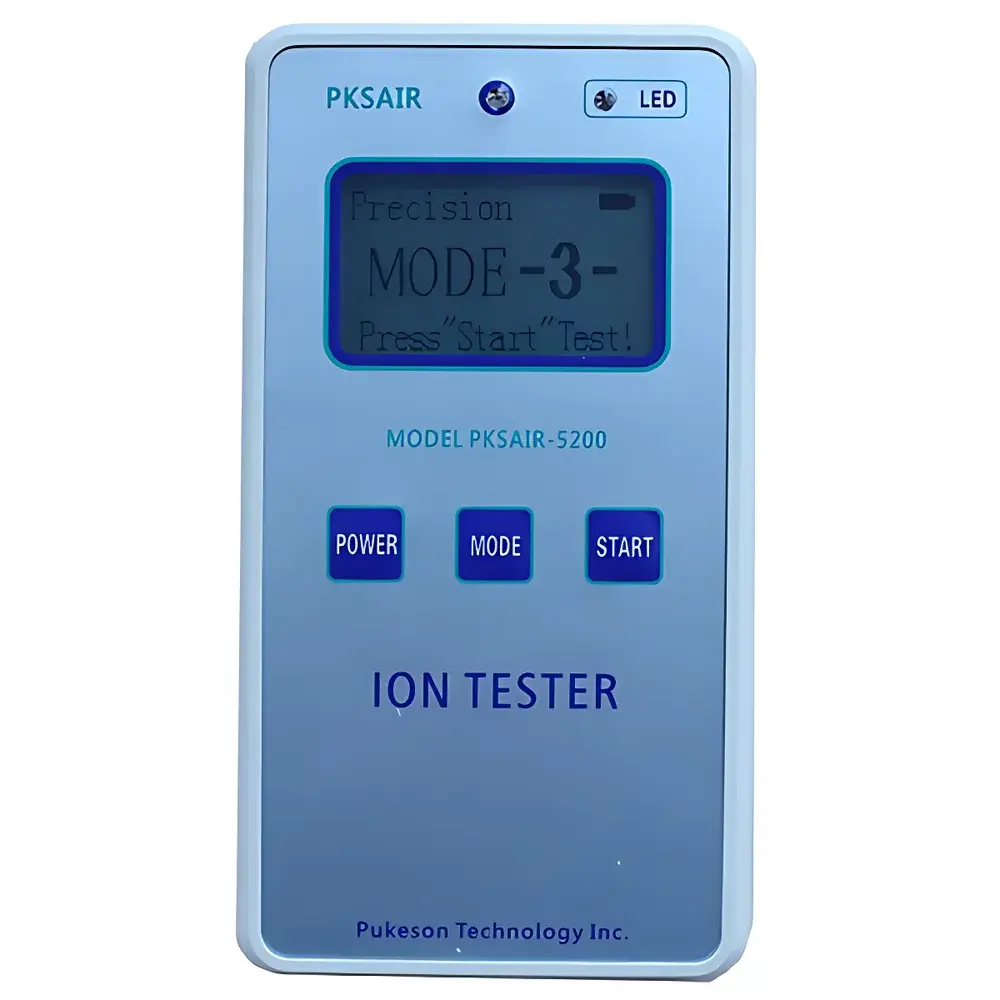
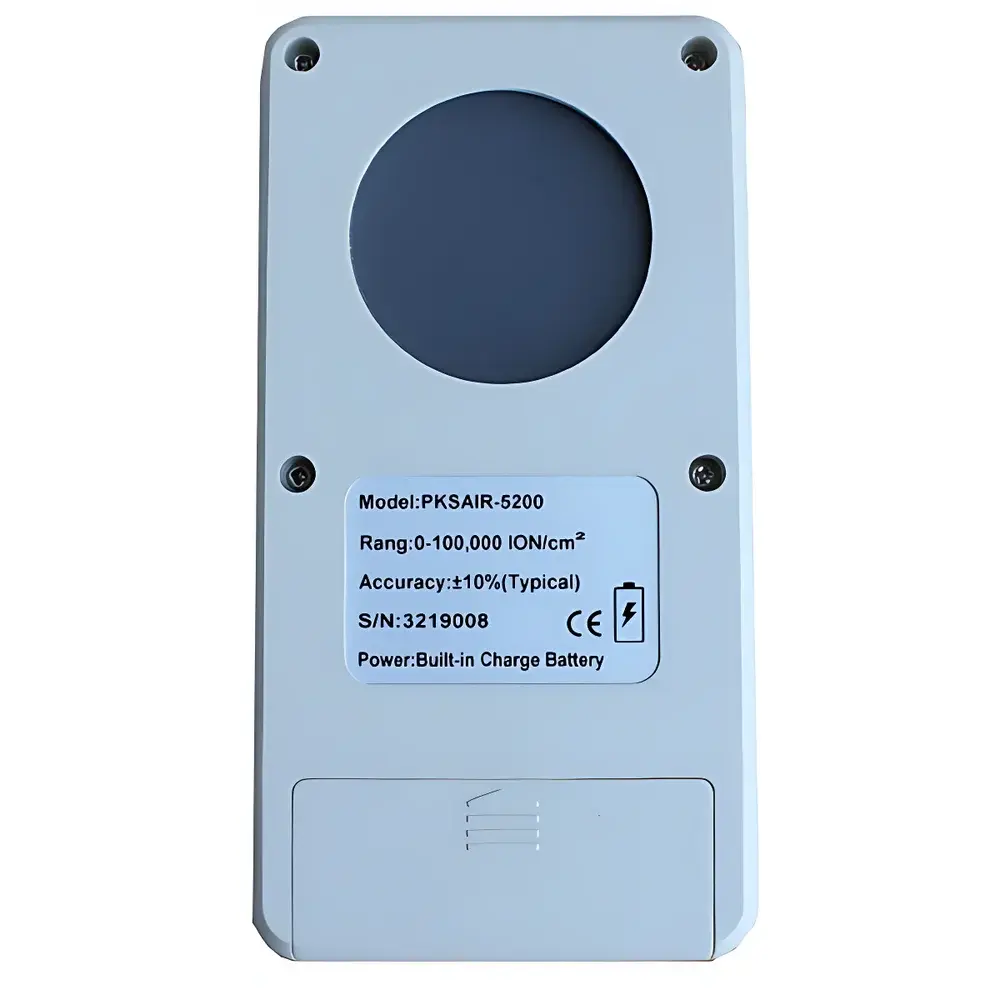
PKSAIR PKSAIR-5200 Portable Air Negative Ion Detector with GM Tube Sensor
| Brand | PKSAIR |
|---|---|
| Origin | Beijing, China |
| Model | PKSAIR-5200 |
| Detection Principle | Geiger-Müller (GM) Tube-based Ionization Measurement |
| Range | 0.00–100,000 ions/cm³ |
| Resolution | 1 ion/cm³ |
| Accuracy | ≤ ±5% |
| Sampling Method | Passive Electrostatic Induction + GM Tube Detection |
| Display | 2-inch HD LCD (English/Chinese bilingual firmware) |
| Power | Rechargeable 800 mAh Li-polymer battery (up to 50 h continuous operation) |
| Operating Temperature | −20 °C to +50 °C |
| Relative Humidity | ≤95% RH (non-condensing) |
| Dimensions | 144 × 78 × 33 mm |
| Weight | 0.36 kg |
| Compliance | Intrinsic Safety Circuit Design |
| Connectivity | Micro-USB (5 V DC charging) |
Overview
The PKSAIR PKSAIR-5200 Portable Air Negative Ion Detector is an engineered field instrument designed for quantitative assessment of negative ion emission from naturally radioactive mineral-based materials—including tourmaline, zeolite, ceramic powders, functional wall coatings, textiles, bedding, and ophthalmic accessories such as “negative ion eyewear.” Unlike conventional air ion counters that measure ambient atmospheric ions via corona discharge or parallel-plate collectors, the PKSAIR-5200 employs a calibrated Geiger-Müller (GM) tube sensor to detect low-intensity alpha and beta emissions originating from trace radionuclides (e.g., 232Th, 238U decay series) in mineral matrices. These emissions ionize surrounding air molecules, generating measurable negative ion concentrations (reported in ions per cubic centimeter, ions/cm³). The device operates on the principle that sustained ion emission correlates with material-specific radioactivity levels and surface area exposure—making it suitable for quality control in manufacturing, third-party verification, and regulatory pre-screening of consumer wellness products claiming “natural negative ion generation.” Its compact form factor and intrinsic safety circuitry support deployment in production floors, retail demonstration environments, academic labs, and field validation studies where portability and operational robustness are essential.
Key Features
- High-stability imported GM tube sensor with linear response across full dynamic range (0.00–100,000 ions/cm³)
- 24-bit analog-to-digital converter paired with 32-bit nanoscale microprocessor for low-noise signal processing and thermal drift compensation
- Intrinsically safe electronic architecture compliant with IEC 60079-11 for use in non-hazardous industrial zones
- Ergonomic ABS+PC composite housing—impact-, chemical-, UV-, and flame-resistant (UL94 V-0 rated)
- Two-inch high-contrast monochrome LCD with dual-language firmware (English/Chinese), supporting real-time data logging and status diagnostics
- Three selectable measurement modes: single-point snapshot, 10-second averaging, and continuous 60-second rolling average
- Integrated protective membrane over GM tube aperture to minimize mechanical damage and particulate contamination
- Multi-layer electromagnetic interference (EMI) shielding and electrostatic discharge (ESD) protection (IEC 61000-4-2 Level 4)
- Micro-USB 5 V DC charging interface compatible with standard Android power adapters; no consumables or calibration gases required
- Auto-power-off after 10 minutes of inactivity; battery runtime up to 50 hours under typical intermittent-use conditions
Sample Compatibility & Compliance
The PKSAIR-5200 is validated for direct-contact or proximity-based evaluation of solid-phase materials containing naturally occurring radioactive minerals. Compatible sample types include but are not limited to: sintered ceramic tiles, woven tourmaline-infused fabrics, plaster-based wall coatings, polymer-embedded mineral composites, and optically transparent lens substrates coated with negative-ion-emitting nanoceramic layers. While not intended for occupational radiation dosimetry or environmental radon monitoring, the instrument conforms to general-purpose electromagnetic compatibility (EMC) standards per EN 61326-1 and electrical safety requirements per EN 61010-1. It supports documentation workflows aligned with GLP (Good Laboratory Practice) and ISO/IEC 17025 traceability frameworks when used with external calibration logs and timestamped measurement records. Note: This device does not meet FDA 21 CFR Part 11 requirements for electronic records and signatures unless integrated into a validated laboratory information management system (LIMS).
Software & Data Management
The PKSAIR-5200 operates autonomously without host software dependency. All measurement data—including timestamp, mode selection, and raw counts—are stored internally in non-volatile memory (up to 500 records). Data export is accomplished via manual transcription or optional RS232/USB-C adapter (sold separately). Firmware supports configurable display language switching and user-defined auto-shutdown delay. For enterprise integration, PKSAIR provides CSV-compatible output templates and basic API documentation upon request—enabling scripted ingestion into Excel, MATLAB, or custom QC dashboards. Audit trails may be maintained externally using serial number–indexed logbooks or digital annotation tools compliant with internal QA protocols.
Applications
- Raw material screening of mineral powders prior to incorporation into functional textiles or building materials
- Batch release testing for negative-ion-emitting eyewear, wristbands, and therapeutic cushions
- On-site verification during trade shows, distributor training, and point-of-sale demonstrations
- Academic research into correlations between mineral composition, specific activity, and measured ion yield
- Comparative analysis of aging effects on ion emission stability across thermal, humidity, and UV exposure cycles
- Supporting technical documentation for CE marking submissions under Directive 2014/30/EU (EMC Directive)
FAQ
Does the PKSAIR-5200 measure ambient air ions or only mineral-derived emissions?
It measures negative ions generated *in situ* by radioactive decay within the test material—not background atmospheric ions. Results reflect localized emission intensity under standardized proximity conditions.
Can this instrument quantify radionuclide concentration (e.g., Bq/kg)?
No. It reports derived ion concentration (ions/cm³), not absolute radioactivity. Correlation to activity requires empirical calibration against reference sources traceable to national metrology institutes.
Is annual recalibration required?
PKSAIR recommends functional verification every 12 months using a certified check source (e.g., 241Am disc source); full recalibration is performed at authorized service centers only.
What environmental conditions affect measurement accuracy?
Relative humidity above 90% RH may cause surface condensation on the GM tube window, leading to signal attenuation. Temperatures below −10 °C or above +45 °C may reduce battery efficiency and increase baseline noise.
Is the device suitable for regulatory submission or certification testing?
It serves as a screening tool—not a certified metrological standard. Final compliance claims must be substantiated using accredited laboratories employing NIST-traceable instrumentation and ISO 17025–accredited methods.







