
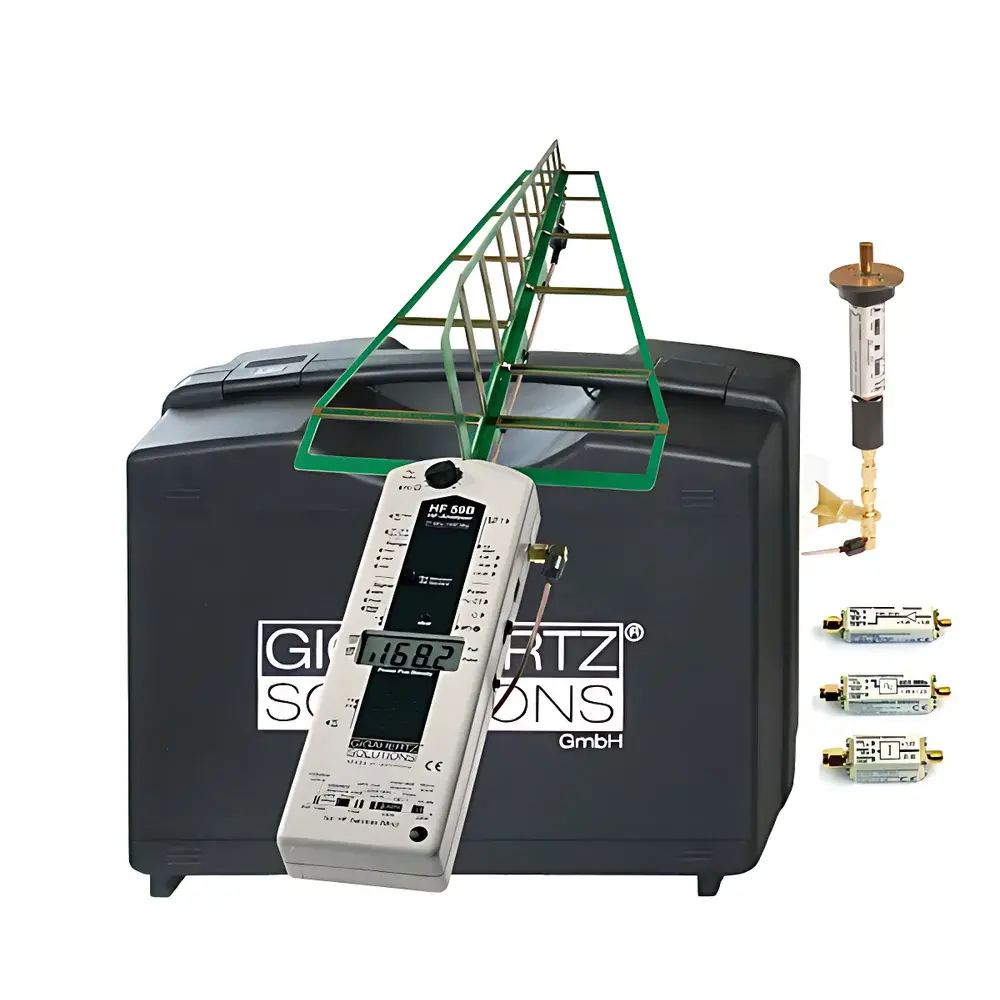
Gigahertz Optik HFE59B Broadband Electromagnetic Field Strength Analyzer
| Brand | Gigahertz Optik |
|---|---|
| Origin | Germany |
| Model | HFE59B |
| Frequency Range | 27 MHz – 3.3 GHz |
| Measurement Accuracy | ±3 dB (27 MHz – 3.3 GHz) |
| Electric Field Range | 0.02–27.5 V/m |
| Display Unit | μW/m² |
| Antenna Interface | SMA, 50 Ω |
| Power Supply | Rechargeable NiMH battery or DC input |
| Dimensions | 70 × 120 × 30 mm |
| Weight | 2.1 kg |
Overview
The Gigahertz Optik HFE59B is a precision broadband electromagnetic field strength analyzer engineered for professional environmental and occupational EMF assessment. It operates on the principle of calibrated RF electric field detection using broadband antenna coupling and real-time digital signal processing (DSP), delivering traceable, frequency-weighted measurements across a continuous spectrum from 27 MHz to 3.3 GHz. Unlike narrowband survey meters, the HFE59B performs simultaneous wideband spectral analysis—enabling both integrated power density evaluation (in μW/m²) and directional source localization. Its dual-antenna architecture—comprising a calibrated omnidirectional UBB27 antenna for ambient field mapping and a high-directivity logarithmic periodic antenna for emission source triangulation—supports compliance-driven workflows required in regulatory monitoring, EMC pre-compliance screening, and occupational safety audits. All units are manufactured and factory-calibrated in accordance with ISO/IEC 17025-accredited procedures at Gigahertz Optik’s facility in Turkenfeld, Germany.
Key Features
- Real-time DSP-based broadband measurement engine with ±3 dB amplitude accuracy across full 27 MHz–3.3 GHz range, including validated response up to 5.8 GHz for Wi-Fi 5/6 applications
- Dual-antenna system: UBB27 omnidirectional antenna (for isotropic field integration) + optimized log-periodic directional antenna (for spatial source identification and rejection of off-axis interference)
- Integrated steep-sided bandpass filtering at antenna port, automatically suppressing out-of-band signals beyond 3.3 GHz to prevent measurement saturation and ensure linearity
- Patented circuit design (DE10317805, DE19809784) enabling automatic compensation of instrument self-emission and ambient background offset—critical for low-level field detection in urban or indoor environments
- Acoustic feedback system: internal speaker and 2.5 mm headphone jack providing tone amplitude proportional to instantaneous field strength, supporting hands-free directional scanning
- Portable form factor (70 × 120 × 30 mm, 2.1 kg) with ergonomic single-hand operation, rechargeable NiMH battery, auto-power-off, and low-battery warning
- SMA 50 Ω RF input interface compatible with third-party calibrated antennas; AC/DC output for data logging or external instrumentation interfacing
Sample Compatibility & Compliance
The HFE59B is designed for quantitative assessment of electromagnetic emissions from diverse RF sources—including mobile base stations (GSM900/1800/1900, UMTS, LTE800/2600, 5G NR sub-6 GHz), broadcast transmitters (DVB-T/T2), radar systems, Wi-Fi/WLAN (2.4 GHz, 5.8 GHz), Bluetooth, DECT, TETRA/BOS, ISM bands (434 MHz, 868 MHz), microwave ovens, and industrial RF heaters. Its measurement methodology aligns with key international standards including ICNIRP 2020 guidelines, IEEE C95.1-2019, EN 50492:2022 (EMF assessment for workers), and EN 50413:2022 (general public exposure). While not certified as a Class 1 instrument per IEC 62232, its calibration traceability to PTB (Physikalisch-Technische Bundesanstalt) ensures metrological validity for GLP-compliant reporting and internal audit documentation.
Software & Data Management
The HFE59B operates as a standalone field instrument with no mandatory PC dependency; all measurements are displayed directly on its high-contrast LCD screen in μW/m², V/m, or dBm units. For extended data capture, optional PC software (compatible with Windows 10/11) enables time-stamped logging via USB or RS232, export to CSV/Excel, and generation of annotated measurement reports compliant with ISO/IEC 17025 documentation requirements. The device supports audit-trail-ready operation: all configuration changes, calibration dates, and user-defined limit thresholds are stored internally with timestamping—facilitating FDA 21 CFR Part 11–aligned validation in regulated environments where traceability is mandated.
Applications
- Environmental EMF monitoring near cellular base stations, broadcast towers, and radar installations
- Workplace safety assessments per EU Directive 2013/35/EU and national OSHA-equivalent regulations
- EMI/EMC pre-compliance surveys during product development and site acceptance testing
- Radio spectrum management and interference hunting in municipal, aviation, and defense infrastructure
- Indoor RF hotspot identification in schools, hospitals, and residential buildings
- Verification of shielding effectiveness in Faraday enclosures and anechoic chambers
- Field validation of RF exposure mitigation measures prior to regulatory submission
FAQ
Does the HFE59B require annual recalibration?
Yes. Gigahertz Optik recommends recalibration every 12 months against primary standards at an accredited laboratory to maintain traceability to PTB. Calibration certificates include uncertainty budgets per ISO/IEC 17025.
Can the HFE59B measure magnetic field (H-field) components?
No. The HFE59B is optimized for electric field (E-field) measurement only. For combined E/H assessment, Gigahertz Optik offers complementary instruments such as the ME3830B series.
Is the directional antenna included in the standard package?
Yes. The HFE59B standard delivery includes both the UBB27 omnidirectional antenna and the logarithmic periodic directional antenna, along with SMA cables, carrying case, NiMH battery, and charger.
What is the minimum detectable field strength?
At 900 MHz, the noise floor is ≤0.02 V/m (equivalent to ~0.001 μW/m²), enabling reliable detection of low-level emissions typical of Wi-Fi routers or DECT base stations at 1–3 m distance.
Does the device support frequency-selective analysis?
No. The HFE59B provides broadband RMS power density without spectral resolution. For frequency-domain analysis, Gigahertz Optik recommends pairing it with the Spectran V6 real-time spectrum analyzer.
Related Products







