
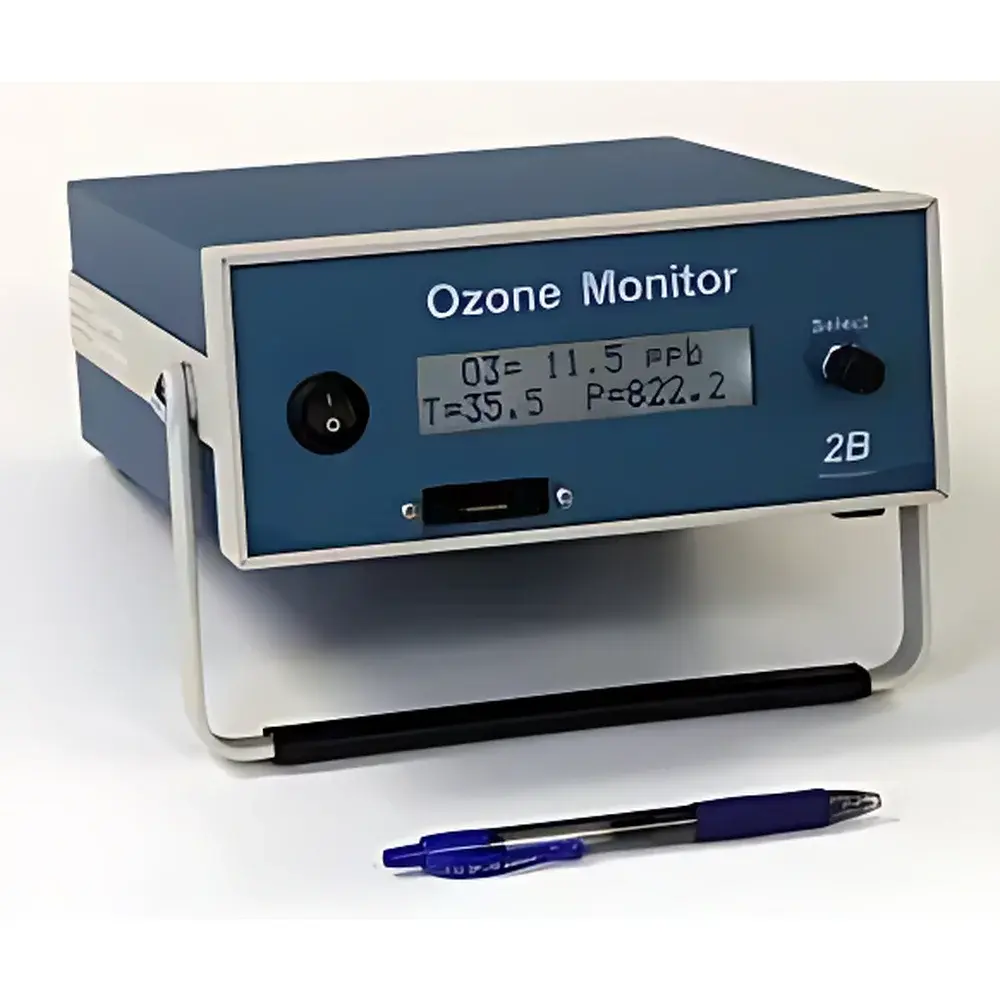
2B Technologies Model 202 Ozone Analyzer
| Origin | USA |
|---|---|
| Manufacturer Type | Authorized Distributor |
| Origin Category | Imported |
| Model | 202 |
| Instrument Type | Portable |
| Measurement Range | 1 ppb to 100,000 ppb (0–100 ppm) |
| Limit of Detection | 3.0 ppb (10-second measurement mode) |
| Response Time | 20 s (to 95% of step change, two-point) |
| Zero Drift | <1% per day |
| Resolution | >1.5 ppb or 2% of reading |
Overview
The 2B Technologies Model 202 Ozone Analyzer is a portable, NIST-traceable ultraviolet (UV) absorption spectrometer engineered for high-accuracy, field-deployable ozone (O3) quantification in ambient air, occupational environments, and atmospheric research applications. It operates on the well-established principle of Beer-Lambert absorption at 254 nm — a wavelength where ozone exhibits strong, selective absorbance with minimal spectral interference from common atmospheric constituents. This optical methodology ensures intrinsic specificity and long-term stability without chemical reagents or consumables. Certified by the U.S. Environmental Protection Agency (EPA) as a Federal Equivalent Method (FEM EQOA-0410-190), the Model 202 meets the performance criteria defined in 40 CFR Part 58 for use in regulatory monitoring networks under the Clean Air Act. Its compact form factor (2.5 kg), low power draw (7.2 W @ 12 V DC), and robust thermal and pressure compensation architecture make it uniquely suited for unmanned aerial platforms (UAVs), remote mountain or marine stations, mobile laboratories, and personal exposure studies where size, weight, and energy constraints preclude conventional benchtop analyzers.
Key Features
- UV absorption at 254 nm with dual-beam optical path (upgradable to Model 205 configuration)
- FEM-certified performance (EPA EQOA-0410-190) for regulatory-grade data compliance
- NIST-traceable factory calibration with documented uncertainty budget
- Dew-Line™ humidity correction algorithm — reduces H2O-induced bias from >100 ppb to <5 ppb across 0–95% RH
- Integrated temperature, pressure, and humidity compensation — corrects for altitude-induced density effects (e.g., ~14% error per 1000 m elevation without correction)
- Three analog inputs (0–2.5 V) for synchronous logging of external T, P, and RH sensors
- Internal data logger (16,383 records) + optional SD card storage (>10 years at 5-min averaging)
- Low-noise photodetector and thermally stabilized UV lamp enabling sub-ppb resolution and 3.0 ppb LOD (2σ, 10-s mode)
- Long-life internal diaphragm pump with integrated flow meter and automatic flow regulation (>0.6 L/min required)
- Wide operating range: 0–50 °C standard; optional –20 to 50 °C with cold-weather package (heated lamp & pump)
Sample Compatibility & Compliance
The Model 202 is designed for continuous, unattended sampling of ambient air, indoor air, and controlled laboratory atmospheres. It complies with EPA 40 CFR Part 58 Appendix A (Ambient Air Monitoring Reference and Equivalent Methods), satisfying requirements for network-level ozone monitoring under National Ambient Air Quality Standards (NAAQS). Its FEM designation permits direct substitution for reference methods in state implementation plans (SIPs) and air quality management districts. The analyzer supports Good Laboratory Practice (GLP) and Good Manufacturing Practice (GMP) workflows through audit-ready calibration logs, timestamped raw data, and user-accessible firmware versioning. All calibrations are traceable to NIST Standard Reference Materials (SRMs), and the instrument’s linear dynamic range (0–250 ppm) exceeds typical environmental concentrations while maintaining ≤2% full-scale accuracy per ASTM D5012 and ISO 13964.
Software & Data Management
Data acquisition and configuration are managed via a built-in LCD interface and RS-232 serial communication (2400/4800/19200 baud). The analyzer supports real-time output in multiple units (ppb, ppm, µg/m³, mg/m³) with user-defined scaling factors applied to analog outputs. Internal logging offers selectable averaging intervals (10 s, 1 min, 5 min, 1 h), ensuring flexibility for both high-temporal-resolution atmospheric chemistry studies and long-term trend analysis. Optional USB-to-serial adapters enable direct integration with Windows/Linux-based data acquisition systems. Firmware updates and diagnostic reports are accessible via terminal emulation software. While no proprietary cloud platform is bundled, the ASCII-formatted output stream is compatible with third-party SCADA, IoT edge gateways, and time-series databases (e.g., InfluxDB, Grafana) — facilitating deployment in automated environmental sensor networks compliant with ISO/IEC 17025 data integrity requirements.
Applications
- Regulatory ozone monitoring in EPA-designated nonattainment areas (e.g., Chesapeake Bay region)
- Vertical profiling via UAVs, tethered balloons, and light aircraft platforms
- Personal exposure assessment in epidemiological health studies (e.g., respiratory morbidity correlation)
- Indoor air quality (IAQ) audits in healthcare facilities, schools, and industrial settings
- Material degradation testing — quantifying ozone flux during accelerated aging of elastomers, coatings, and polymers
- Calibration transfer and intercomparison campaigns among reference, equivalent, and indicative methods
- Mobile monitoring along transportation corridors and urban hotspots using vehicle-mounted configurations
FAQ
Is the Model 202 suitable for unattended operation in remote locations?
Yes — its low power consumption (7.2 W), internal battery option, and wide temperature range support autonomous deployment for up to 12 months when paired with solar charging and SD card logging.
Does the instrument require routine zero/span calibration in the field?
While not mandatory due to inherent optical stability, EPA-compliant protocols recommend biweekly zero checks and monthly span verification using certified ozone generators or permeation devices.
Can the Model 202 be integrated into an existing air quality monitoring network?
Absolutely — it provides RS-232 and analog outputs compatible with most dataloggers and telemetry systems, and its FEM status ensures data acceptance by state agencies under 40 CFR 58.20.
How does Dew-Line™ correction improve measurement reliability?
By dynamically modeling water vapor absorption cross-talk at 254 nm, Dew-Line™ eliminates the need for Nafion dryers or chilled-mirror systems, preserving sample integrity and reducing maintenance overhead.
What validation documentation accompanies each unit?
Each analyzer ships with a NIST-traceable calibration certificate, FEM certification letter from EPA, factory test report (including noise, drift, and linearity data), and full CE/UKCA conformity declaration.
Related Products







