
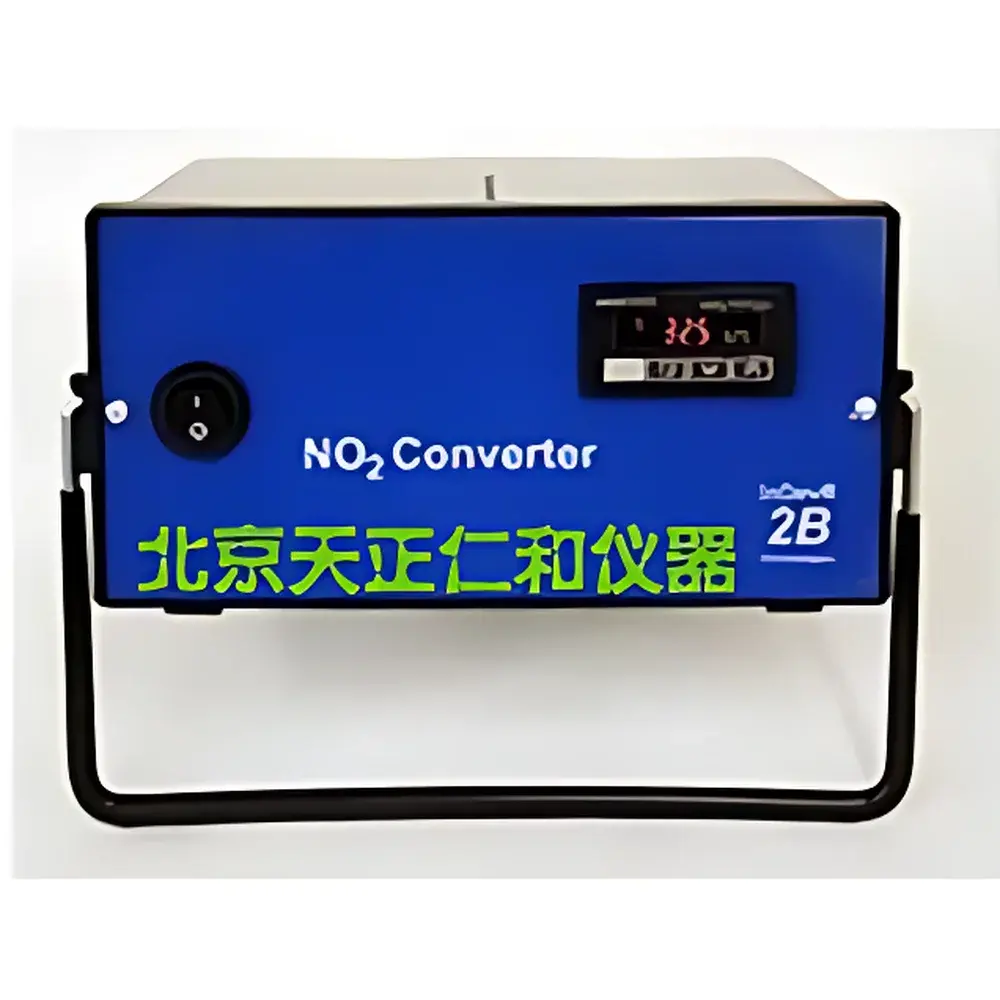
NO2 Converter Model 401
| Origin | USA |
|---|---|
| Manufacturer Type | Authorized Distributor |
| Origin Category | Imported |
| Model | 401 |
| Pricing | Available Upon Request |
| Conversion Principle | Molybdenum Oxide (MoO₃) at 325 °C |
| Dimensions (H×W×D) | 10 cm × 19 cm × 24 cm |
| Weight | 2.2 kg |
| Power Supply | 110 V or 220 V AC, 90 W (max), 45 W (steady-state) |
| Sample Flow Rate | 1.0 L/min |
| NO/NOₓ Measurement Mode Options | Continuous NO, Continuous NOₓ, or Cyclic Switching (5 min, 15 min, or 60 min intervals) |
| Zero Frequency Options | Disabled, Continuous, or Periodic (30 min, 1 h, 4 h) |
Overview
The Model 401 NO₂ Converter is a precision-engineered thermal catalytic converter designed for integration into ambient air quality monitoring systems that employ chemiluminescence detection (CLD) for nitrogen oxides (NOₓ) quantification. It operates on the well-established principle of catalytic reduction: gaseous NO₂ is quantitatively converted to NO via high-temperature reaction with molybdenum oxide (MoO₃) at a tightly controlled 325 °C. This conversion enables accurate, trace-level measurement of NO₂ concentration by indirect detection—where the CLD analyzer measures total NO after conversion and subtracts the native NO signal (measured in bypass mode) to yield NO₂ = (NOₓ − NO). The device is fully compatible with standard EPA Reference Method 7E and EN 14792-compliant NOₓ analyzers and supports regulatory-grade data acquisition for ambient air networks, stack emissions monitoring, and research-grade atmospheric chemistry studies.
Key Features
- High-fidelity MoO₃ catalyst bed maintained at 325 °C with ±1 °C thermal stability, ensuring >98% NO₂-to-NO conversion efficiency across the operational flow range (1.0 L/min).
- Integrated NO zero-monitoring capability via internal sample line shunt, enabling automated baseline verification without external zero gas cylinders.
- Flexible operational modes configurable via front-panel menu or remote RS-232/RS-485 interface: continuous NO measurement, continuous NOₓ (i.e., post-conversion) measurement, or time-scheduled alternation between NO and NOₓ channels.
- User-definable switching intervals for NO/NOₓ cycling: factory presets include 5, 15, and 60 minutes; custom intervals supported via firmware configuration.
- Configurable zero-check frequency: options include disabled, continuous (during idle cycles), or periodic execution at 30-minute, 1-hour, or 4-hour intervals—fully compliant with EPA QA/QC requirements for automated zero drift correction.
- Compact, rack-mountable housing (10 × 19 × 24 cm) constructed from anodized aluminum with EMI-shielded electronics, suitable for both field-deployed telemetry enclosures and laboratory benchtop installations.
- Low-power thermal management architecture: peak draw ≤90 W during startup; steady-state power consumption reduced to 45 W after thermal stabilization, minimizing heat load in temperature-sensitive monitoring shelters.
Sample Compatibility & Compliance
The Model 401 is validated for use with ambient air, urban background samples, and diluted stack effluents containing NO₂ concentrations from 0.1 ppb to 10 ppm. Its design conforms to ISO 7205 (air quality — performance characteristics of instruments for measuring gaseous pollutants), and its operational protocol aligns with U.S. EPA 40 CFR Part 53 Appendix A3 (performance requirements for NO₂ analyzers) and EU Directive 2008/50/EC Annex III (measurement methods for NO₂). All internal wetted surfaces are passivated stainless steel or borosilicate glass to prevent adsorption artifacts and ensure long-term calibration stability. The unit meets IEC 61326-1:2013 for electromagnetic compatibility and IEC 61000-6-2/6-3 for industrial immunity and emission profiles.
Software & Data Management
Local operation is managed through a 4-button membrane keypad and dual-line LCD display, providing real-time status of heater temperature, flow rate, and active measurement mode. For networked deployments, the converter supports ASCII-based serial communication (RS-232/RS-485, 9600 baud, N-8-1) with standardized command-response syntax for remote mode control, heater setpoint adjustment, and diagnostic readout (e.g., thermocouple voltage, fan RPM, error flags). Logged events—including mode transitions, zero cycles, and heater fault states—are timestamped and stored in non-volatile memory for audit-ready traceability. When integrated into a full-stack monitoring platform, the Model 401 complies with FDA 21 CFR Part 11 requirements for electronic records when paired with validated data acquisition software supporting user authentication, audit trails, and electronic signatures.
Applications
- Ambient air quality monitoring networks (AQN) operated by national environmental agencies and municipal authorities.
- Reference-grade calibration laboratories performing intercomparison studies per ISO/IEC 17025.
- Mobile monitoring platforms (e.g., van-mounted or UAV-deployed systems) requiring low mass, low power, and vibration-resistant construction.
- Indoor air quality (IAQ) assessment in traffic-adjacent buildings and underground parking facilities.
- Field validation of optical NO₂ sensors (e.g., DOAS, cavity-enhanced absorption) using CLD as a transfer standard.
- Long-term trend analysis in climate research stations where NO₂/NOₓ speciation informs ozone formation potential modeling.
FAQ
What catalyst material is used, and why is 325 °C specified?
The Model 401 employs a sintered molybdenum oxide (MoO₃) catalyst bed. This material provides optimal NO₂ conversion kinetics and minimal side reactions (e.g., NH₃ interference or NO decomposition) at precisely 325 °C—a temperature empirically validated to balance conversion efficiency (>98%), catalyst longevity (>2 years under continuous operation), and thermal stability against ambient fluctuations.
Can the Model 401 be used with ozone-based NO analyzers?
No. The Model 401 is designed exclusively for integration with chemiluminescence detectors (CLD) that rely on the NO + O₃ reaction. It is not compatible with photolytic or electrochemical NO detection schemes.
Is external zero gas required for calibration?
No. The built-in NO zero monitor uses a catalytic scrubber to remove NO from the sample stream, eliminating dependence on bottled zero air or synthetic zero gas—reducing consumables and improving field autonomy.
Does the unit support Modbus or Ethernet communication?
Standard communication is RS-232/RS-485 ASCII. Optional OEM firmware modules support Modbus RTU over RS-485; native Ethernet (TCP/IP) requires integration via an external protocol gateway compliant with IEC 61850 or MQTT v3.1.1.
What maintenance is required?
Annual inspection of the catalyst bed integrity and thermocouple calibration is recommended. No routine consumables are required; the MoO₃ catalyst does not require replacement under normal ambient air sampling conditions.
Related Products







