
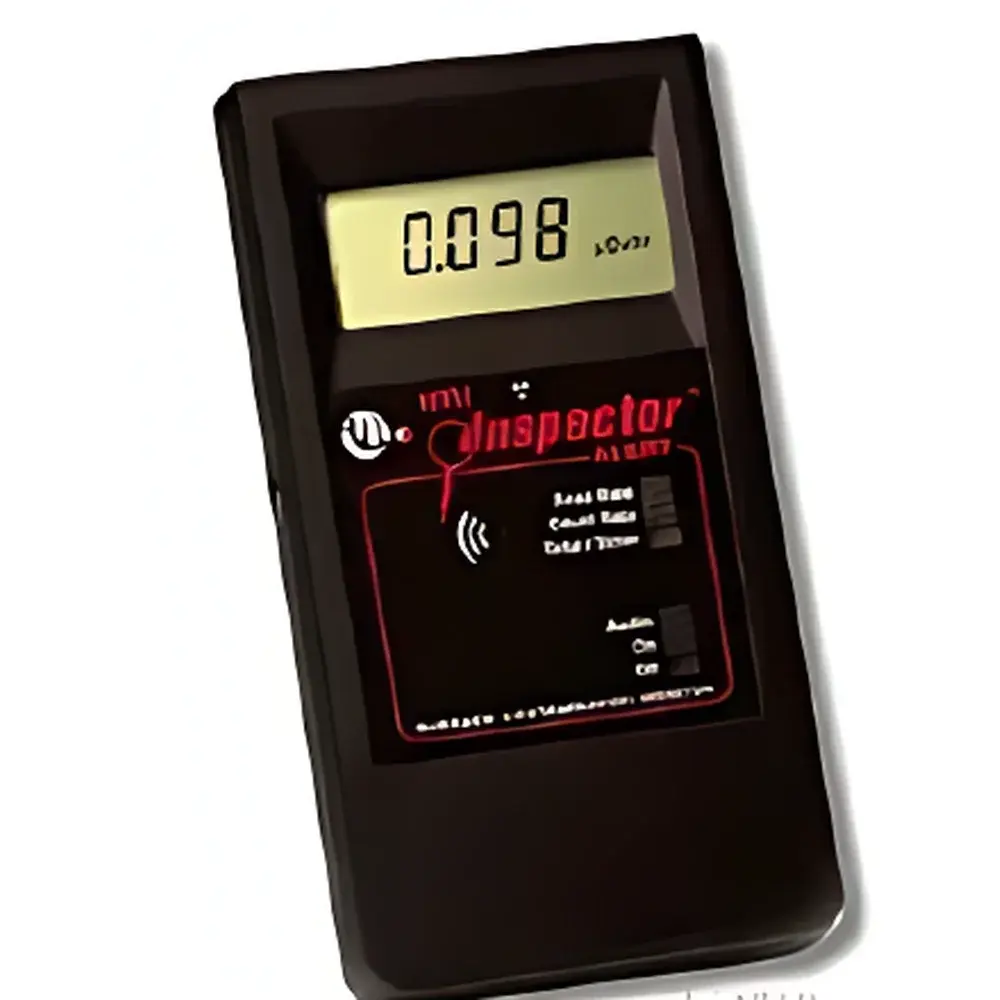
MEDCOM Inspector Alert™ V2 Geiger-Müller Radiation Survey Meter
| Origin | USA |
|---|---|
| Manufacturer Type | Authorized Distributor |
| Origin Category | Imported |
| Model | Inspector Alert™ V2 |
| Detection Principle | Halogen-quenched Geiger-Müller tube with mica window (1.75" diameter, 1.5–2.0 mg/cm² density) |
| Radiation Types Detected | Alpha, Beta, Gamma, and X-ray |
| Dose Rate Range | 0.01–1100 µSv/hr |
| Exposure Rate Range | 0.001–110 mR/hr |
| Count Rate | 0–350,000 CPM / 0–5,000 CPS |
| Total Count Capacity | 1–9,999,000 counts |
| Alarm Thresholds | Adjustable for µSv/hr (0–500), mR/hr (0–50), CPM (0–160,000) |
| Display | 4-digit LCD with mode indicators |
| Update Interval | 3-second rolling average (adaptive to radiation level) |
| Power | Single AA alkaline battery (≥3500 hr at background) |
| Dimensions | 150 × 80 × 30 mm |
| Weight | 323 g (incl. battery) |
| Operating Temperature | –20 °C to +50 °C |
| Certifications | CE (EN 55011:1998+A2, EN 61326:2006, EN 61000-4-2:1995, EN 61000-4-3:1997), RoHS, WEEE, ISO 9001:2001, ISO 14001 |
Overview
The MEDCOM Inspector Alert™ V2 is a portable, high-sensitivity Geiger-Müller (GM) radiation survey meter engineered for reliable detection and quantitative assessment of alpha, beta, gamma, and X-ray radiation in field and laboratory environments. At its core lies a halogen-quenched GM tube featuring a large-area (1.75-inch / 45 mm diameter), ultra-thin mica end-window (1.5–2.0 mg/cm² density), optimized for efficient detection of low-penetrating alpha and beta particles—particularly critical in environmental monitoring, nuclear facility perimeter checks, radiological emergency response, and educational applications. Unlike scintillation or semiconductor-based detectors, the GM principle provides robust, cost-effective, and inherently stable counting performance across wide dynamic ranges without requiring temperature stabilization or high-voltage tuning. The instrument operates on fundamental ionization physics: incident radiation ionizes gas within the tube, triggering discrete, measurable electrical pulses proportional to event occurrence—not energy deposition—making it ideal for contamination screening and dose rate estimation where spectral resolution is secondary to rapid, repeatable presence/absence and relative intensity assessment.
Key Features
- Large-area GM detector with mica window enables high-efficiency detection of alpha (e.g., Am-241, 18% efficiency at 5.5 MeV) and medium-energy beta emitters (e.g., Sr-90, 38% efficiency; P-32, 33% efficiency)
- Four simultaneous readout modes: dose rate (µSv/hr, mR/hr), count rate (CPM, CPS), and cumulative total count—with real-time switching via front-panel button
- Programmable timer function supporting user-defined measurement durations from 1 minute to 40 hours, enabling precise integration for low-level environmental sampling
- Adaptive averaging algorithm: display updates every 3 seconds with a default 30-second rolling average; automatically shortens time constant as count rate increases to improve responsiveness during elevated exposure
- Audio alert system with adjustable threshold levels per unit (µSv/hr, mR/hr, CPM); audible click per detected event (muteable) and sustained alarm when preset limits are exceeded
- Anti-saturation design maintains functional output up to 100× nominal full-scale reading—prevents lockup in high-radiation fields and ensures continuity of operation during transient spikes
- Dual analog I/O interface: stereo 3.5 mm output jack (0–9 V, 1 kΩ impedance) for pulse logging to PCs, data loggers, or educational DAQ systems; 2.5 mm mono input jack for external calibration pulse injection (0–3.3 V, >5 µs width, rising-edge triggered)
Sample Compatibility & Compliance
The Inspector Alert™ V2 is designed for direct surface scanning of solid, liquid, and airborne particulate samples—ideal for swipe tests, soil screening, water filter analysis, and air filter media inspection. Its thin mica window permits alpha detection only when the source is in direct contact or within ≤1 cm distance, aligning with standard health physics protocols for alpha contamination surveys (e.g., ANSI N13.12, ISO 7503-1). The instrument meets EU regulatory requirements for electromagnetic compatibility and safety: CE-marked per EN 55011 (Class B emissions), EN 61326 (industrial test equipment immunity), EN 61000-4-2 (ESD), and EN 61000-4-3 (radiated RF immunity). It complies with RoHS Directive 2011/65/EU and WEEE Directive 2012/19/EU. While not a medical device, its performance characteristics support use in GLP-aligned environmental monitoring programs and satisfy baseline instrumentation requirements referenced in ASTM D3084 (standard guide for radioactivity measurements) and IAEA Safety Standards Series No. RS-G-1.7.
Software & Data Management
The included PC interface software (Windows-compatible) enables time-stamped data capture, histogram generation, and export to CSV or Excel formats. Raw pulse output from the 3.5 mm jack is compatible with third-party data acquisition platforms—including LabVIEW, MATLAB, and Arduino-based logging systems—facilitating custom analysis workflows. All firmware operations retain full audit trail capability: timestamped configuration changes, alarm activation events, and battery voltage logs are internally recorded and retrievable via serial command protocol. Though not FDA 21 CFR Part 11-compliant out-of-the-box, the device supports traceable calibration through its dedicated 2.5 mm calibration input port and documented linearity verification procedures per manufacturer’s technical manual—enabling integration into validated QA/QC frameworks under ISO/IEC 17025 or ISO 14001 environmental management systems.
Applications
- Environmental site assessment: post-remediation verification, radon progeny screening in soil/water, and legacy nuclear site surveillance
- First responder radiological reconnaissance: rapid identification of orphan sources, dirty bomb signatures, or lost industrial gauges
- Academic and training labs: hands-on demonstration of radioactive decay statistics, inverse-square law validation, and shielding effectiveness testing
- Health physics support: routine contamination sweeps in nuclear medicine departments, PET cyclotron facilities, and radioisotope production labs
- Regulatory compliance monitoring: periodic checks per NRC Regulatory Guide 4.15 or EPA Method 901.1 for gross alpha/beta activity in drinking water pre-filtration
FAQ
What types of radiation does the Inspector Alert™ V2 detect?
It detects alpha, beta, gamma, and X-ray radiation using a halogen-quenched Geiger-Müller tube with a thin mica end-window. Alpha detection requires direct contact or proximity ≤1 cm due to limited penetration range.
Is the device suitable for measuring radon gas directly?
No—it does not measure radon gas concentration directly. However, it can detect alpha-emitting radon progeny (e.g., Po-218, Po-214) deposited on surfaces or filters, supporting indirect assessment when used with standardized air sampling protocols.
How often should the instrument be calibrated?
Annual calibration is recommended per ISO/IEC 17025 guidelines. Field verification using a check source (e.g., KCl or Cs-137 disk) prior to each use ensures ongoing accuracy and traceability.
Can the Inspector Alert™ V2 be used in extreme temperatures?
It operates reliably from –20 °C to +50 °C. Prolonged exposure below –10 °C may reduce battery performance and LCD response time; operation above +45 °C may affect long-term GM tube stability.
Does the device store historical measurement data internally?
No internal memory is provided for long-term storage. However, real-time pulse output allows continuous external logging via the 3.5 mm audio jack, enabling indefinite archival when paired with a compatible data logger or PC.
Related Products







