
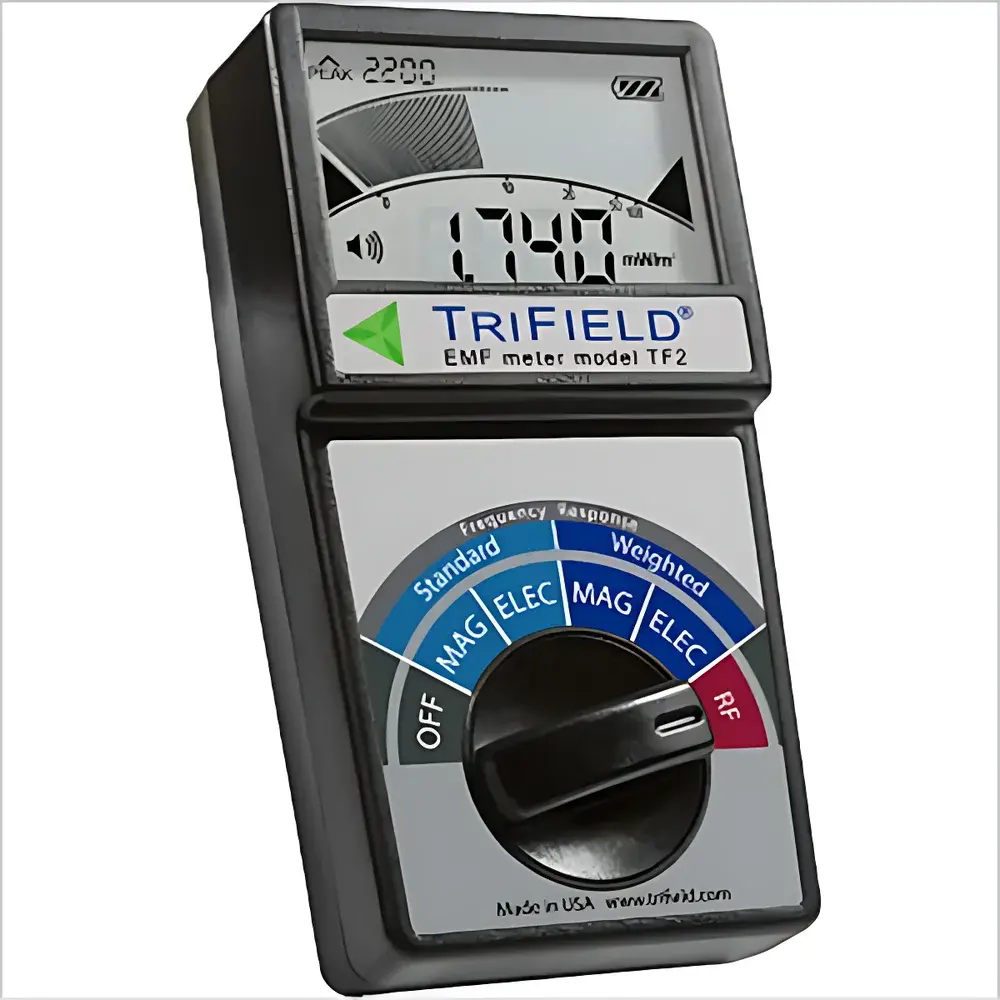
TF2 Digital Tri-Mode Electromagnetic Field Analyzer
| Origin | USA |
|---|---|
| Manufacturer Type | Authorized Distributor |
| Origin Category | Imported |
| Model | TF2 |
| Price Range | USD 700 – 1,400 |
| Frequency Range | 40 Hz to 100 kHz (ELF/VLF) |
| Measurement Accuracy | ±5% of reading (at 50/60 Hz for E-field) |
| Electric Field Range | 1–1000 V/m |
| Magnetic Field Range | 0.1–100.0 mG |
| RF Power Density Range | 0.001–19.999 mW/m² |
| Display Resolution | 0.1 mG / 1 V/m / 0.001 mW/m² |
| Power Supply | 9V alkaline battery (IEC 6LR61), ~12 h with backlight |
| Dimensions | 136 × 75 × 38 mm |
| Weight | ~230 g (incl. battery) |
Overview
The TF2 Digital Tri-Mode Electromagnetic Field Analyzer is a portable, handheld instrument engineered for simultaneous measurement of three distinct electromagnetic field (EMF) components: low-frequency alternating magnetic fields (AC MF), low-frequency alternating electric fields (AC EF), and high-frequency radiofrequency/microwave (RF/MW) power density. It operates on well-established physical principles—induction coil sensing for AC magnetic fields (40 Hz–100 kHz), capacitive coupling for AC electric fields (40 Hz–100 kHz), and broadband diode-based detection for RF/microwave energy (20 MHz–6 GHz). Designed for occupational health assessments, residential EMF surveys, and pre-compliance screening, the TF2 supports both standard (flat-response) and exposure-weighted (frequency-dependent) measurement modes aligned with international human exposure guidelines—including ICNIRP (1998/2010), IEEE C95.6™-2002, and IEEE C95.1™-2005. Its tri-mode architecture eliminates the need for multiple dedicated instruments in field-based environmental monitoring workflows.
Key Features
- Tri-mode detection: Independent, real-time measurement of AC magnetic field (3-axis isotropic sensor), AC electric field (1-axis), and RF/microwave power density (1-axis broadband probe)
- Exposure-weighted mode: Implements frequency-dependent weighting curves per IEEE C95.6 and ICNIRP low-frequency guidelines—sensitivity increases linearly from 60 Hz to 500 Hz to approximate induced current in tissue
- Peak-hold functionality: Captures transient RF bursts (e.g., smart meter pulses, Wi-Fi frames, Bluetooth packets) with 12 ms sampling interval and 3-second peak retention
- Backlit LCD with logarithmic bar graph: Displays instantaneous and peak values as percentage of full-scale range (0%, 10%, 20%, 50%, 100%) for rapid visual assessment
- Audio tone modulation: Adjustable audible feedback synchronized with field intensity—enables hands-free source localization without visual attention
- Compact ergonomic design: IP54-rated housing, 230 g mass, and battery-powered operation support extended field use without external power
Sample Compatibility & Compliance
The TF2 is validated for measurement of EMF emissions from common residential, commercial, and industrial sources—including switch-mode power supplies, HVAC systems, distribution panels, induction cooktops, fluorescent ballasts, Wi-Fi access points (2.4/5 GHz), cellular base stations (700 MHz–3.5 GHz), and smart utility meters (900 MHz, 2.4 GHz). It complies with the functional requirements of IEC 62110:2019 (measurement of electric and magnetic fields from AC power systems) and supports data interpretation in accordance with national and international exposure limits (e.g., ICNIRP 2010, IEEE Std C95.1-2019). While not certified for regulatory compliance testing under ISO/IEC 17025, its traceable calibration protocol (per manufacturer’s internal SOP-EMF-01) ensures reproducibility suitable for screening-level assessments, GLP-aligned workplace evaluations, and epidemiological survey protocols.
Software & Data Management
The TF2 operates as a standalone instrument with no proprietary software dependency. All measurements are displayed and stored locally in non-volatile memory (up to 99 logged sessions). Peak and RMS values, measurement mode, timestamp, and unit selection are retained per session. For documentation traceability, users may manually record readings alongside contextual metadata (location, source type, distance, ambient conditions) in accordance with ISO/IEC 17025 Clause 7.5.2 (recording of observations). The device supports audit-ready reporting when integrated into laboratory information management systems (LIMS) via standardized CSV export from external logging tools (e.g., third-party data loggers with analog output interface). No firmware updates or cloud connectivity are implemented—ensuring data sovereignty and eliminating cybersecurity exposure vectors.
Applications
- Residential EMF audits: Mapping ELF fields near bedroom walls, home offices, and children’s play areas; identifying wiring errors, net currents, or grounding deficiencies
- Workplace safety screening: Evaluating exposure near industrial inverters, welding equipment, MRI ancillary systems, and telecom infrastructure cabinets
- Building biology assessments: Supporting Bau-Biologie evaluation standards (SBM-2015) for sleeping environments and sensitive workspaces
- Product development validation: Pre-testing of consumer electronics (smart speakers, IoT hubs, wireless chargers) for unintentional EMF emissions prior to formal EMC testing
- Educational demonstrations: Visualizing field decay vs. distance, shielding effectiveness of conductive materials, and coupling mechanisms between conductors and fields
- Utility and telecom site surveys: Rapid identification of elevated fields near substation fences, transformer vaults, or rooftop antenna arrays
FAQ
What does “exposure-weighted mode” mean, and how is it calculated?
Exposure-weighted mode applies a frequency-dependent correction factor derived from the induced current model in homogeneous tissue (per IEEE C95.6-2002). At 60 Hz, 1 mG maps to 1.0 unit; at 120 Hz, the same 1 mG reads as 2.0 units—reflecting increased biological coupling efficiency in the 60–500 Hz band.
Can the TF2 distinguish between 2.4 GHz Wi-Fi and 5 GHz Wi-Fi signals?
No. The RF detector is broadband and unselective—it measures total power density across 20 MHz–6 GHz without spectral resolution. It identifies presence and magnitude of RF bursts but cannot identify carrier frequency or modulation scheme.
Is calibration traceable to NIST or other national metrology institutes?
The TF2 is calibrated using reference field generators traceable to NIST-traceable primary standards (via A2LA-accredited calibration lab). Full calibration certificate (including uncertainty budget per ISO/IEC 17025) is available upon request for an additional fee.
Why does RF accuracy specify ±20% at 1 GHz, not across the full band?
Detector response varies with frequency due to antenna factor drift and diode nonlinearity. ±20% reflects worst-case expanded uncertainty (k=2) at 1 GHz—the most commonly encountered RF emission frequency in residential environments. Accuracy degrades toward band edges (20 MHz and 6 GHz) and is not specified beyond ±30%.
Does the TF2 meet FCC Part 15 or CE RED requirements for emissions testing?
No. The TF2 is a measurement tool—not a test receiver. It lacks the selectivity, dynamic range, and CISPR-compliant bandwidths required for regulatory conformance testing. It is intended only for indicative, comparative, or screening-level assessments.
Related Products







