
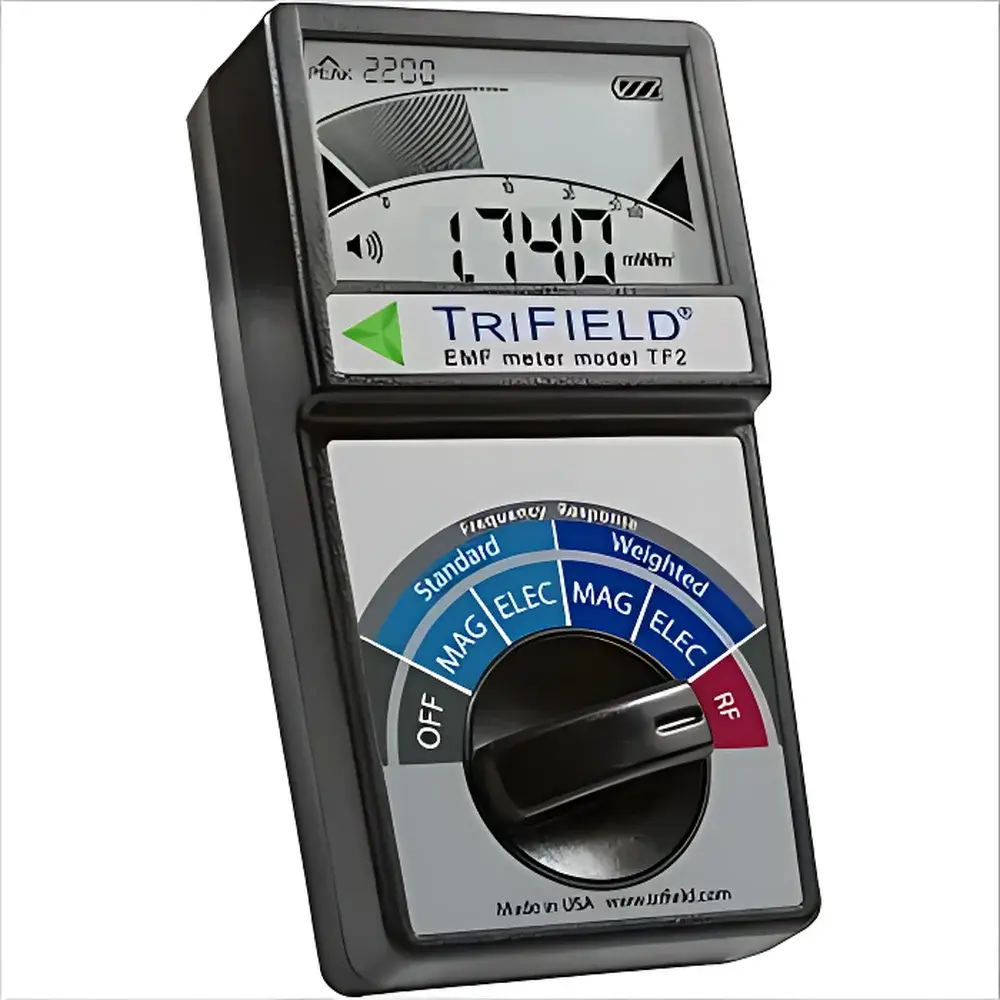
Trifield TF2 Digital Tri-Mode Electromagnetic Field (EMF) Meter
| Origin | USA |
|---|---|
| Manufacturer Type | Authorized Distributor |
| Origin Category | Imported |
| Model | TF2 |
| Price Range | USD 695–1,390 |
| Frequency Range | 40 Hz to 100 kHz (AC Magnetic & Electric Fields), 20 MHz to 6 GHz (RF/Microwave) |
| Measurement Accuracy | ±4% (AC Magnetic Field, 50/60 Hz), ±5% (AC Electric Field, 50/60 Hz), ±20% (RF at 1 GHz) |
| AC Electric Field Range | 1–1000 V/m |
| AC Magnetic Field Range | 0.1–100.0 mG |
| RF Power Density Range | 0.1–1000.0 mW/m² |
| Display Resolution | 0.1 mG / 1 V/m / 0.1 mW/m² |
| Power Supply | 9V Alkaline Battery (IEC 6LR61) |
| Battery Life | ~20 h (backlight off), ~12 h (backlight on) |
| Dimensions | 136 × 75 × 38 mm |
| Weight | 230 g (including battery) |
Overview
The Trifield TF2 Digital Tri-Mode Electromagnetic Field (EMF) Meter is a precision-engineered, handheld instrument designed for quantitative assessment of low-frequency and radiofrequency electromagnetic fields in occupational, residential, and environmental settings. It operates on three distinct physical principles: induction-based detection for AC magnetic fields (40 Hz–100 kHz), capacitive coupling for AC electric fields (40 Hz–100 kHz), and broadband diode-based power density measurement for RF/microwave radiation (20 MHz–6 GHz). Unlike single-parameter survey meters, the TF2 integrates all three modalities into one calibrated platform—enabling simultaneous contextual evaluation of field components that contribute differently to human exposure per international guidelines (ICNIRP, IEEE C95.1/C95.6, GB 8702-2014). Its dual-mode operation—Standard (flat frequency response) and Exposure-Weighted (frequency-dependent weighting aligned with neural stimulation thresholds)—supports both compliance screening and biologically informed risk assessment. The device complies with fundamental metrological requirements for field instrumentation per IEC 61786-1:2013 (Measurement of DC and AC magnetic fields up to 100 kHz) and incorporates traceable calibration protocols referenced to NIST-traceable standards.
Key Features
- Tri-mode detection: Simultaneous AC magnetic field (3-axis isotropic sensor), AC electric field (single-axis high-impedance probe), and RF/microwave power density (broadband antenna + RMS detector)
- Exposure-weighted mode: Implements frequency-dependent weighting curves per ICNIRP 2010 and IEEE C95.6–2002 for low-frequency fields—scaling readings to equivalent 60 Hz current induction in tissue
- Real-time peak hold: Captures transient RF bursts (e.g., smart meter pulses, Wi-Fi frames) with 12 ms sampling interval; retains maximum value for up to 3 seconds
- Logarithmic bar graph display: Visualizes instantaneous field intensity across 0–100% of full scale (0.1, 10, 20, 50, 100%) for rapid spatial mapping
- Backlit LCD with audible tone feedback: Enables precise source localization in low-light environments or behind walls/furniture
- No zero-drift auto-ranging: Fixed-range architecture eliminates switching artifacts during dynamic measurements near transformers or switchgear
- Field-proven ruggedness: IP54-rated enclosure, shock-absorbing rubber overmold, and battery compartment sealed against dust ingress
Sample Compatibility & Compliance
The TF2 is validated for use in heterogeneous electromagnetic environments—including indoor residential spaces, utility substations, telecommunications infrastructure, and industrial control rooms. Its AC magnetic field sensor meets IEC 61786-1 Class 2 accuracy specifications for occupational exposure assessment (±4% at 50/60 Hz). The RF module adheres to CISPR 16-1-1:2019 requirements for broadband field probes operating above 30 MHz. All modes support comparative evaluation against internationally recognized exposure limits, including ICNIRP (2020), IEEE C95.1 (2019), and China’s GB 8702-2014. While not certified for regulatory enforcement under ISO/IEC 17025, the instrument is routinely deployed by EMF consultants, utility safety officers, and building biologists conducting pre-compliance audits, post-installation verification, and long-term ambient monitoring per GLP-aligned documentation practices.
Software & Data Management
The TF2 operates as a standalone field instrument with no proprietary software dependency. All measurements are displayed in real time with immediate visual and auditory feedback—eliminating latency associated with Bluetooth or USB data streaming. Peak-hold values, instantaneous readings, and percentage-of-limit indicators are stored in volatile memory for on-device review only (no internal logging). For auditability, users may manually record timestamped observations using standardized templates aligned with ISO 14644-1 cleanroom documentation frameworks or EPA EMF Survey Guidelines (EPA/600/R-92/018). When integrated into formal health and safety programs, the TF2 supports traceable reporting workflows compliant with FDA 21 CFR Part 11 (electronic records) when paired with validated external logging systems and signed observation logs.
Applications
- Residential EMF surveys: Mapping fields from wiring errors, grounding issues, distribution panels, and proximity to overhead/underground power lines
- Workplace safety assessments: Evaluating exposure near MRI fringe fields, induction heaters, welding equipment, and variable-frequency drives
- Telecom infrastructure auditing: Characterizing RF leakage from cellular base stations, DAS nodes, and small-cell deployments
- Appliance emissions profiling: Quantifying magnetic fields from refrigerators, HVAC compressors, and induction cooktops; RF emissions from smart meters, cordless phones, and IoT gateways
- Building biology evaluations: Supporting mitigation strategies for sleeping areas, home offices, and schools per IBN (Institut für Baubiologie) SBM-2015 criteria
- Educational demonstrations: Visualizing Faraday cage effectiveness, shielding material performance, and distance attenuation laws (1/r², 1/r³)
FAQ
What is the difference between Standard and Exposure-Weighted modes?
Standard mode applies uniform sensitivity across 40 Hz–100 kHz for engineering analysis. Exposure-Weighted mode scales readings per ICNIRP’s induced current model—increasing sensitivity linearly from 60 Hz to 500 Hz to reflect greater biological relevance at lower frequencies.
Can the TF2 measure 5G NR signals?
Yes—the RF detector covers 20 MHz–6 GHz, encompassing sub-6 GHz 5G bands (n41, n77, n78). However, it does not resolve modulation schemes or channel-specific power; it reports total broadband power density.
Why does RF accuracy specify ±20% at 1 GHz?
Broadband diode detectors exhibit inherent nonlinearity and temperature drift. The ±20% tolerance reflects worst-case uncertainty across the 20 MHz–6 GHz band per CISPR 16-1-1 Annex D validation protocols.
Is calibration required before each use?
No—factory calibration is stable for 12 months under normal conditions. Annual recalibration against NIST-traceable field sources is recommended for audit-ready applications.
Does the TF2 comply with FCC OET Bulletin 65?
It is not FCC-certified as an emissions test receiver, but its measurement methodology aligns with OET 65 Section 4.2.3 for RF exposure assessment in uncontrolled environments.
Related Products







