
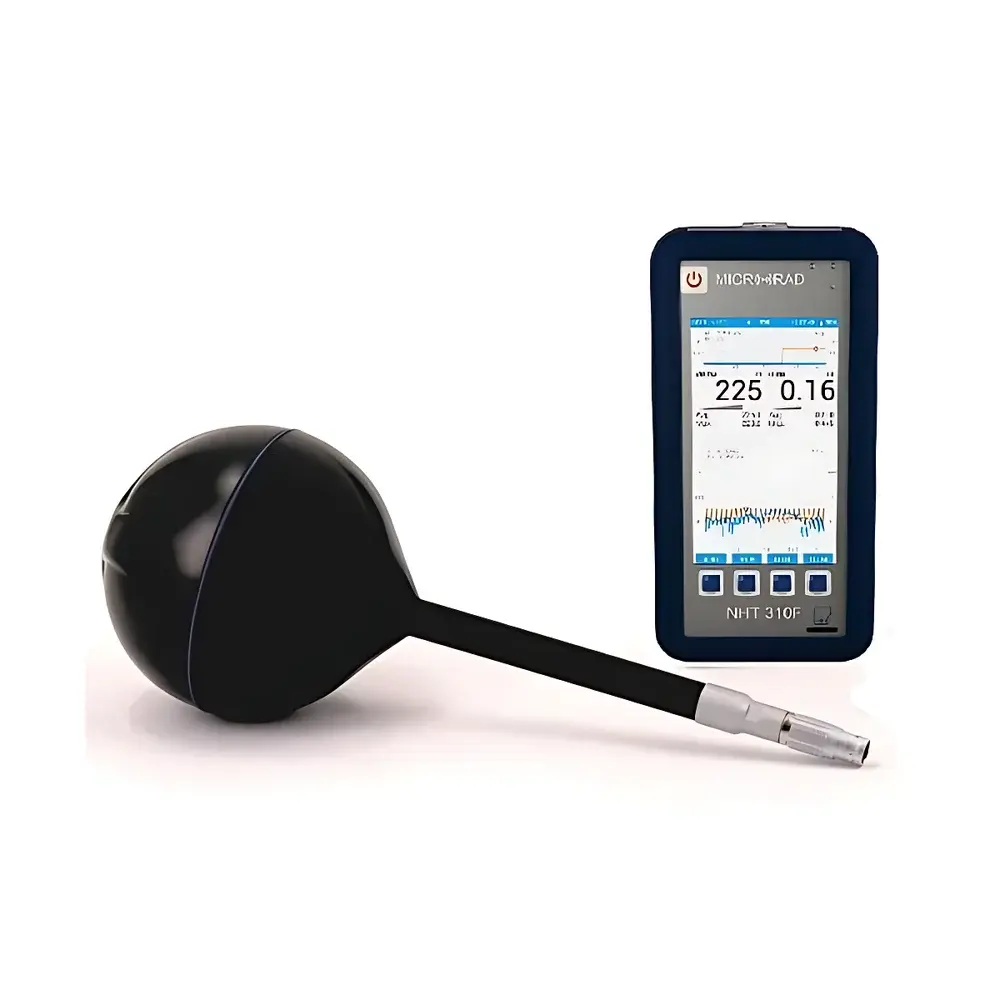
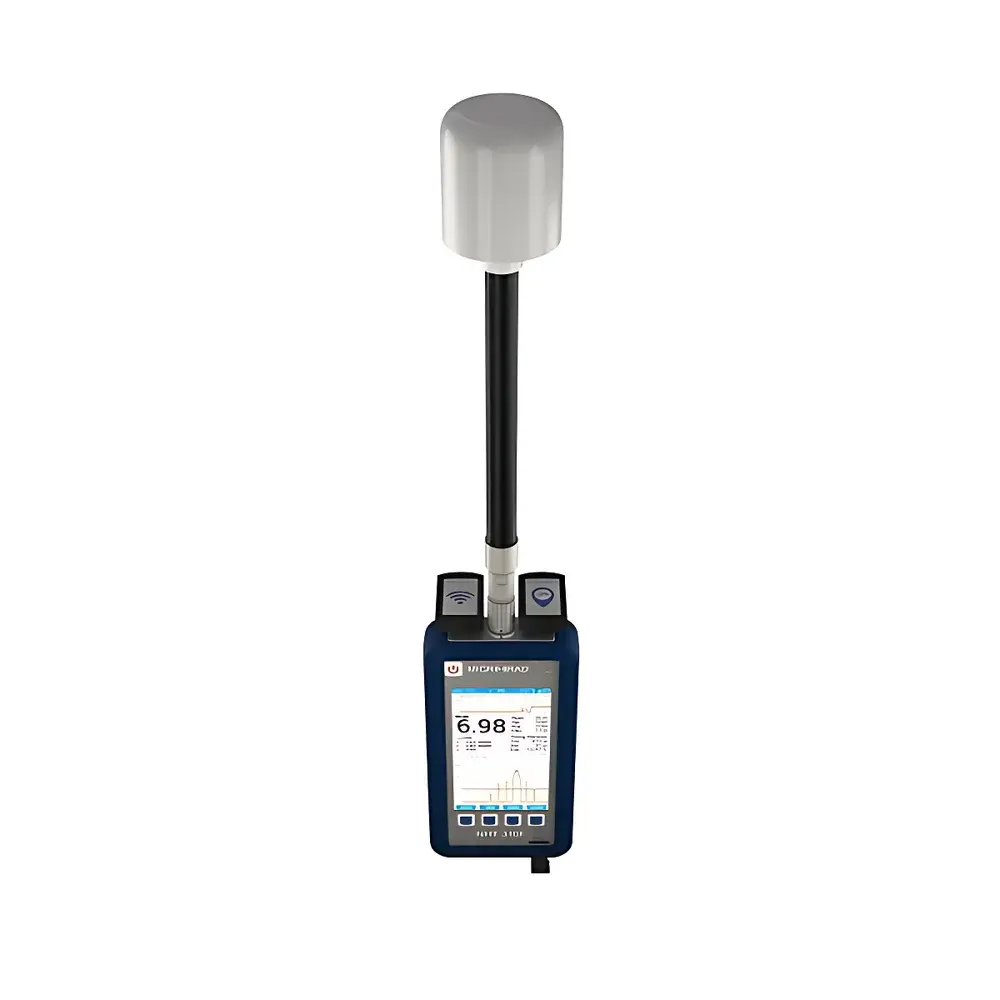
MICRORAD NTH-310F Wideband Electromagnetic Field Analyzer
| Origin | Germany |
|---|---|
| Manufacturer Type | Authorized Distributor |
| Origin Category | Imported |
| Model | NTH-310F |
| Price Range | USD 13,500 – 27,000 (FOB) |
| Frequency Range | 100 kHz – 6.5 GHz |
| Measurement Accuracy | ±3 dB (100 MHz – 3.3 GHz) |
| Electric Field Range | 0.01 – 9999 V/m |
| Magnetic Field Range | 0.0001 – 265.3 A/m |
Overview
The MICRORAD NTH-310F Wideband Electromagnetic Field Analyzer is a precision-engineered, portable broadband measurement system designed for compliance-driven electromagnetic field (EMF) safety assessment across occupational, environmental, and regulatory domains. Built upon the foundational principles of isotropic field sensing and real-time RMS detection, the NTH-310F employs triaxial probe technology to simultaneously capture orthogonal electric (E) and magnetic (H) field components—enabling vector magnitude calculation via root-sum-square (RSS) synthesis. Its architecture supports full-spectrum evaluation from low-frequency power systems (50/60 Hz) through radiofrequency (RF) and microwave bands up to 6.5 GHz, aligning with the stringent exposure limits defined in EU Directive 2013/35/EU, ICNIRP 2010, and national standards including GB 8702-2014 and HJ 681-2013. Unlike legacy single-band meters, the NTH-310F integrates hardware-level pulse analysis with sub-500 ns temporal resolution—critical for characterizing transient emissions from 5G base stations, radar systems, industrial induction heaters, and pulsed RF sources. The instrument’s core functionality is anchored in metrological traceability: each calibrated probe is certified per IEC 61786-1 and EN 50499, with individual calibration certificates issued against accredited reference standards.
Key Features
- Triaxial isotropic probes with automatic plug-and-play recognition and embedded calibration data retrieval
- Real-time, high-resolution display (4.3″ TFT, 272 × 480 pixels, 262k color) with sunlight-readable brightness and touch + physical shortcut key interface
- Multi-mode measurement: instantaneous RMS, time-weighted peak, spatial average, and maximum hold with user-defined averaging intervals (1 s – 24 h)
- Integrated GPS module (optional) for geotagged measurements; synchronized timestamping and coordinate embedding in all stored records
- Dual communication interfaces: standard Micro-USB + optional Wi-Fi or fiber-optic serial link (full-duplex, galvanically isolated) to eliminate measurement artifacts from metallic cabling
- Onboard microSD card slot (up to 16 GB) supporting >2 million data points; configurable auto-save intervals (0.25–60 s) for long-term unattended monitoring
- Built-in environmental sensors (optional): temperature and humidity compensation with automatic metadata tagging
- Rechargeable Li-ion battery enabling >24 hours of continuous operation (backlight off); operating temperature range: −10 °C to +50 °C
- Non-magnetic, ergonomically optimized chassis (170 × 85 × 31 mm; 650 g) compliant with CEI EN 50143 and EN 62233 for EMF exposure assessment
Sample Compatibility & Compliance
The NTH-310F accommodates a modular family of 12+ interchangeable probes—covering DC to 100 GHz—enabling application-specific field characterization without instrument substitution. Probe types include combined E/H sensors (e.g., 33S, 33C), dedicated E-field probes (01E–11E), and low-frequency H-field probes (10B–30H), each validated for use in environments governed by EN 50500 (railway traction systems), EN 62233 (household appliances), and IEC 62110 (power transmission facilities). All measurement units—including V/m, A/m, µT, W/m², mW/cm², and % of exposure limit—are dynamically selectable and auto-scaled per probe specification. Internal weighting algorithms apply ICNIRP 1998/2010, 2013/35/EU, and national exposure thresholds in real time, computing instantaneous compliance ratios for multi-frequency mixed-field scenarios. Data files retain full audit trail metadata: probe ID, calibration date, GPS coordinates, ambient temperature/humidity, measurement mode, and raw X/Y/Z axis values—ensuring full GLP/GMP and ISO/IEC 17025 traceability.
Software & Data Management
MicroLink PC software (included) provides full remote control, visualization, and post-processing capabilities. It emulates the NTH-310F’s display in real time—including oscilloscope-style waveform rendering—and enables live parameter configuration, firmware updates, and spatial averaging calculations. Measurement datasets export to CSV or Excel with embedded metadata (GPS, probe serial number, calibration validity, environmental conditions). Advanced features include Google Maps integration for geospatial heatmapping, time-series trend analysis over customizable windows (1 min–60 min), and export of X/Y/Z axis data to third-party EMC analysis tools per CISPR 16-1-1 requirements. The companion Android/iOS app delivers identical functionality for field-deployed tablets and smartphones—supporting Wi-Fi or fiber-connected operation without physical tethering. All communications adhere to TLS 1.2 encryption where applicable, and software logs maintain immutable audit trails for FDA 21 CFR Part 11–compliant workflows.
Applications
The NTH-310F serves as a primary tool for accredited laboratories conducting EMF surveys in accordance with HJ/T 10.2-1996 and GBZ/T 189.x series standards. Typical use cases include: electromagnetic compatibility (EMC) pre-compliance screening in shielded chambers; occupational exposure assessment near MRI scanners, RF plasma generators, and welding equipment; long-term ambient monitoring around HV substations, wind turbine inverters, and 5G macro/micro-cell sites; verification of shielding effectiveness in medical or research facilities; and regulatory reporting for telecom infrastructure licensing under national spectrum management frameworks. Its pulse-capture capability makes it especially suited for evaluating burst-mode transmitters (e.g., TD-LTE, 5G NR TDD), while its low-frequency sensitivity supports evaluation of stray fields from maglev transport systems and industrial electrolysis cells.
FAQ
Does the NTH-310F support simultaneous E-field and H-field measurement?
Yes—when equipped with dual-axis or triaxial combined probes (e.g., 33S, 33C), the instrument acquires synchronized E and H components and computes power density (S = E × H) in real time.
Is probe calibration traceable to national metrology institutes?
All probes are calibrated at MICRORAD’s ISO/IEC 17025-accredited laboratory against primary standards maintained by PTB (Germany) and NIST (USA); certificates include uncertainty budgets and frequency-dependent correction factors.
Can the device operate inside anechoic or semi-anechoic chambers?
Yes—via optional fiber-optic interface, the NTH-310F eliminates RF coupling through cables, preserving chamber integrity and measurement fidelity during radiated immunity or emission testing.
What is the minimum detectable pulse width and how is duty cycle calculated?
The instrument resolves pulses as narrow as 500 ns and automatically computes pulse repetition frequency (PRF), pulse width, and duty cycle using internal digital signal processing—no external oscilloscope required.
How does the GPS module integrate with measurement data?
Positional metadata (latitude, longitude, altitude, UTC timestamp) is embedded directly into each stored record and visualized geospatially in MicroLink, enabling site-specific exposure mapping and regulatory boundary verification.
Related Products







