
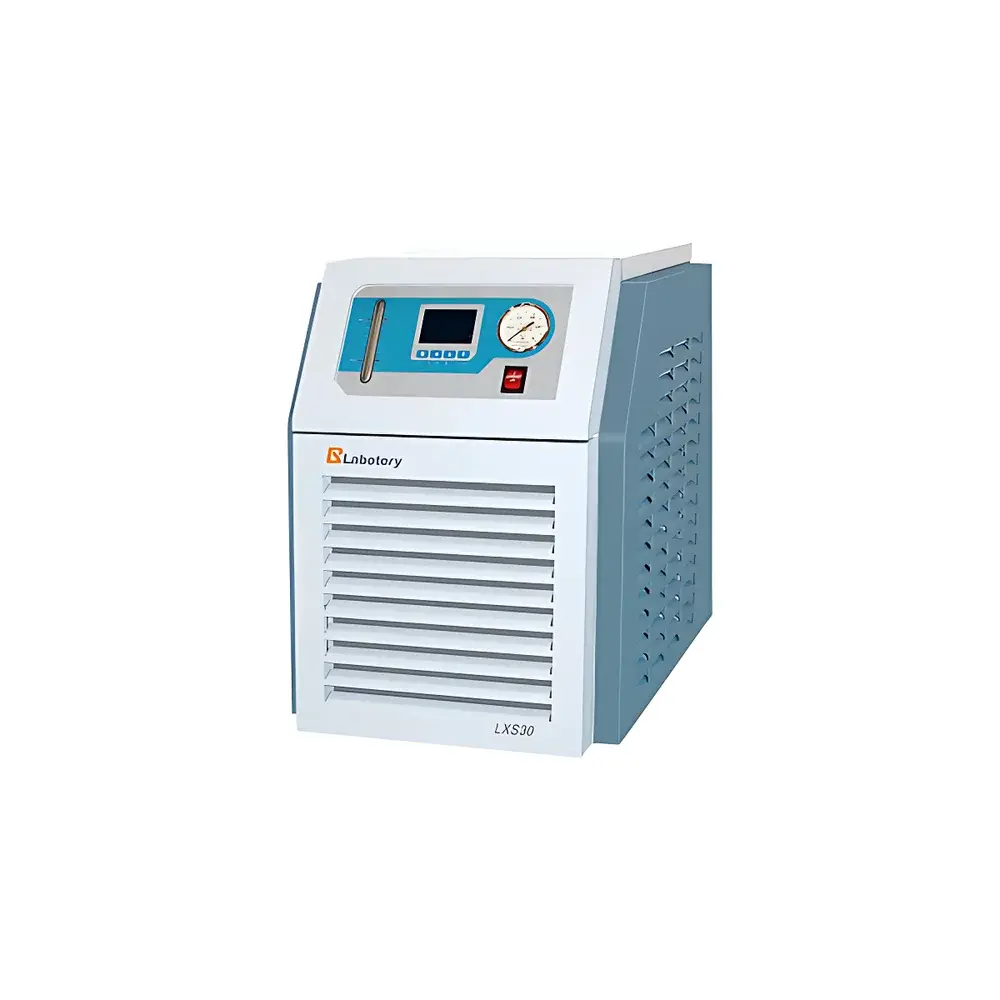
Labotery LX-09A Integrated Circulating Chiller
| Brand | Labotery |
|---|---|
| Origin | Tianjin, China |
| Model | LX-09A |
| Instrument Type | Integrated |
| Cooling Method | Water-cooled |
| Temperature Control Range | 8–35 °C |
| Temperature Stability | ±1.0 °C |
| Refrigeration Capacity | 900 W @ 25 °C |
| Circulation Pump Pressure | 1.5 bar |
| Flow Rate | 4 L/min @ 1.5 bar |
| Reservoir Volume | 9 L |
| Operating Mode | Continuous |
| Refrigerant | R-134a |
| Power Supply | 220 V / 50 Hz |
| Dimensions (W×D×H) | 400 × 590 × 541 mm |
| Temperature Resolution | 0.1 °C |
| Total Power Consumption | 660 W |
Overview
The Labotery LX-09A Integrated Circulating Chiller is an engineered thermal management solution designed for continuous, stable cooling of laboratory instruments requiring precise temperature control. It operates on a vapor-compression refrigeration cycle using environmentally compliant R-134a refrigerant and incorporates Hot Gas Bypass (HGB) modulation—eliminating compressor cycling to deliver smooth, stepless cooling power adjustment. Unlike on/off-based chillers, the HGB system maintains consistent setpoint temperatures with minimal thermal overshoot, making it suitable for sensitive applications such as laser systems, spectrophotometers, rotary evaporators, and analytical instrumentation where thermal drift can compromise measurement integrity. The unit features a sealed, corrosion-resistant stainless-steel reservoir and is optimized for use with deionized or distilled water—preventing scale formation, microbial growth, and flow restriction in downstream equipment.
Key Features
- Hot Gas Bypass (HGB) modulation for continuous, non-cycling refrigeration—ensuring high thermal stability and extended compressor service life.
- PID-controlled microcomputer interface with LCD display; intuitive navigation and 0.1 °C temperature resolution for accurate setpoint programming and real-time monitoring.
- Dual-loop circulation architecture: internal closed-loop cooling for the chiller’s own heat exchanger, and external loop for instrument cooling—enabling independent flow optimization and minimizing cross-contamination risk.
- High-efficiency plate-type heat exchanger with enhanced surface area-to-volume ratio for rapid thermal transfer and reduced pressure drop.
- Integrated safety protections: high/low temperature alarm, low-water-level detection, overpressure bypass valve activation, and automatic shutdown under fault conditions.
- Low-noise operation (<52 dB(A)) achieved via imported silent centrifugal pump and vibration-dampened mounting—suitable for noise-sensitive environments including cleanrooms and shared lab spaces.
- Engineered reservoir design with sediment trap and particulate isolation chamber to protect pump impellers and heat exchanger surfaces from abrasive wear.
- Ergonomic drain port and modular inlet/outlet fittings (G1/4″ BSP) simplify maintenance, fluid replacement, and integration with standard lab tubing (e.g., Tygon®, Viton®).
Sample Compatibility & Compliance
The LX-09A is compatible with a broad range of laboratory equipment requiring stable coolant delivery at moderate thermal loads—including UV-Vis spectrophotometers, ICP-OES plasma sources, electrophoresis power supplies, vacuum pumps, and small-scale reactors. Its 9 L reservoir and 4 L/min flow capacity support single-instrument or multi-port configurations (with optional flow splitters). All wetted materials comply with ISO 8573-1 (compressed air purity classes) and USP Class VI biocompatibility standards for indirect fluid contact. While not certified to UL/CSA or CE for medical device integration, the unit meets IEC 61010-1:2010 safety requirements for laboratory electrical equipment and supports GLP/GMP-aligned operational documentation through its programmable logging interface.
Software & Data Management
The LX-09A includes a built-in data logging function that records temperature setpoints, actual bath temperature, pump status, and alarm events at user-defined intervals (1–60 min). Logged data is stored internally (up to 30 days at 10-min intervals) and exportable via USB flash drive in CSV format for traceability and audit readiness. Optional RS-485 Modbus RTU communication enables integration into centralized lab infrastructure monitoring systems (e.g., LabArchives, DeltaV, or custom SCADA platforms), supporting remote start/stop, parameter readback, and event-triggered notifications. No proprietary software is required; raw logs are compatible with Excel, Python pandas, and LIMS-compatible parsing tools.
Applications
- Cooling of high-power optical components (e.g., solid-state lasers, CCD detectors) where thermal lensing must be minimized.
- Temperature stabilization of analytical columns in HPLC and UHPLC systems to improve retention time reproducibility.
- Heat removal from vacuum pump jackets and condenser coils in rotary evaporation setups.
- Process cooling for small-scale synthesis reactors operating between 8 °C and 35 °C.
- Supporting environmental simulation chambers requiring auxiliary cold-side heat rejection.
- Long-duration cell culture incubator cooling loops where uninterrupted thermal continuity is critical.
FAQ
What type of coolant is recommended for optimal performance?
Deionized or distilled water is strongly recommended. Glycol/water mixtures up to 30% v/v may be used if sub-zero ambient operation is required—but reduce heat transfer efficiency by ~12% and necessitate recalibration of flow sensors.
Can the LX-09A be integrated into a building’s central chilled water supply?
Yes—the unit accepts external chilled water input (5–25 °C) via its secondary water-cooled condenser circuit, enabling hybrid operation and reducing electrical load in facilities with existing HVAC infrastructure.
Is the temperature stability specification (±1.0 °C) guaranteed across the full 8–35 °C range?
Yes, under standard test conditions (ambient 20 °C, 50% RH, no external heat load). Stability may degrade by ≤0.3 °C at extremes of the range (e.g., 8 °C under full 900 W load) due to reduced refrigerant saturation pressure.
Does the unit support 21 CFR Part 11-compliant electronic records?
Not natively—however, exported CSV logs meet ALCOA+ principles when archived with time-stamped metadata and controlled access protocols. Full Part 11 compliance requires third-party validation of the USB export workflow.
What maintenance schedule is recommended for long-term reliability?
Inspect reservoir cleanliness and replace coolant every 6 months; verify pump seal integrity and clean sediment trap quarterly; perform annual calibration verification using NIST-traceable thermistor probes.



