
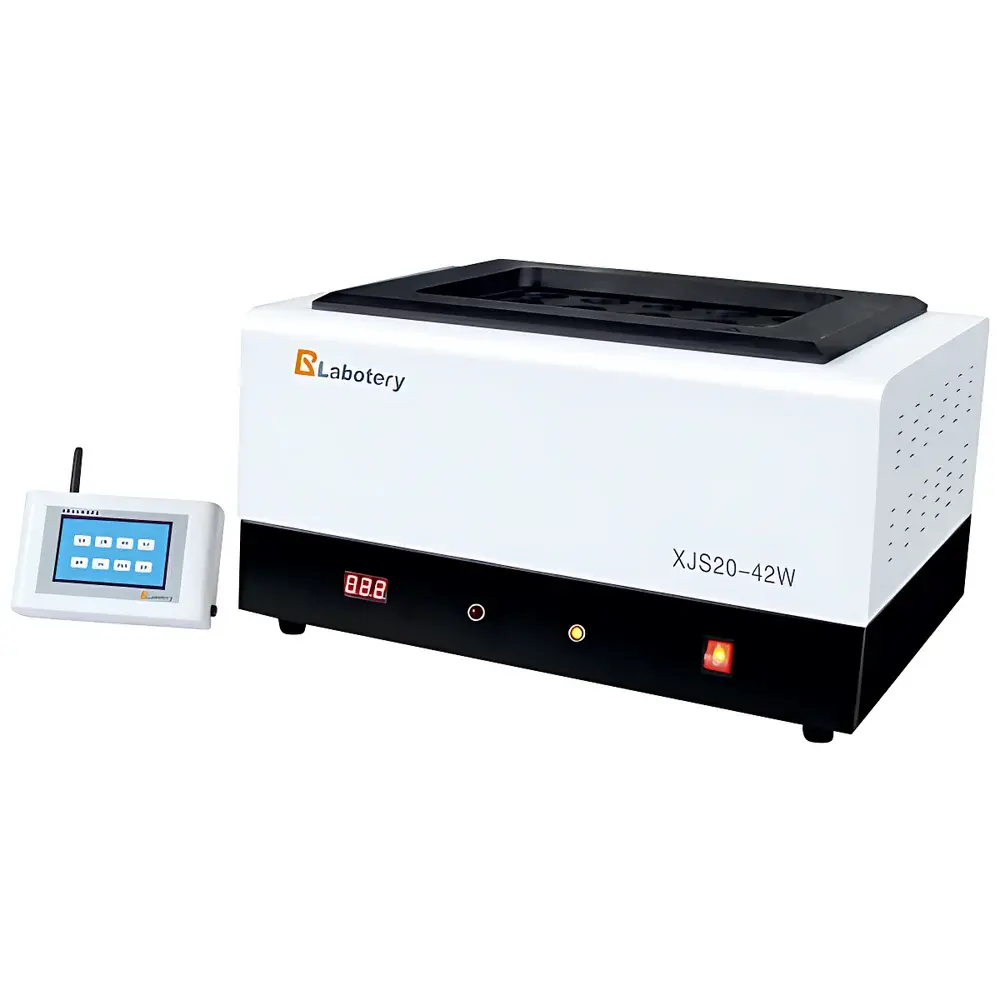
Labotery XJT16-20W Wireless Smart COD Digestion System
| Brand | Labotery |
|---|---|
| Origin | Tianjin, China |
| Model | XJT16-20W |
| Digestion Method | Rapid Digestion |
| Heating Module | Dual Graphite Heating Blocks |
| Batch Capacity | 16 × 100 mL |
| Temperature Range | 0–220 °C |
| Temperature Accuracy | ±0.2 °C |
| Timer Accuracy | ±0 s |
| Sample Well Diameter × Depth | Φ44 × 50 mm |
| Heating Block Dimensions (L×W×H) | 355 × 301 × 240 mm |
| Power Supply | 220 V / 50 Hz |
| Heating Material | High-Purity Graphite with PTFE Coating |
| Max. Power Consumption | 1500 W |
| Temperature Resolution | 0.1 °C |
| Inter-Well Uniformity | ±1.5 °C |
| Single-Well Temp. Stability | ±0.5 °C |
| Continuous Operation Duration | >48 h |
Overview
The Labotery XJT16-20W Wireless Smart COD Digestion System is a precision-engineered, benchtop rapid digestion instrument designed for compliant chemical oxygen demand (COD) analysis in environmental water quality laboratories. It operates on the principle of closed-vessel, open-reflux, high-temperature acid digestion—fully aligned with standard methods including ISO 6060, APHA 5220D, and HJ 828–2017 (China’s national standard for COD determination). Unlike conventional hotplate or block digesters, the XJT16-20W integrates dual high-purity graphite heating blocks with PTFE corrosion-resistant coating, enabling uniform thermal distribution across all 16 digestion positions while minimizing reagent evaporation and cross-contamination. Its constant-temperature ramping architecture ensures reproducible oxidation of organic matter under controlled sulfuric acid–potassium dichromate conditions, directly supporting accurate back-titration or spectrophotometric quantification downstream.
Key Features
- Dual independent graphite heating blocks with integrated PTFE anti-corrosion coating—resistant to concentrated H2SO4, HNO3, and HF up to 220 °C
- Wireless palm-top PC control via secure 2.4 GHz RF communication—enabling full parameter adjustment and real-time monitoring from outside fume hoods, eliminating operator exposure to corrosive vapors
- 4.3-inch true-color capacitive touchscreen controller with embedded 7 preloaded digestion protocols and 40-segment programmable ramp/hold profiles
- Dual-sensor temperature feedback system: simultaneous measurement of heating block surface and sample liquid temperature (sensor-rated to 210 °C), configurable for either mode
- Zero-timer drift design with hardware-based quartz oscillator timing circuitry—guaranteeing ±0 second cumulative error over multi-hour runs
- Integrated reflux venting geometry that reduces reagent consumption by ~50% compared to standard open-reflux setups, without compromising digestion completeness
- “One-vessel workflow” capability: digestion, acid removal (赶酸), and final volume adjustment (定容) performed sequentially within the same digestion tube—reducing transfer errors and contamination risk
- Auto-shutdown with dual-stage overtemperature protection: audible/visual alarm at 225 °C followed by immediate power cutoff at 230 °C
Sample Compatibility & Compliance
The XJT16-20W accommodates standard 100 mL borosilicate glass digestion tubes (Φ44 × 50 mm) and is validated for use with domestic and international COD test kits (e.g., Hach LCK, Merck Spectroquant, and local equivalents). All wetted surfaces meet USP Class VI and ISO 10993 biocompatibility requirements for laboratory-grade chemical contact. The system supports GLP-compliant operation through traceable method storage, user-access logging (via optional USB export), and audit-ready parameter records—including start time, target temperature profile, actual measured temperatures per well, and end-of-cycle confirmation. While not FDA 21 CFR Part 11 certified out-of-box, its firmware architecture permits integration with third-party LIMS platforms supporting electronic signature and data integrity controls.
Software & Data Management
The embedded controller stores up to 7 method templates with full 40-step programmability—each defining ramp rate (°C/min), hold duration (min), and target temperature—with independent setpoints per segment. Real-time graphical display shows both programmed and actual temperature curves for each heating zone. All run logs—including timestamps, deviations from setpoint, and alarm events—are retained in non-volatile memory and exportable via USB 2.0 as CSV files. No proprietary software installation is required; exported datasets are compatible with Excel, JMP, and Python-based QA/QC pipelines. Firmware updates are delivered via encrypted USB stick with SHA-256 checksum verification.
Applications
This system is routinely deployed in municipal wastewater treatment plants, environmental monitoring stations, third-party testing labs (CMA/CNAS-accredited), and university research facilities conducting routine COD, total phosphorus (TP), and total nitrogen (TN) digestion per standardized wet-chemical oxidation protocols. Its thermal stability and inter-well uniformity make it suitable for method validation studies requiring ≤±3% RSD in duplicate digestions. The wireless interface also enables deployment in mobile labs or field-deployable containerized units where physical access to instrumentation is constrained.
FAQ
Is the XJT16-20W compatible with EPA Method 410.4?
Yes—the instrument meets the thermal performance criteria (150 °C minimum, ±2 °C accuracy, 2-hour hold) specified for open-reflux digestion in EPA 410.4 when operated using the built-in “EPA-COD” protocol.
Can I use Teflon-lined digestion tubes instead of glass?
No—only borosilicate glass tubes meeting DIN 12777 specifications are recommended. PTFE-lined tubes may deform above 180 °C and compromise reflux efficiency.
Does the system support remote monitoring via Ethernet or Wi-Fi?
No—wireless operation is limited to the included handheld RF controller. Network connectivity is not implemented to maintain electromagnetic compatibility in analytical lab environments.
What maintenance is required for long-term accuracy?
Annual calibration of the dual RTD sensors against NIST-traceable dry-block calibrators is recommended. Graphite block surfaces should be wiped with ethanol after each batch; no lubrication or coating renewal is needed.
Is the 48-hour continuous operation rating validated under load?
Yes—tested per IEC 61000-4-30 with 16 × 100 mL tubes containing 5 mL H2SO4/K2Cr2O7 reagent at 165 °C, ambient 22 °C/50% RH.







