Labotery ZQPZ-228G Precision Combined Illuminated Orbital Shaker Incubator
| Brand | Labotery |
|---|---|
| Origin | Tianjin, China |
| Model | ZQPZ-228G |
| Timer Range | 0–999 h 59 min |
| Oscillation Frequency | 10–300 rpm |
| Frequency Accuracy | ±1 rpm |
| Orbit Diameter | Ø26 mm |
| Temperature Range (Dark) | 4–65 °C |
| Temperature Range (Illuminated) | 10–65 °C |
| Temperature Resolution | 0.1 °C |
| Temperature Uniformity | ±0.5 °C at 37 °C |
| Control Method | PID Microcomputer |
| Illuminance | 0–16,000 lx (standard), optional 0–30,000 lx |
| Shelf Dimensions | 850 × 530 mm |
| Single-Shelf Capacity | 100 mL × 95, 250 mL × 56, 500 mL × 38, 1000 mL × 22, or 2000 mL × 12 |
| Standard Configured Capacity per Shelf | 100 mL × 45, 250 mL × 28, 500 mL × 28, 1000 mL × 14, or 2000 mL × 9 |
| Power Consumption (per Shelf) | 1.5 kW |
| Input Voltage | AC 220 V ±10%, 50–60 Hz |
| External Dimensions (per Shelf) | 1368 × 900 × 600 mm |
| Net Weight (per Shelf) | 220 kg |
| Display | 7-inch 16-bit true-color touchscreen |
| Data Storage | 1-year history retention |
| USB Export | Supported for data backup and printing |
| Environmental Monitoring | External ambient temperature probe included |
| Safety Features | Door-activated motor stop, over-temperature audiovisual alarm with auto-shutdown, self-diagnostic fault detection, waterproof motor, triple liquid containment system, UV sterilization lamp, LED full-spectrum illumination with multi-level intensity control |
Overview
The Labotery ZQPZ-228G Precision Combined Illuminated Orbital Shaker Incubator integrates two critical laboratory functions—temperature-controlled orbital shaking and programmable spectral illumination—into a single, space-efficient platform. Engineered for reproducible microbial, cell, and plant tissue culture under dynamically controlled environmental conditions, it operates on the principle of orbital agitation (Ø26 mm) combined with P.I.D.-regulated thermal management and calibrated photometric output. Unlike conventional shaker incubators limited to dark-phase operation, the ZQPZ-228G enables synchronized light/dark cycling, photoautotrophic growth studies, circadian rhythm assays, and photobioreactor pre-screening—all within a single chamber. Its modular stackable architecture supports up to three independently controlled layers, each with discrete temperature, speed, illumination, and timing parameters, thereby accommodating heterogeneous experimental protocols without cross-contamination or thermal crosstalk.
Key Features
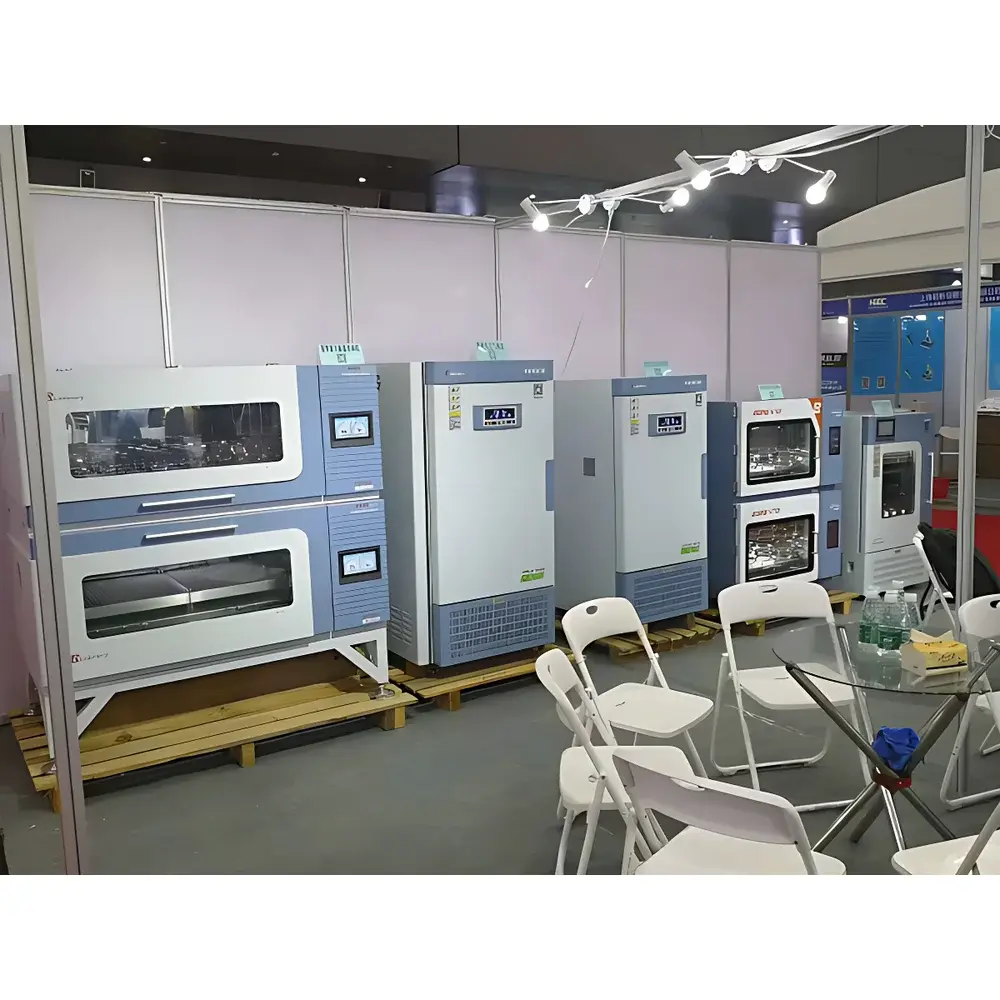
- Triple-layer modular design with independent microprocessor control per shelf—enabling concurrent experiments under divergent thermal, kinetic, and photic conditions.
- Full-spectrum white LED illumination system (0–16,000 lx standard; 0–30,000 lx optional), calibrated for photosynthetic photon flux density (PPFD) consistency across the visible range (400–700 nm); dimmable in discrete steps with real-time lux monitoring.
- Three-tier liquid containment architecture: (1) stainless steel inner chamber with integrated splash guard baffle; (2) IP67-rated sealed servo motor; (3) bottom-mounted drainage port with corrosion-resistant brass fitting—validated per IEC 60529 for incidental spill resilience.
- High-fidelity motion control via brushless servo motor delivering ±1 rpm accuracy across 10–300 rpm range; zero-maintenance operation with <0.5% speed drift over 10,000-hour service life.
- 7-inch 16-bit true-color touchscreen interface with encrypted user access levels; supports both fixed-parameter (constant mode) and multi-step program mode (up to 20 segments) with ramp/soak logic.
- Comprehensive environmental monitoring: internal chamber temperature, ambient room temperature (via external NTC probe), real-time illuminance, and motor status—all logged with timestamped metadata.
- Regulatory-ready data integrity features: audit-trail-enabled event logging, USB-exportable CSV/IMG files (data tables or annotated trend plots), automatic power-loss recovery with non-volatile memory retention.
Sample Compatibility & Compliance
The ZQPZ-228G accommodates standard microbiological and bioprocess vessels—including Erlenmeyer flasks (100–2000 mL), baffled shake flasks, and custom bioreactor sleeves—secured on a rigid 850 × 530 mm aluminum alloy platform with universal clamping geometry. Its temperature uniformity of ±0.5 °C at 37 °C meets ISO 29183:2021 requirements for incubator performance validation. Illumination calibration is traceable to NIST-certified photometric standards. The unit complies with IEC 61010-1 (Safety Requirements for Electrical Equipment for Measurement, Control, and Laboratory Use) and EMC Directive 2014/30/EU. Optional configurations support GLP/GMP-aligned workflows, including 21 CFR Part 11-compliant electronic signatures (via firmware update), UV-C germicidal irradiation (254 nm, 30-min cycle), and door-interlocked motion inhibition.
Software & Data Management
Embedded firmware provides native data visualization: real-time overlay of temperature, speed, illuminance, and elapsed time on a unified graph; historical curve replay with zoom/pan functionality; exportable PNG screenshots and CSV datasets via USB 2.0 port. All operational events—including parameter changes, alarm triggers, door openings, and power interruptions—are timestamped and stored in a tamper-evident log file. Data retention spans ≥12 months under continuous operation. For networked environments, optional Wi-Fi module enables remote monitoring through Labotery’s secure cloud portal (TLS 1.3 encrypted), supporting role-based access control and automated daily report generation. Firmware updates are delivered via signed OTA packages to ensure cryptographic integrity.
Applications
- Photoheterotrophic cultivation of cyanobacteria and microalgae under controlled light/dark cycles.
- Plant callus induction and suspension culture requiring simultaneous agitation and PAR-regulated illumination.
- Recombinant protein expression in E. coli BL21(DE3) strains where optical density-driven induction benefits from real-time turbidity correlation with illumination intensity.
- Environmental simulation studies—e.g., UV-B stress response in Arabidopsis thaliana seedlings—with programmable spectral weighting and dose accumulation tracking.
- QC/QA stability testing of light-sensitive biologics (e.g., monoclonal antibodies, viral vectors) per ICH Q5C guidelines.
- High-throughput screening of photosynthetic efficiency in mutant libraries using integrated lux-based growth kinetics.
FAQ
Does the ZQPZ-228G support multi-layer synchronization or independent layer control?
Each shelf operates under fully independent PID control—temperature, speed, illumination, and timer settings can be configured separately without inter-layer coupling.
What is the maximum flask size supported per shelf, and how is load balancing ensured?
Maximum capacity is 2000 mL × 12 flasks per shelf; dynamic imbalance compensation is achieved via inertial mass tuning and adaptive torque modulation during acceleration/deceleration phases.
Is the illumination spectrum tunable beyond intensity adjustment?
Standard configuration delivers broad-spectrum white light optimized for photosynthesis; narrowband spectral customization (e.g., red/blue ratio control) requires OEM firmware revision and is available under contract engineering engagement.
How is temperature uniformity validated across the working volume?
Uniformity is verified per ISO 29183 Annex B using nine calibrated PT100 sensors placed at standardized locations (center, corners, mid-height) during steady-state operation at 25 °C, 37 °C, and 55 °C.
Can the unit be integrated into a LIMS or ELN ecosystem?
Yes—via Modbus TCP or RESTful API (optional add-on license), enabling bidirectional data exchange with major laboratory informatics platforms including LabVantage, Benchling, and Thermo Fisher SampleManager.