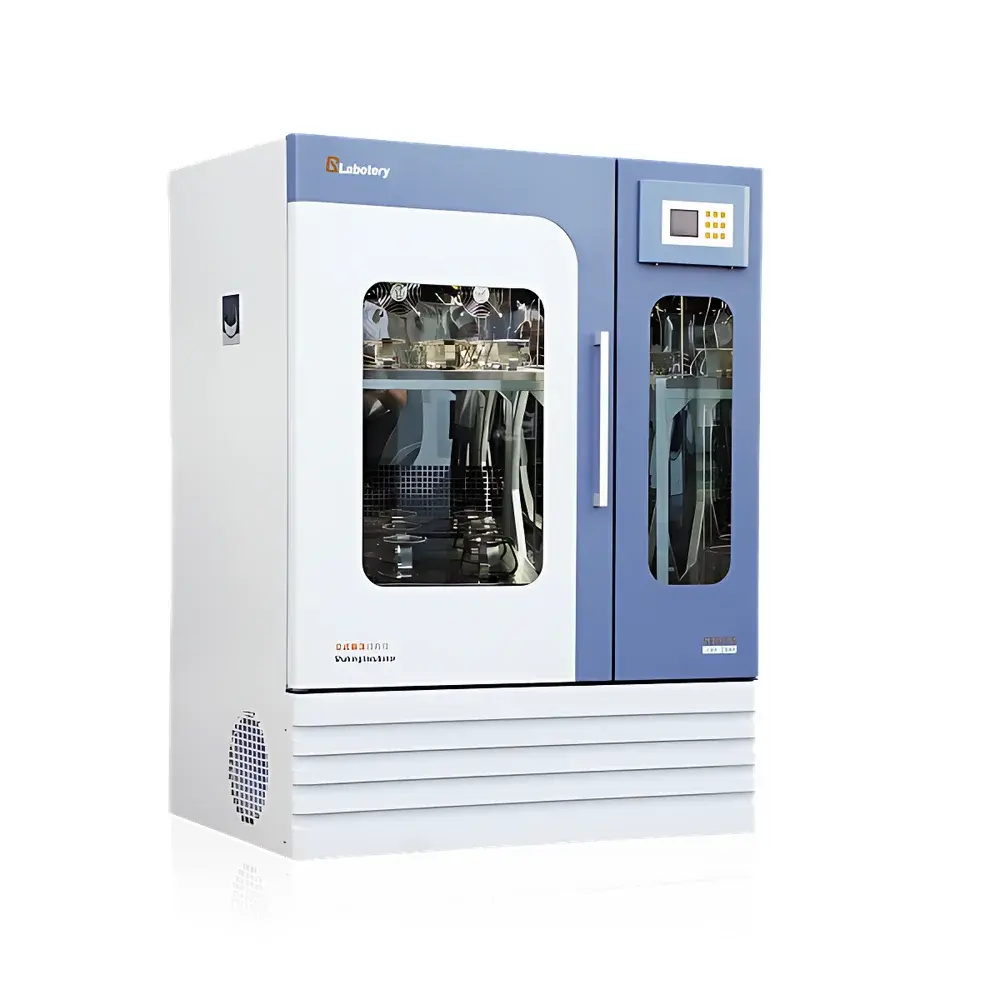
Labotery ZHPL-500 Large-Capacity Orbital Shaking Incubator
| Brand | Labotery |
|---|---|
| Origin | Tianjin, China |
| Model | ZHPL-500 |
| Instrument Type | Water-Jacketed Constant-Temperature Orbital Shaker |
| Timer Range | 0–9999 min (or hr) |
| Oscillation Frequency | 10–300 rpm |
| Frequency Accuracy | ±1 rpm |
| Orbit Diameter | Ø26 mm |
| Temperature Range | Ambient +5°C to 65°C |
| Temperature Uniformity | ±0.5°C (at 37°C) |
| Temperature Fluctuation | ±0.3°C (at 37°C) |
| Temperature Resolution | 0.1°C |
| Control Method | PID Microcomputer Control |
| Shelf Dimensions/Quantity | 830 × 508 mm / 2 shelves |
| Power Consumption | 1.8 kW |
| Input Voltage | AC 220 V ±10%, 50–60 Hz |
| External Dimensions (W×D×H) | 1080 × 850 × 1440 mm |
| Net Weight | 280 kg |
| Compliance | Designed for GLP-compliant laboratories |
Overview
The Labotery ZHPL-500 Large-Capacity Orbital Shaking Incubator is an engineered platform for scalable, temperature-controlled suspension culture of microbial, mammalian, and insect cell lines under continuous orbital agitation. It operates on the principle of horizontal orbital motion—generating gentle yet uniform shear forces ideal for aerobic bioprocessing in flasks, tubes, and deep-well plates. Unlike reciprocating or rotary shakers, this system employs a balanced multi-dimensional drive mechanism to minimize vibration transmission and ensure long-term mechanical stability. Its dual-shelf architecture supports up to 2,000 mL vessels across two independently accessible planes, enabling parallel cultivation experiments or staged growth protocols without cross-contamination risk. The unit integrates water-jacketed thermal management with forced-air convection via centrifugal circulation ducts, achieving rapid equilibration and exceptional spatial temperature homogeneity (±0.5°C at 37°C), critical for reproducible fermentation kinetics and metabolic profiling.
Key Features
- Dual stainless-steel working shelves (830 × 508 mm each), constructed from electropolished 304-grade mirror-finish panels for corrosion resistance and cleanability.
- Double-layer tempered glass door with argon-filled insulating gap, offering real-time visual monitoring while minimizing thermal loss and condensation.
- Integrated UV germicidal lamp (254 nm) and LED illumination system for sterile observation and routine chamber decontamination between runs.
- High-efficiency, non-CFC refrigeration compressor with adaptive thermal load compensation—prevents auto-shutdown due to overheating during extended low-temperature operation (down to ambient +5°C).
- Brushless DC motor drive with closed-loop speed feedback, delivering precise rotational control (10–300 rpm, ±1 rpm accuracy) and >50,000-hour service life without carbon brush replacement.
- Programmable logic controller supporting bidirectional rotation, door-safety interlock (instant stop upon opening), and power-failure memory retention for uninterrupted protocol execution.
- Two control interface options: standard LCD display with tactile keypad or optional 4.3-inch resistive touchscreen running embedded firmware with multi-step program scheduling (up to 5 programs × 30 segments each, max segment duration: 999 h 59 min).
Sample Compatibility & Compliance
The ZHPL-500 accommodates diverse vessel configurations per shelf: up to 18 × 1000 mL Erlenmeyer flasks, 37 × 500 mL bottles, or 45 × 250 mL containers—configured using factory-installed universal clamping fixtures. Optional custom fixture kits support microtiter plates, serum bottles, and single-use bioreactors. All internal surfaces comply with ISO 14644-1 Class 7 cleanroom material standards. The system meets IEC 61010-1 safety requirements for laboratory equipment and supports validation documentation packages aligned with ASTM E2500 and EU Annex 11 for computerized system qualification. When operated with the optional Ethernet-enabled Labotery Control Suite v3.x, full electronic records—including timestamps, setpoints, deviations, and operator IDs—are generated with tamper-evident digital signatures, satisfying FDA 21 CFR Part 11 and EU GMP Annex 11 traceability mandates.
Software & Data Management
The optional Labotery Control Suite provides remote supervision via secure HTTPS web interface or native Windows client. It archives time-stamped temperature, speed, and alarm logs with configurable retention (default: 12 months). Real-time trend curves can be overlaid across multiple units for comparative analysis. Data export supports CSV, PDF report generation, and direct printing via integrated thermal printer (optional accessory). Role-based access control enforces SOP adherence: administrators configure parameters, technicians execute protocols, and QA reviewers audit logs—all with immutable audit trails. All firmware updates are digitally signed and verified prior to installation to prevent unauthorized modification.
Applications
- High-yield recombinant protein expression in E. coli and yeast cultures.
- Seed train expansion for CHO and HEK293 suspension processes.
- Oxygen-sensitive anaerobic enrichment using gas-permeable membranes and side-port gas mixing.
- Environmental microbiology studies requiring simultaneous incubation at varied temperatures and agitation rates.
- Pharmaceutical stability testing per ICH Q1A(R2) guidelines under controlled humidity-free conditions.
- Enzyme kinetics assays where consistent shear rate and thermal history directly influence catalytic turnover.
FAQ
What is the maximum flask volume supported per shelf?
Each shelf accommodates up to eighteen 2000 mL Erlenmeyer flasks or twelve 1000 mL vessels using standard clamps.
Does the unit support CO₂-enriched atmospheres?
No built-in CO₂ regulation; however, compatible gas-tight enclosures with external gas blending modules are available as validated accessories.
Is calibration certificate included with shipment?
NIST-traceable temperature and speed calibration reports are provided upon request at additional cost; field verification tools (PT100 probe, optical tachometer) are supported.
Can the system operate unattended for 72+ hours?
Yes—equipped with redundant thermal cutoffs, voltage surge protection, and non-volatile memory to resume operation after grid interruption.
What maintenance intervals are recommended?
Compressor oil inspection every 24 months; drive belt tension check annually; UV lamp replacement every 8,000 hours of use.