
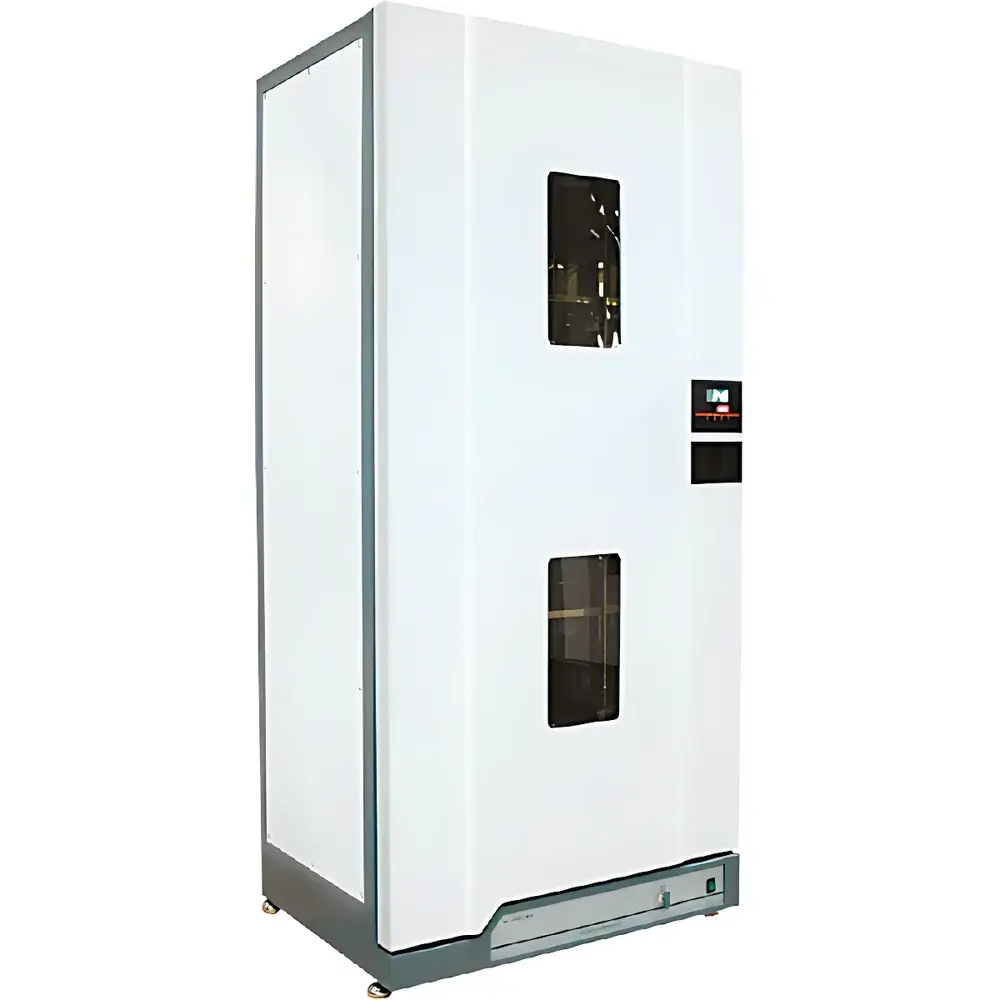
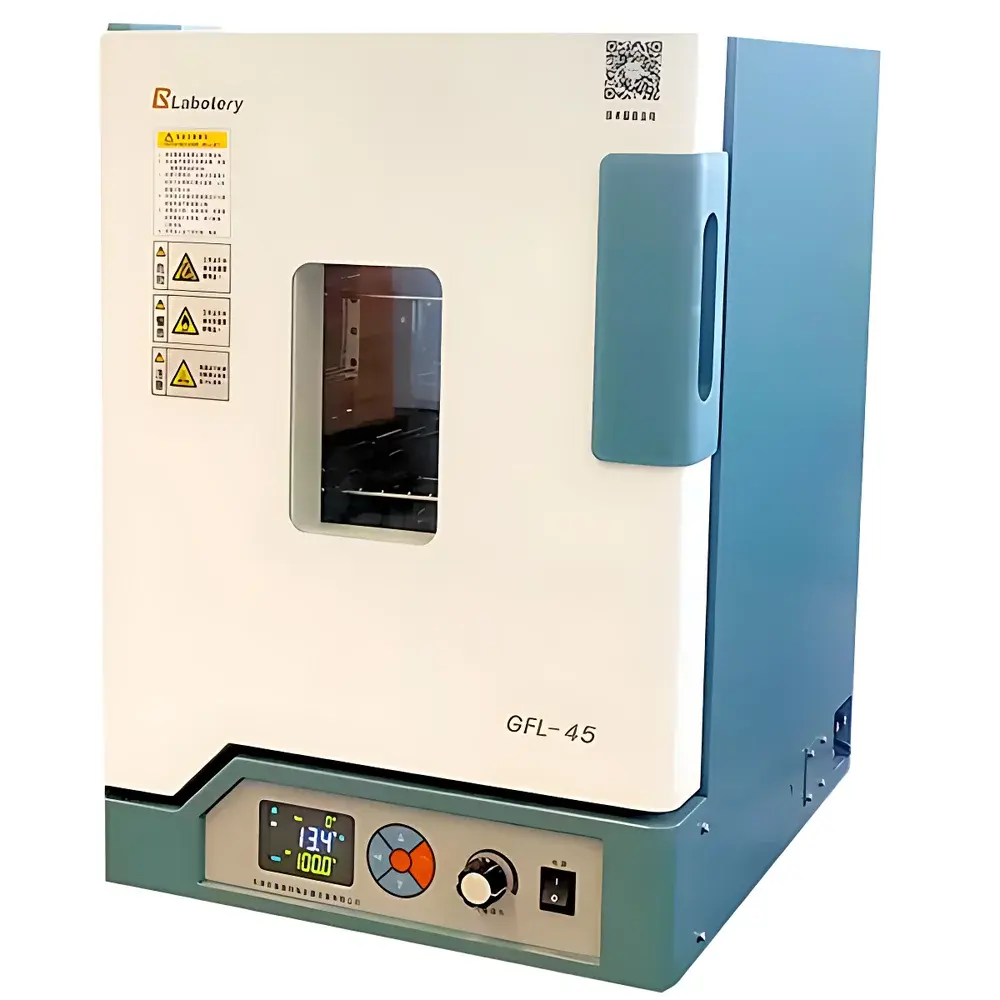
Labotery GFL-230 Precision Forced-Air Drying Oven
| Brand | Labotery |
|---|---|
| Origin | Tianjin, China |
| Model | GFL-230 |
| Instrument Type | Precision Drying Oven |
| Temperature Range | RT+5°C to 300°C |
| Temperature Uniformity | ±1°C |
| External Dimensions | 480 × 525 × 695 mm |
| Internal Chamber Dimensions | 350 × 300 × 400 mm |
| Chamber Material | Mirror-Finish Stainless Steel (AISI 304) |
| Heating Method | Horizontal Forced-Air Circulation with Adjustable Airflow |
| Control System | PID Microprocessor Controller with LCD Display |
| Temperature Resolution | 0.1°C |
| Timer Range | 1–9999 minutes |
| Power Supply | 220 V / 50 Hz |
| Heating Power | 3 kW |
| Net Weight | 36 kg |
| Load Capacity | 2 adjustable stainless steel shelves, 15 kg per shelf |
Overview
The Labotery GFL-230 Precision Forced-Air Drying Oven is an engineered solution for controlled thermal processing in research laboratories, quality control environments, and industrial R&D settings. Based on the principle of horizontal forced-air convection, the oven ensures uniform heat distribution across the entire working chamber—critical for reproducible drying, baking, sterilization, curing, and thermal stabilization of samples. Unlike natural-convection ovens, the GFL-230 employs a rear-mounted blower system that directs heated air horizontally across the chamber, minimizing thermal stratification and enabling consistent temperature profiles even under variable load conditions. Its operational range from ambient +5°C to 300°C supports both low-temperature moisture removal and high-temperature material conditioning, making it suitable for applications spanning polymer crosslinking, pharmaceutical excipient drying, electronic component pre-baking, and residual solvent evaporation in analytical sample preparation.
Key Features
- Horizontal airflow design with rear-mounted centrifugal fan and infinitely adjustable air velocity control—enabling precise tuning of convective heat transfer for sensitive or heterogeneous samples.
- Mirror-finish AISI 304 stainless steel interior chamber with fully rounded corners and seamless welds—designed for ease of cleaning, corrosion resistance, and compliance with ISO 14644 cleanroom-compatible maintenance protocols.
- Two removable, load-rated stainless steel wire shelves (15 kg capacity each), fabricated from solid 4 mm-diameter rods—providing mechanical stability during high-mass thermal cycling.
- Dual-pane tempered glass observation window with argon-filled interlayer—offering real-time visual monitoring while maintaining thermal integrity and reducing surface condensation.
- PID microprocessor-based temperature controller with 0.1°C resolution, programmable ramp/soak profiles, and automatic power-on/off scheduling—supporting unattended operation over extended cycles.
- Integrated safety architecture including over-temperature cut-off (independent of main controller on GFL-230 and larger models), audible/visual alarm, and door-mounted magnetic safety interlock.
- Front-panel color LCD interface displaying setpoint, actual temperature, elapsed time, and remaining timer—all simultaneously visible without menu navigation.
Sample Compatibility & Compliance
The GFL-230 accommodates a broad spectrum of sample types—including glassware, metal parts, ceramic substrates, polymer films, filter papers, biological tissue carriers, and coated wafers—without risk of oxidation or contamination, thanks to its inert stainless steel chamber and absence of catalytic heating elements. It meets fundamental requirements for GLP-compliant thermal validation workflows when paired with external calibrated thermocouples and documented calibration certificates. While not certified to IEC 61000-4 electromagnetic immunity standards out-of-the-box, its robust EMI-filtered power supply and grounded chassis ensure stable performance in shared laboratory infrastructure. For regulated environments, optional RS485 serial communication enables integration into centralized LIMS or SCADA systems supporting FDA 21 CFR Part 11 audit trail requirements when used with compliant software layers.
Software & Data Management
The GFL-230 operates via embedded firmware with no proprietary software dependency. Optional RS485 connectivity allows bidirectional ASCII command interfacing with third-party lab automation platforms (e.g., LabVIEW, Python-based PySerial scripts, or commercial ELN systems). Real-time temperature logging is achievable using external data loggers connected to the analog output port (0–5 V DC proportional to chamber temperature). An optional thermal printer module provides hard-copy records traceable to individual runs—valuable for SOP-driven processes in ISO 9001-certified manufacturing labs. Firmware supports parameter memory retention across power cycles and includes factory-reset functionality for configuration recovery.
Applications
- Drying of moisture-sensitive reagents and hygroscopic standards prior to gravimetric analysis (ASTM E121–22).
- Pre-conditioning of test specimens for tensile, adhesion, or dielectric testing per ASTM D618 and ISO 291.
- Baking of printed circuit boards (PCBs) to remove entrapped humidity before conformal coating (IPC-CC-830B).
- Thermal sterilization of non-critical lab tools at 160°C for 2 hours (USP dry-heat sterilization guidance).
- Curing of epoxy, silicone, and acrylic adhesives under controlled ramp-hold profiles.
- Stabilization of reference materials and calibration weights in metrology labs per ISO/IEC 17025 clause 7.6.3.
FAQ
What is the recommended calibration frequency for the GFL-230?
Annual calibration against NIST-traceable reference thermometers is advised for ISO/IEC 17025 compliance; quarterly verification using Class A PT100 probes is recommended for high-throughput QC labs.
Can the GFL-230 be used for inert-atmosphere processing?
No—it lacks gas inlet/outlet ports or pressure-sealing capability; for nitrogen-purged operations, consider the Labotery GFL-N series with optional purge kit.
Is the airflow direction configurable?
Airflow is fixed horizontally from rear to front; vertical or top-down configurations are available only in the GFL-V and GFL-T variants.
Does the oven support multi-stage temperature programming?
Yes—the standard controller supports up to 8 segments; full 30-segment programmability requires the optional multi-step upgrade firmware.
How is thermal uniformity validated in this model?
Per IEC 60068-3-5, uniformity is verified at nine points (center + eight corners) in empty chamber at 100°C, 150°C, and 250°C; typical deviation is ≤±0.8°C at mid-range setpoints.



