
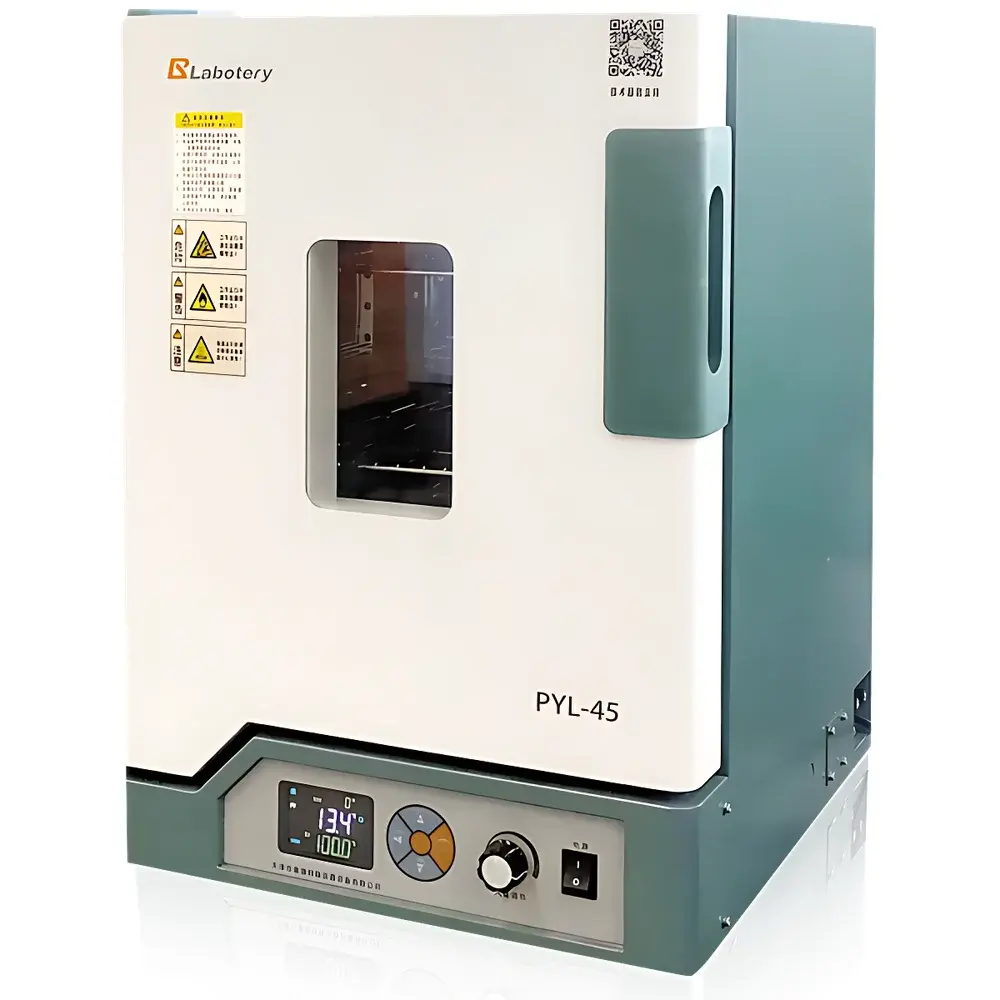
Labotery HWL Series Precision Drying Oven
| Brand | Labotery |
|---|---|
| Model | HWL-45 / HWL-70 / HWL-125 |
| Temperature Range | RT+5°C to 300°C |
| Temperature Uniformity | ±1°C |
| Interior Dimensions (W×D×H) | 420×400×400 mm (HWL-70) |
| Interior Material | Mirror-Finish Stainless Steel |
| Heating Method | Forced-Air Circulation |
| Display | Color LCD with PID Control, Timer (1–9999 min), Temp. Correction, Auto Start/Stop |
| Power Supply | 220 V / 50 Hz |
| Heating Power | 1.0 kW (HWL-45), 1.5 kW (HWL-70), 2.0 kW (HWL-125) |
| Net Weight | 47 kg (HWL-70) |
Overview
The Labotery HWL Series Precision Drying Oven is a benchtop forced-air convection oven engineered for reproducible thermal processing in regulated laboratory and quality control environments. Operating on the principle of uniform hot-air circulation—achieved via an internal axial fan and strategically positioned heating elements—the HWL series ensures consistent temperature distribution across the entire working chamber. This architecture minimizes thermal gradients and supports applications requiring strict adherence to time–temperature profiles, including moisture removal, polymer curing, pre-weighing sample conditioning, pharmaceutical stability testing (per ICH Q1A–Q1E guidelines), and residual solvent evaporation prior to GC or HPLC analysis. Designed for compliance-critical workflows, the HWL series meets fundamental mechanical and electrical safety requirements aligned with IEC 61010-1 and incorporates structural features that support GLP/GMP documentation practices.
Key Features
- Forced-air convection system with rear-mounted centrifugal blower and adjustable airflow baffle—ensures ±1°C temperature uniformity (measured at 5 points per IEC 60068-3-5) across the stainless-steel chamber.
- Mirror-finish 304 stainless-steel interior with seamless, radius-rounded corners—facilitates cleaning validation and prevents particulate accumulation; compliant with ISO 14644-1 Class 8 cleanroom-compatible maintenance protocols.
- Removable, load-rated stainless-steel wire shelves (15 kg capacity per shelf); shelf positions adjustable without tools to accommodate varied sample geometries and batch sizes.
- Dual-pane, low-emissivity observation window with silicone-sealed frame—provides real-time visual monitoring while minimizing heat loss and maintaining insulation integrity.
- Microprocessor-based PID temperature controller with 0.1°C resolution, programmable ramp-soak profiles (optional multi-segment timer), and built-in over-temperature cut-off (independent hardware limiter standard on HWL-125).
- Color LCD interface supporting simultaneous display of setpoint, real-time chamber temperature, elapsed time, and remaining timer duration; includes password-protected parameter lockout for SOP-controlled operation.
- Eco-insulated chamber walls (high-density mineral wool, λ ≤ 0.038 W/m·K) and energy-efficient heating circuitry—reduces standby power consumption by up to 22% versus conventional resistive ovens.
Sample Compatibility & Compliance
The HWL series accommodates standard laboratory vessels—including glass Petri dishes, aluminum weighing pans, ceramic crucibles, and polypropylene trays—without risk of warping or outgassing under sustained operation below 250°C. Chamber geometry supports ISO/IEC 17025-accredited calibration using NIST-traceable PT100 probes placed at defined spatial coordinates (center + four corners). Optional RS485 serial interface enables integration into LIMS or SCADA systems for electronic recordkeeping compliant with FDA 21 CFR Part 11 (when paired with validated third-party software). All models are CE-marked and conform to EN 61000-6-3 (EMC emission) and EN 61000-6-2 (immunity) standards.
Software & Data Management
While the base unit operates via embedded firmware, optional communication modules enable bidirectional data exchange. The RS485 port supports Modbus RTU protocol for remote setpoint adjustment, real-time temperature logging, and alarm status polling. When connected to Labotery’s OEM PC software (sold separately), users may generate audit-trail-enabled reports—including timestamped temperature logs, operator ID stamps, and deviation alerts—with configurable PDF export and digital signature capability. Printer output (via optional thermal unit) produces hard-copy records meeting ISO 17025 clause 7.8 documentation requirements.
Applications
- Moisture content determination per ASTM D2298 and ISO 712 for food, feed, and agricultural commodities.
- Thermal stabilization of reference standards prior to gravimetric analysis (e.g., USP ).
- Curing of epoxy-coated substrates and printed circuit board laminates under controlled ramp rates.
- Pre-drying of filter papers and sintered glass crucibles in environmental testing labs (EPA Method 1664).
- Accelerated aging studies of packaging materials per ASTM F1980.
- Residual solvent removal from API intermediates prior to crystallization (ICH Q5C).
FAQ
What is the recommended calibration frequency for the HWL oven in a GLP environment?
Annual calibration against a NIST-traceable reference thermometer is standard; however, user-defined interval checks (e.g., daily chamber uniformity verification at 105°C) are advised per ISO/IEC 17025 clause 7.7.
Can the HWL oven be used for sterilization applications?
No—it lacks validated biological indicator monitoring, chamber pressurization, and steam-generation capability required for sterilization (per ISO 17665); it is rated solely for dry-heat decontamination and thermal processing.
Is the temperature sensor replaceable by the end user?
Yes—the PT100 sensor is field-serviceable via rear-panel access; replacement requires recalibration verification but no firmware reprogramming.
Does the oven support ramp-and-soak programming out of the box?
Multi-segment temperature profiling is available as an optional firmware upgrade (order code: HWL-PROG); standard units support single-setpoint operation with timer-based start/stop.
What safety certifications does the HWL series hold?
CE marking per Machinery Directive 2006/42/EC and Low Voltage Directive 2014/35/EU; RoHS 2011/65/EU compliant; no UL or CSA listing is provided.



