
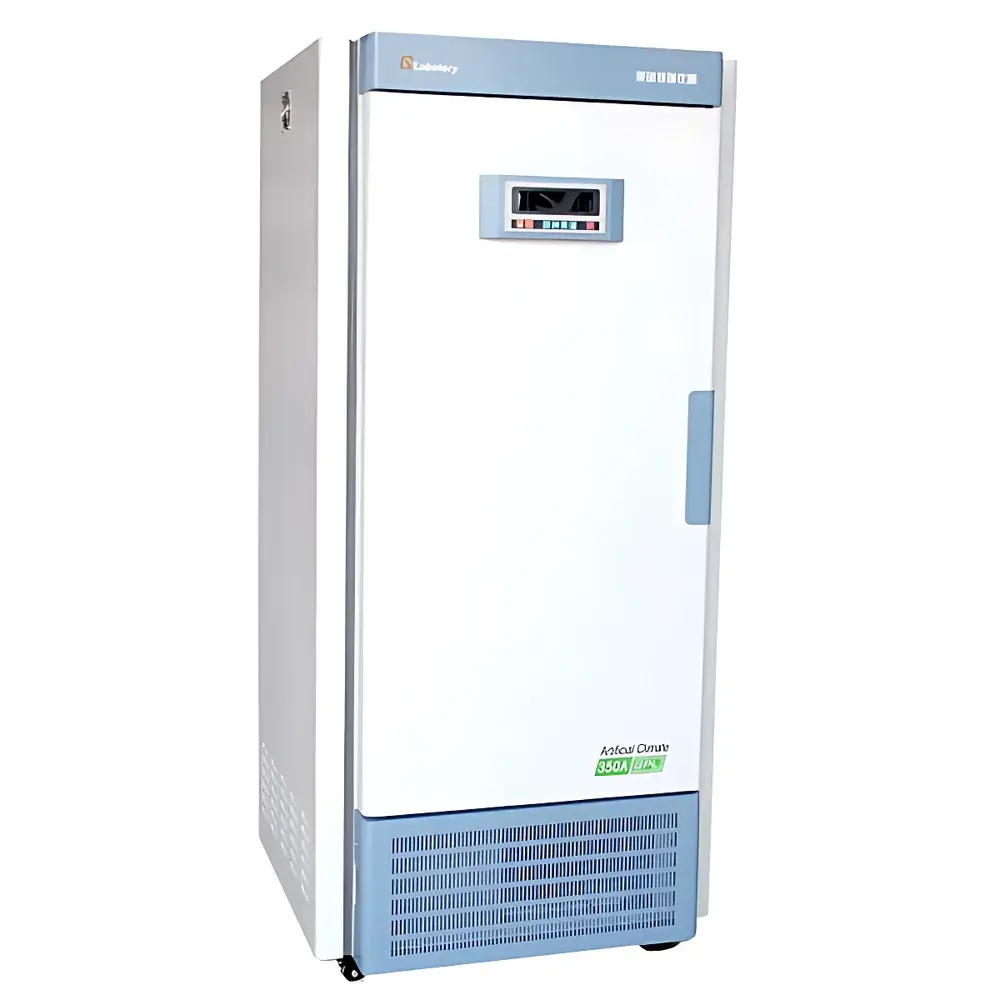
Labotery GPL-250/350/450 Series Precision Plant Growth Chambers
| Brand | Labotery |
|---|---|
| Origin | Tianjin, China |
| Model | GPL-250 / GPL-350 / GPL-450 |
| Temperature Control Range | 10–60 °C (with light), 0–60 °C (without light) |
| Chamber Volume | 250 L / 350 L / 450 L |
| Temperature Uniformity | ±1 °C |
| Temperature Fluctuation | ±0.5 °C (intermittent mode), ±0.2 °C (equilibrium mode) |
| Temperature Resolution | 0.1 °C |
| Power Input | 1200 W / 1700 W / 2200 W |
| Voltage | AC 220 V, 50 Hz |
| Operating Ambient | +5–35 °C |
Overview
The Labotery GPL-250/350/450 Series Precision Plant Growth Chambers are engineered for reproducible, long-term simulation of controlled environmental conditions essential to plant physiology, photobiology, seed germination, and microbial culture studies. These chambers operate on a dual-mode thermal control architecture—integrating high-efficiency refrigeration with precise resistive heating—to maintain stable setpoints across the full operational range (0–60 °C without illumination; 10–60 °C under active lighting). Unlike conventional incubators, the GPL series employs a patented external humidification system in its A-model variants (GPL-250A/350A/450A), enabling accurate RH regulation from 30% to 95% RH. The non-A models (GPL-250/350/450) are optimized for applications requiring strict temperature and photoperiod control without humidity modulation—ideal for photomorphogenesis assays, circadian rhythm studies, or thermosensitive mutant screening where moisture variability must be excluded from experimental variables.
Key Features
- LED-based cold-light illumination system with adjustable intensity (0–25,000 lux), low thermal load, and >50,000-hour rated lifespan—designed to minimize radiant heat interference with chamber temperature stability.
- Imported hermetic compressor with R134a-free refrigerant, compliant with international environmental directives (e.g., EU F-Gas Regulation), ensuring extended service life and reduced global warming potential (GWP).
- Double-door configuration: outer insulated door with inner tempered glass viewing window; inner door features mechanical locking mechanism for secure containment during sensitive experiments.
- Electropolished 304 stainless steel interior with radius-rounded corners and seamless welds—resistant to corrosion from repeated sterilization cycles (e.g., 70% ethanol, hydrogen peroxide vapor, or UV-C exposure).
- Tool-free adjustable shelving system using solid 304 stainless steel support rods; each shelf supports up to 25 kg uniformly distributed load.
- Variable-speed axial fan with infinitely adjustable airflow (0–100%), preventing desiccation stress or mechanical damage to delicate seedlings or callus cultures.
- PID-driven microprocessor controller with real-time parameter display, power-fail memory retention, and auto-restart functionality—ensuring uninterrupted protocol execution after grid interruption.
Sample Compatibility & Compliance
The GPL series accommodates standard laboratory vessels including Petri dishes (up to 150 mm diameter), Magenta boxes, growth pouches, multi-well plates, and hydroponic trays. Internal dimensions (e.g., 700 × 560 × 1145 mm for GPL-450) permit vertical stacking of modular plant racks while maintaining ≥100 mm clearance around all sides for laminar air distribution. All models meet IEC 61000-4 electromagnetic compatibility standards and conform to EN 61010-1 safety requirements for laboratory equipment. While not certified to ISO 14644 cleanroom classifications, the sealed chamber design and optional HEPA-filtered recirculation kit (available upon request) support GLP-aligned workflows in regulated academic and agricultural biotech settings.
Software & Data Management
Standard RS485 interface enables integration with LabVIEW, MATLAB, or custom SCADA systems via Modbus RTU protocol. Optional USB data logging module records timestamped temperature, light intensity, and fan speed at user-defined intervals (1–60 min resolution) and exports CSV files compatible with statistical analysis platforms (e.g., R, Python pandas). When equipped with the GMP-compliant printer option, the system generates audit-trail-enabled hardcopy reports—including operator ID, start/stop timestamps, deviation alerts, and calibration verification stamps—fully traceable per FDA 21 CFR Part 11 Annex 11 expectations. Remote monitoring is supported through optional GSM-enabled SMS alerting, transmitting fault codes (e.g., “E03: Humidity Sensor Failure”, “E12: Door Left Open”) directly to designated mobile numbers.
Applications
- Controlled-environment phenotyping of crop genotypes under defined photoperiods and thermal regimes.
- In vitro propagation of orchids, medicinal herbs, and endangered species requiring precise light quality (PPFD tuning via optional spectral filters) and temperature ramping.
- Long-term storage of fungal cultures (e.g., Aspergillus, Fusarium) at suboptimal temperatures to suppress sporulation while preserving viability.
- Validation of sterilization protocols by monitoring spore germination kinetics under calibrated UV-A/visible light spectra.
- Pre-acclimation studies for tissue-cultured plantlets prior to greenhouse transfer—using programmable diurnal cycles mimicking local seasonal insolation patterns.
FAQ
What is the difference between GPL and GPL-A models?
The GPL-250/350/450 models provide precise temperature and illumination control only. The GPL-250A/350A/450A variants add integrated humidification and dehumidification subsystems, enabling full climate simulation (temperature + RH + light) for applications such as drought stress modeling or mycological growth profiling.
Can the chamber simulate natural day/night cycles?
Yes. The multi-segment programmable controller supports up to 30 time-temperature-light steps per cycle, allowing users to define ramp rates, hold durations, and light intensity gradients that replicate seasonal photoperiod shifts or eclipse events.
Is validation documentation available for regulatory submissions?
Factory-installed IQ/OQ documentation packages—including as-delivered temperature uniformity maps, sensor calibration certificates (NIST-traceable), and alarm response test logs—are available as optional add-ons for clients operating under ISO 17025 or FDA-regulated QA frameworks.
How is condensation managed during high-humidity operation?
The optional door-heating function applies low-voltage resistive heating to the inner glass pane, eliminating fogging and preventing moisture ingress into the control electronics housing—critical for sustained 95% RH operation at 30 °C.
What maintenance intervals are recommended?
Compressor oil inspection every 24 months; condenser coil cleaning quarterly; HEPA filter replacement (if installed) every 6 months; annual verification of temperature sensor drift against reference RTD probe per ASTM E2207 guidelines.




