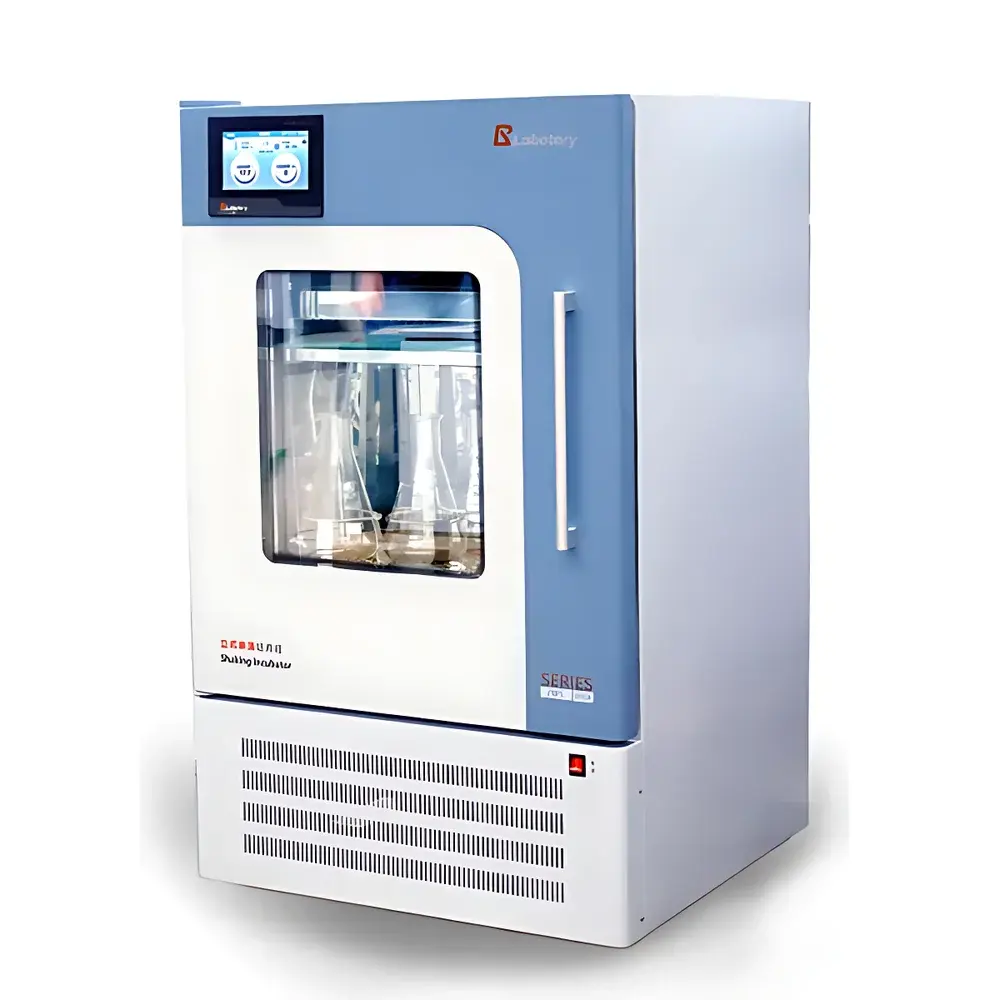
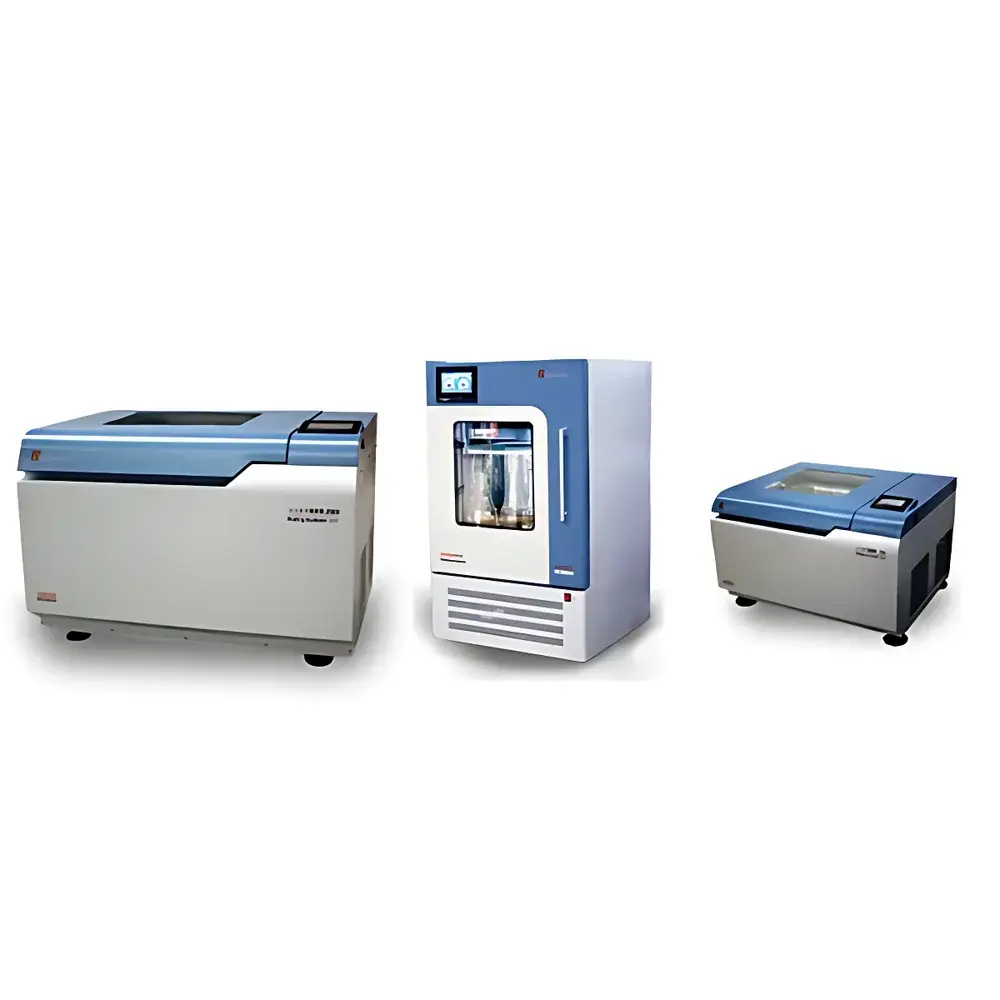
Labotery ZQPL-200A Precision Vertical Orbital Incubator Shaker
| Brand | Labotery |
|---|---|
| Origin | Tianjin, China |
| Model | ZQPL-200A |
| Instrument Type | Full-Temperature Orbital Shaker Incubator |
| Timer Range | 0–999 h 59 min |
| Oscillation Frequency | 10–300 rpm |
| Frequency Accuracy | ±1 rpm |
| Orbit Diameter | Ø26 mm |
| Temperature Range | 4–65 °C |
| Temperature Resolution | ±0.1 °C |
| Temperature Uniformity | ±0.5 °C (at 37 °C) |
| Control Method | PID Microprocessor |
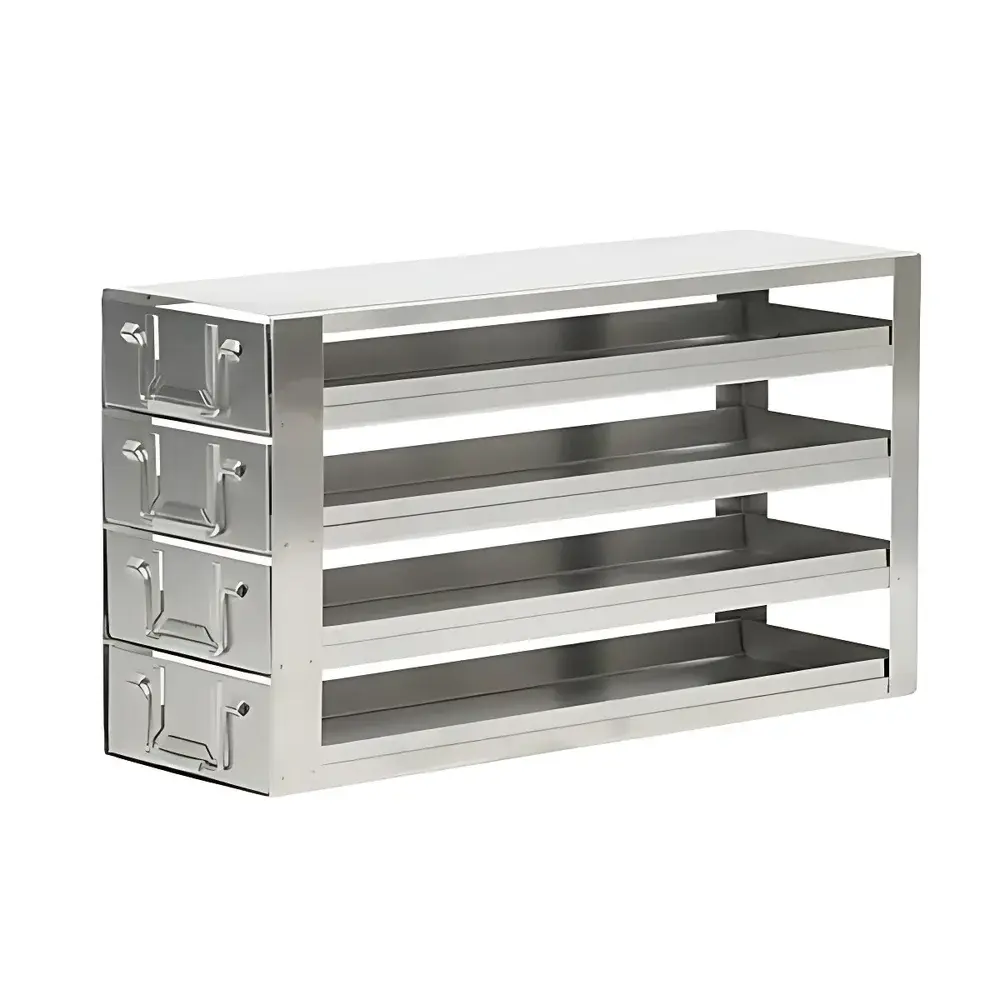
| Shelving | Dual-tier platform (2 shelves) |
| Shelf Dimensions | 439 × 528 mm each |
| Capacity per Shelf | 100 mL × 25 / 250 mL × 20 / 500 mL × 12 / 1000 mL × 6 / 2000 mL × 4 |
| Standard Fixture Configuration | Lower shelf with fixed 500 mL clamps (×12), upper shelf with universal spring clamps |
| Power Consumption | 1.3 kW |
| Input Voltage | AC 220 V ±10%, 50–60 Hz |
| External Dimensions (W×D×H) | 740 × 780 × 1260 mm |
| Net Weight | 170 kg |
| Display | 7-inch 16-bit true-color touchscreen interface |
| Data Logging | Internal storage (1-year history), USB export (CSV/PDF), optional thermal printer output |
| Safety Features | Door-activated motor stop, overtemperature audiovisual alarm + auto cut-off, self-diagnostic system, keypad lock, power-fail memory |
| Optional Upgrades | Remote monitoring via mobile app (iOS/Android), external environmental temperature probe, UV sterilization module, interior LED illumination |
Overview
The Labotery ZQPL-200A Precision Vertical Orbital Incubator Shaker is an engineered solution for controlled, reproducible cultivation of microbial, mammalian, and insect cell cultures under simultaneous temperature regulation and orbital agitation. Designed around the principles of uniform heat distribution and mechanical stability, it employs a centrifugal air circulation system to maintain spatial temperature homogeneity within ±0.5 °C at 37 °C — a critical requirement for sensitive biological assays such as recombinant protein expression, fermentation kinetics, and suspension cell expansion. Its vertical dual-shelf architecture optimizes laboratory floor space without compromising volumetric capacity or thermal integrity. The unit integrates a brushless servo motor drive system delivering precise rotational control from 10 to 300 rpm (±1 rpm accuracy), coupled with a robust Ø26 mm orbit optimized for oxygen transfer in Erlenmeyer flasks and culture vessels ranging from 100 mL to 2 L.
Key Features
- Vertical dual-platform design with independent load balancing — supports up to 2000 mL vessels on lower shelf and versatile spring-clamp compatibility on upper shelf
- High-efficiency hermetic refrigeration system using R134a-free compressor with dust-filtered condenser intake for long-term reliability in shared lab environments
- 7-inch 16-bit true-color touchscreen HMI with unified interface for setpoint entry, real-time graphing, and historical data review — no mode switching required
- PID-based microprocessor temperature control with adaptive tuning, supported by internal PT100 sensor array and optional external ambient temperature probe for compensation
- Integrated UV-C germicidal lamp (254 nm) and white LED illumination, both controllable via touchscreen; door-interlocked motor shutdown ensures operator safety during access
- Comprehensive data governance: timestamped logging (≥1 year retention), USB export (CSV for Excel analysis, PDF for audit-ready reports), optional thermal printer integration
- Firmware-level security: programmable keypad lock, timed function freeze, and power-loss memory preserving all active parameters and runtime states
Sample Compatibility & Compliance
The ZQPL-200A accommodates standard laboratory glassware and disposable bioreactors including 100–2000 mL Erlenmeyer flasks, baffled flasks, and square-section culture bottles. Its dual-tier configuration allows heterogeneous vessel loading — e.g., high-density bacterial cultures on the lower shelf and low-shear mammalian suspensions on the upper shelf — without cross-contamination risk. All wetted surfaces are electropolished stainless steel (AISI 304), compliant with ISO 14644-1 Class 7 cleanroom surface requirements for non-sterile but controlled environments. The system meets IEC 61010-1:2010 safety standards for laboratory equipment and incorporates design elements aligned with GLP documentation practices, including immutable audit trails for temperature and agitation logs, essential for FDA 21 CFR Part 11–compliant workflows when paired with validated software extensions.
Software & Data Management
Data acquisition operates autonomously via embedded firmware with no PC dependency. Real-time curves (temperature vs. time, rpm vs. time) render dynamically on-screen with zoom, pan, and screenshot functions. Historical datasets are indexed by session ID, date/time stamp, and user tag (if enabled via optional network authentication). Exported CSV files contain raw sensor values at 10-second intervals, compatible with MATLAB, Python pandas, or JMP for statistical modeling. The optional mobile application (iOS/Android) provides encrypted TLS 1.2 remote viewing of live parameters and alarm status — not remote control — preserving local operational authority. Firmware updates are delivered via signed USB packages with SHA-256 verification to prevent unauthorized modification.
Applications
- Microbial growth profiling under variable temperature–agitation regimes (e.g., E. coli expression optimization across 25–37 °C at 150–250 rpm)
- Suspension culture of CHO or HEK293 cells requiring low-shear orbital motion and tight thermal control (±0.3 °C)
- Enzyme reaction kinetics studies where dissolved oxygen concentration must be stabilized via defined orbital amplitude and frequency
- Environmental microbiology incubations simulating mesophilic or thermophilic conditions (4–65 °C range)
- Pharmaceutical stability testing per ICH Q1A(R2) guidelines using programmable ramp-hold profiles
- Bioprocess development for single-use bioreactor seed train scaling, validated through parallel shaker-to-bioreactor correlation studies
FAQ
What is the maximum flask size supported per shelf?
Each shelf accommodates up to six 2000 mL flasks (baffled), twelve 500 mL flasks, or twenty-five 100 mL flasks — based on standardized center-of-mass distribution and clearance margins.
Does the system support programmable multi-step temperature and speed profiles?
Yes — the built-in controller offers both constant-setpoint (single-value) and multi-segment program modes, with up to 16 steps per program, each defining target temperature, rpm, and dwell time.
Is the UV sterilization cycle validated for microbial reduction?
The 254 nm UV-C module delivers ≥10 mJ/cm² irradiance at shelf level over 30 minutes, sufficient for >3-log reduction of common lab contaminants (e.g., Bacillus subtilis spores) when operated in empty-chamber mode per ISO 15714.
Can historical data be exported in machine-readable format for LIMS integration?
Yes — USB-exported CSV files include ISO 8601 timestamps, sensor IDs, and engineering units (°C, rpm), enabling direct ingestion into laboratory information management systems without manual reformatting.
What electrical infrastructure is required for safe operation?
A dedicated 20 A, grounded AC 220 V circuit (50–60 Hz) with surge protection is mandatory; continuous operation above 32 °C ambient requires supplemental HVAC due to thermal derating specifications.