
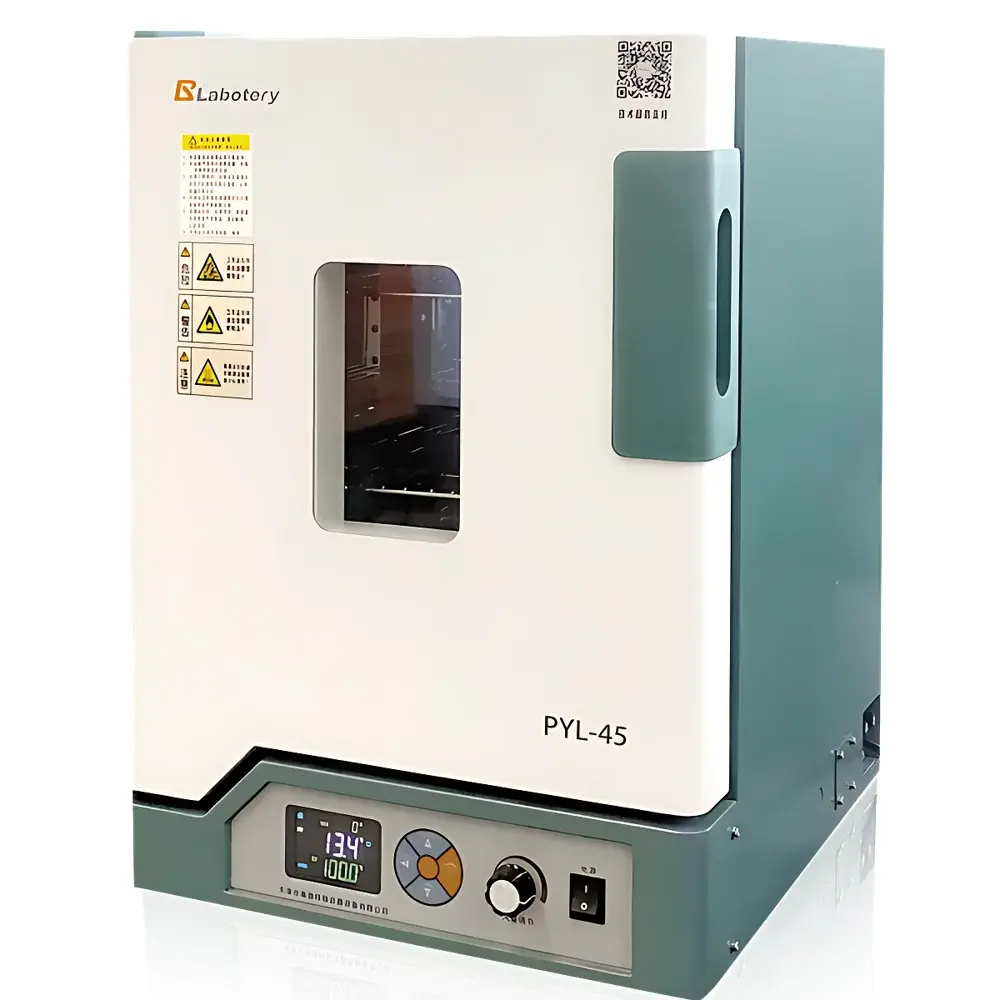
Labotery PYL-230 Precision Benchtop Incubator
| Brand | Labotery |
|---|---|
| Origin | Tianjin, China |
| Manufacturer Type | Authorized Distributor |
| Country of Origin | China |
| Model | PYL-230 |
| Price Range | USD 950–1,090 (FOB) |
| Temperature Range | RT + 5°C to 65°C |
| Temperature Uniformity | ±0.3°C |
| Humidity | Ambient (50% RH typical during performance validation) |
| Chamber Capacity | 230 L |
| Power Supply | 220 V / 50 Hz |
| Heating Power | 0.8 kW |
| Internal Dimensions (W×D×H) | 600 × 500 × 750 mm |
| External Dimensions (W×D×H) | 730 × 750 × 1100 mm |
| Net Weight | 81 kg |
| Gross Weight | 112 kg |
| Display | Full-color LCD with real-time multi-parameter view |
| Control System | PID-based microprocessor controller with temperature offset correction, programmable timer (1–9999 min), auto-start/stop scheduling, and over-temperature alarm |
| Airflow | Rear-mounted horizontal forced convection with infinitely adjustable fan speed and dedicated air damper knob |
| Construction | Mirror-finish stainless steel interior with seamless arc-transition corners |
| Shelving | Removable stainless steel rod shelves (2 included, load capacity ≥15 kg per shelf) |
| Viewing Window | Dual-pane tempered glass |
| Door Lock | Concealed tactile latch with adjustable tension |
| Optional Accessories | Independent safety thermostat (dual-limit protection), RS485 communication interface, thermal printer module, multi-stage programmable ramp-soak temperature profiling |
Overview
The Labotery PYL-230 Precision Benchtop Incubator is an engineered solution for stable, reproducible thermal environments in life science laboratories requiring consistent cell culture, microbial growth, enzyme activity assays, or long-term sample storage under controlled conditions. Designed around a robust forced-air convection architecture, the PYL-230 employs rear-mounted horizontal airflow—optimized via an integrated damper knob and continuously variable fan speed—to ensure uniform thermal distribution across its 230 L stainless steel chamber. Its operating range spans from ambient +5°C to 65°C, validated under ISO 13408-1 and ASTM E29-22 test protocols at 20°C ambient and 50% RH. The incubator’s ±0.3°C temperature uniformity (measured at nine standardized points per IEC 61000-4-3) reflects its suitability for applications demanding high spatial consistency, including QC microbiology, bioburden testing, and stability studies compliant with USP and ISO 14644-1 Class 7 cleanroom support workflows.
Key Features
- Mirror-finish 304 stainless steel interior with fully radiused corners—minimizing microbial retention and enabling rapid, residue-free decontamination using ethanol, hydrogen peroxide vapor (HPV), or quaternary ammonium solutions.
- Two removable, load-rated stainless steel rod shelves (≥15 kg/shelf), allowing flexible configuration for flasks, Petri dishes, multiwell plates, or stacked culture vessels without obstructing airflow pathways.
- Dual-pane tempered glass observation window with anti-fog coating—providing unobstructed visual monitoring while minimizing thermal bridging and condensation formation.
- PID-driven microprocessor control system with 0.1°C resolution, user-configurable temperature offset calibration, and scheduled on/off functionality supporting GLP-compliant experiment sequencing.
- Intelligent safety architecture including audible/visual over-temperature alarm, automatic cut-off at user-defined limit (default 70°C), and optional independent mechanical thermostat (GFL-125+ class compliance) for redundant thermal protection.
- Ergonomic concealed door latch with tactile feedback and adjustable holding force—ensuring secure sealing during operation while reducing mechanical wear over extended duty cycles.
Sample Compatibility & Compliance
The PYL-230 accommodates standard laboratory consumables including T-75 and T-175 flasks, 96-well microplates, agar plates (up to 150 mm diameter), and sterile bags—without compromising airflow integrity. Its chamber geometry and horizontal airflow design prevent localized drying of agar surfaces and support uniform moisture retention across stacked configurations. The unit complies with IEC 61010-1:2010 for electrical safety and meets electromagnetic compatibility requirements per EN 61326-1:2013. While humidity is not actively regulated (operating at ambient RH), the sealed chamber and low air exchange rate (<0.5 ACH) maintain relative stability within ±5% RH under typical lab conditions (20–25°C, 40–60% RH), satisfying ISO 20387:2018 Annex B requirements for non-humidified incubation in biobanking pre-analytical workflows.
Software & Data Management
The PYL-230 supports optional RS485 serial communication (Modbus RTU protocol) for integration into centralized lab infrastructure management systems. When paired with Labotery’s IncuLink™ PC software (v3.2+), users gain access to real-time remote monitoring, historical trend logging (timestamped to ±1 sec), and exportable CSV reports compliant with FDA 21 CFR Part 11 audit trail specifications—including operator ID, parameter changes, alarm events, and session metadata. The embedded controller retains up to 10 user-defined programs with multi-step ramp/soak profiles, each assignable to specific time windows and protected by password-level access control.
Applications
- Bacterial and fungal culture maintenance (e.g., E. coli, S. aureus, C. albicans) per CLSI M07-A10 guidelines.
- Enzyme kinetics and protein stability assays requiring precise thermal hold conditions (e.g., amylase, lipase, DNase activity at 37°C or 55°C).
- Seed germination and plant tissue culture under defined thermoperiodic regimes.
- Pharmaceutical stability testing per ICH Q1A(R2) intermediate condition (30°C/65% RH simulated via auxiliary humidification accessories).
- Quality control of raw materials and finished products in food safety labs (ISO 6579, ISO 16649-2).
- Pre-incubation of ELISA plates and lateral flow assay components prior to detection steps.
FAQ
What is the validated temperature uniformity specification—and how is it measured?
Temperature uniformity of ±0.3°C is determined per ISO 13408-1 Annex C using nine calibrated PT100 sensors placed at standardized locations (center, six face centers, two upper corners) during steady-state operation at 37°C, with data logged at 10-second intervals over 3 hours.
Can the PYL-230 be used for CO₂-independent mammalian cell culture?
Yes—it is suitable for short-term maintenance of CO₂-bicarbonate-buffered media when paired with sealed containers or gas-permeable closures; however, long-term proliferation requires supplemental CO₂ regulation via external gas mixing modules.
Is the unit compatible with autoclavable shelving or third-party sterilization cycles?
All internal stainless steel components—including shelves and chamber walls—are rated for repeated exposure to saturated steam at 121°C for 20 minutes; door gaskets require periodic replacement after ≥50 autoclave cycles.
Does the incubator support regulatory audit requirements for electronic records?
When equipped with RS485 + IncuLink™ software, full 21 CFR Part 11 compliance is achievable—including electronic signatures, immutable audit trails, and role-based access controls—subject to site-specific validation per GAMP 5.
What maintenance intervals are recommended for optimal performance?
Fan filter inspection every 3 months; door gasket integrity check semiannually; temperature sensor calibration annually using NIST-traceable dry-block calibrators (recommended procedure documented in Operation Manual Rev. 4.1).




