
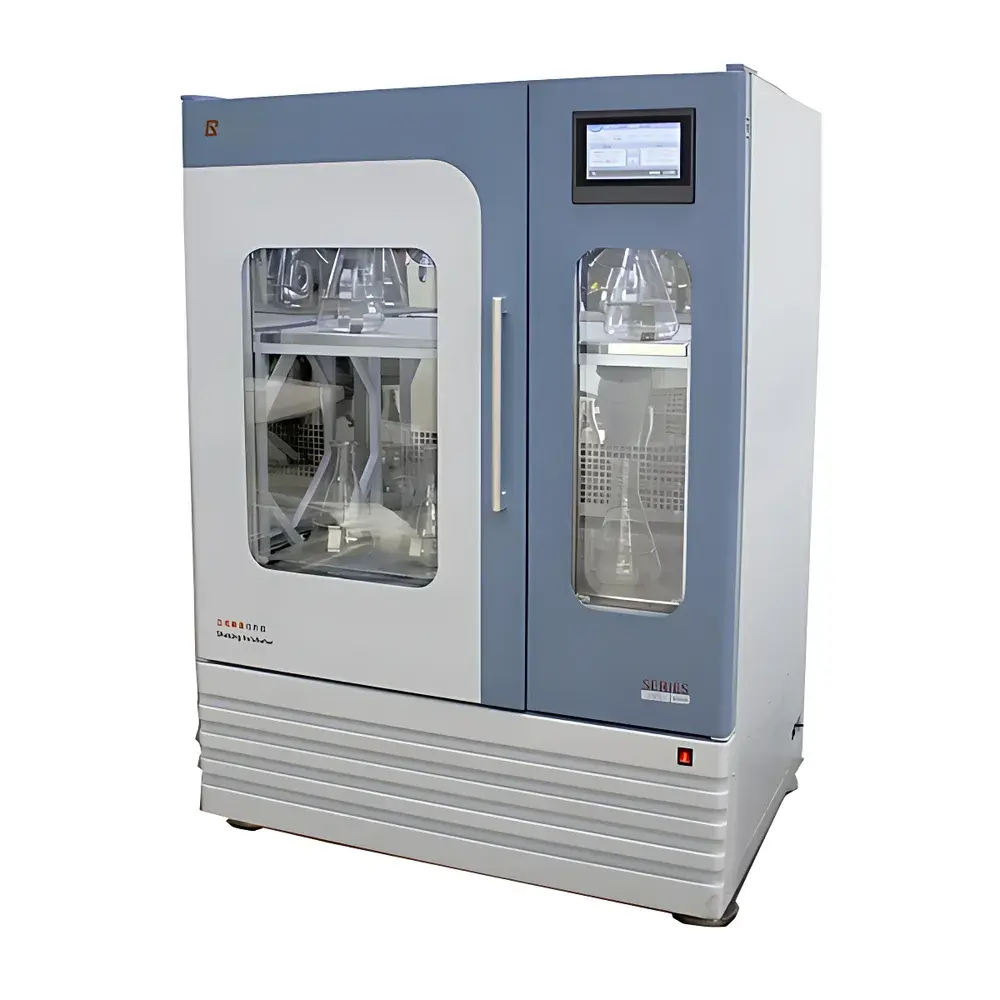
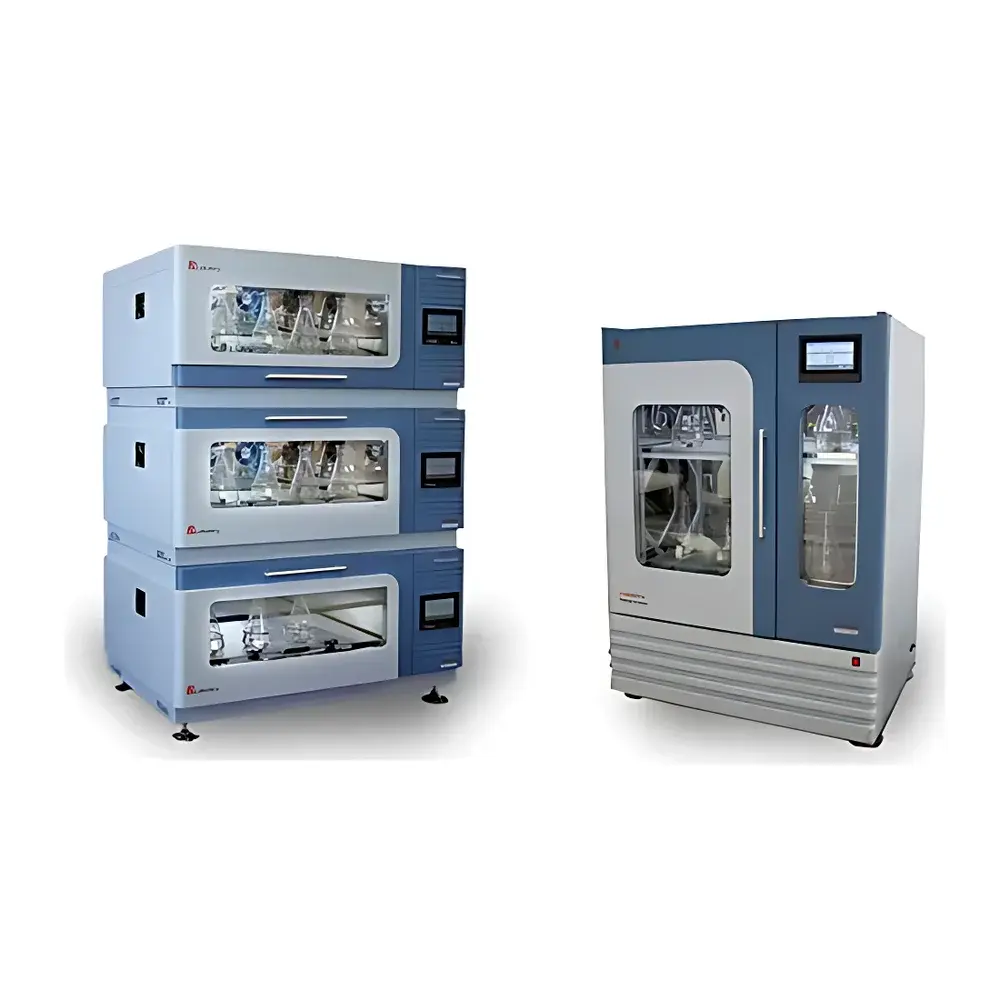
Labotery ZQPL-500A Precision Vertical High-Capacity Incubated Orbital Shaker
| Brand | Labotery |
|---|---|
| Origin | Tianjin, China |
| Model | ZQPL-500A |
| Shaker Type | Full-Temperature Orbital Incubator Shaker |
| Timer Range | 0–999 h 59 min |
| Oscillation Frequency | 10–300 rpm |
| Oscillation Amplitude | Ø26 mm (standard), 50 mm (optional) |
| Temperature Range | 4–65 °C |
| Number of Shaking Platforms | 2 |
| Platform Dimensions | 830 × 500 mm each |
| Temperature Uniformity | ±0.5 °C at 37 °C |
| Temperature Resolution | ±0.1 °C |
| Frequency Accuracy | ±1 rpm |
| Power Consumption | 2.1 kW |
| Input Voltage | AC 220 V ±10%, 50–60 Hz |
| External Dimensions (W×D×H) | 1080 × 850 × 1440 mm |
| Net Weight | 300 kg |
Overview
The Labotery ZQPL-500A is a precision-engineered vertical high-capacity incubated orbital shaker designed for demanding life science applications requiring simultaneous temperature control and consistent orbital agitation. It operates on the principle of controlled horizontal circular motion (orbital shaking) combined with forced-air convection heating and refrigeration—enabling stable, uniform thermal environments across large working volumes. Unlike benchtop or compact shakers, the ZQPL-500A integrates dual independent shaking platforms within a vertically stacked stainless-steel chamber, supporting scalable culture workflows in microbiology, molecular biology, bioprocessing, and cell-based assay development. Its full-temperature range (4–65 °C), coupled with an energy-efficient hermetic compressor and PID-driven microcomputer regulation, ensures reliable performance under both refrigerated and elevated incubation conditions—critical for aerobic microbial growth, protein expression studies, and suspension cell expansion.
Key Features
- Vertical dual-platform architecture with two independently accessible 830 × 500 mm stainless-steel shaking decks—maximizing volumetric throughput while minimizing laboratory floor space.
- Electropolished 304 stainless-steel interior chamber and electrostatically coated steel exterior—resistant to corrosion, chemicals, and repeated cleaning cycles in GLP-compliant labs.
- Centrifugal air circulation system with rear-mounted blower and optimized ducting—achieving ±0.5 °C temperature uniformity at 37 °C across the entire chamber volume.
- True-color 7-inch capacitive touchscreen interface running embedded firmware—supporting both fixed-parameter operation and multi-step programmable protocols with real-time graphical feedback.
- High-fidelity servo motor drive system with optical encoder feedback—delivering precise speed control (10–300 rpm, ±1 rpm accuracy) and maintenance-free long-term operation.
- Integrated environmental monitoring: external ambient temperature probe displayed on main UI; door-open safety interlock halting oscillation and airflow instantly.
- Comprehensive safety suite including over-temperature audiovisual alarm, automatic power cutoff, self-diagnostic error logging, and operator-access lockout via password-protected interface.
- Onboard data management: 1-year internal storage for time-stamped temperature, speed, and runtime logs; exportable via USB to CSV or PDF (data + trend plots); optional real-time thermal/oscillation curve printing.
Sample Compatibility & Compliance
The ZQPL-500A accommodates standard laboratory vessels ranging from 100 mL Erlenmeyer flasks to 2 L baffled bottles per platform—configured via interchangeable universal clamps (factory-supplied: 12 × 1000 mL per deck). Its Ø26 mm orbital throw is optimized for oxygen transfer in aerobic cultures (e.g., E. coli, yeast, mammalian suspension lines), while optional 50 mm amplitude kits support high-viscosity media or low-shear applications. The unit complies with IEC 61000-6-3 (EMC emissions) and IEC 61010-1 (safety for laboratory equipment). While not certified to ISO 13485 or FDA 21 CFR Part 11 out-of-the-box, its audit-ready data logging (timestamped, non-erasable entries), user access controls, and electronic signature-ready protocol execution align with GLP/GMP documentation requirements when deployed with validated SOPs.
Software & Data Management
The embedded control system provides native support for both constant-setpoint and multi-segment ramp-hold programming—including temperature ramps (0.1–10 °C/min), speed gradients, and synchronized start/stop triggers. All operational parameters—temperature, RPM, elapsed time, alarm status—are logged at user-defined intervals (1 s to 60 min) and stored with CRC-verified integrity. Historical datasets are browsable via timeline navigation, exportable to USB drives in CSV format (for Excel/LabChart import) or as annotated PNG screenshots. Optional remote monitoring via secure MQTT-based mobile application (iOS/Android) enables real-time status alerts and parameter adjustment—subject to local network security policy review. Firmware updates are performed offline via USB, preserving configuration integrity.
Applications
- High-yield microbial fermentation (e.g., recombinant protein production in Pichia pastoris or Bacillus subtilis)
- Suspension-adapted mammalian cell culture (CHO, HEK293) under controlled hypothermic or normothermic conditions
- Environmental microbiology assays requiring extended incubation (e.g., BOD testing, biodegradation kinetics)
- Enzyme kinetics and ligand-binding studies requiring precise thermal-agitation coupling
- Media preparation and pre-culture scaling prior to bioreactor inoculation
- Antibiotic susceptibility testing (AST) with broth microdilution under standardized agitation
FAQ
What is the maximum flask capacity per platform?
Each 830 × 500 mm platform supports up to 12 × 1000 mL baffled flasks (standard configuration) or scalable alternatives including 45 × 250 mL, 37 × 500 mL, or 13 × 2000 mL—dependent on clamp selection and media viscosity.
Does the unit support sterile operation?
Yes—the chamber includes integrated UV-C germicidal lamps (254 nm) and a removable, autoclavable stainless-steel shelf liner; all gaskets and seals meet USP Class VI biocompatibility standards.
Is the temperature calibration traceable to NIST standards?
Factory calibration uses NIST-traceable RTD probes; users may perform field verification using external calibrated thermistors—full calibration certificates available upon request with optional IQ/OQ documentation package.
Can the shaker operate unattended for multi-day experiments?
Yes—equipped with battery-backed real-time clock, power-fail recovery mode, and continuous data logging; timer range extends to 999 hours 59 minutes with auto-restart capability after interruption.
What maintenance is required for long-term reliability?
Annual inspection of compressor oil level, fan filter cleaning, and verification of door seal integrity are recommended; servo motor and PID controller require no scheduled maintenance over 10,000 operating hours.




