
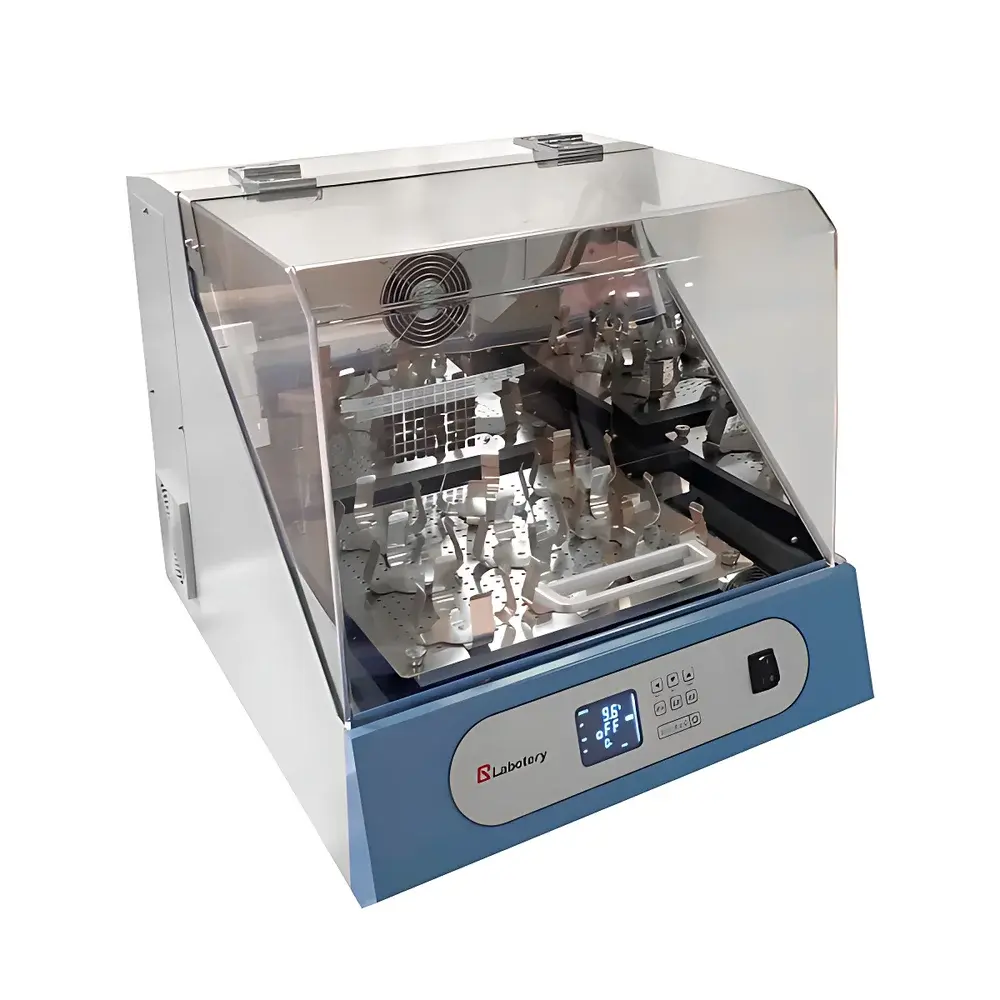
Labotery ZQP-100G Benchtop Orbital Shaking Incubator
| Brand | Labotery |
|---|---|
| Origin | Tianjin, China |
| Model | ZQP-100G |
| Instrument Type | Full-Temperature Orbital Shaker Incubator |
| Timer Range | 0–9999 min |
| Oscillation Frequency | 30–600 rpm |
| Orbit Diameter (Amplitude) | Φ0–50 mm (infinitely adjustable) |
| Temperature Range | Ambient +5°C to 60°C |
| Shelf Quantity | 1 platform |
| Platform Dimensions | 400 × 370 mm |
| Chamber Volume | 100 L |
| Power Supply | AC 220 V ±10%, 50–60 Hz |
| Power Consumption | 0.8 kW |
| External Dimensions (W×D×H) | 550 × 780 × 640 mm |
| Temperature Uniformity | ±0.3°C (at 37°C) |
| Temperature Stability | ±0.3°C (at 37°C) |
| Temperature Resolution | 0.1°C |
| Display | LCD touchscreen interface |
| Drive System | Brushless DC servo motor with bidirectional programmable control |
| Safety Features | Door-activated stop, over-temperature alarm & auto-shutoff, current overload protection, power failure memory, self-diagnostic system |
Overview
The Labotery ZQP-100G Benchtop Orbital Shaking Incubator is an integrated temperature-controlled orbital shaker engineered for reproducible cultivation of microbial, mammalian, and insect cell cultures under precisely regulated thermal and mechanical conditions. It operates on the principle of orbital shaking—generating uniform circular motion (with selectable amplitude up to 50 mm) to enhance oxygen transfer and suspension homogeneity in liquid media—while maintaining stable, programmable incubation temperatures from ambient +5°C to 60°C. Designed for laboratories requiring flexibility across diverse life science workflows—including aerobic bacterial fermentation, recombinant protein expression, enzyme kinetics assays, and suspension-based bioprocess development—the ZQP-100G delivers consistent performance in a compact, space-efficient footprint suitable for standard biosafety cabinets or shared benchtop environments.
Key Features
- Brushless DC servo motor drive ensures high torque stability, precise speed control (±1 rpm accuracy), and maintenance-free operation over extended duty cycles.
- Infinitely adjustable orbit diameter (Φ0–50 mm) enables optimization of shear stress and gas–liquid mass transfer for sensitive cell lines or viscous culture media.
- Programmable bidirectional oscillation sequence: users may define multi-step protocols incorporating forward rotation, reverse rotation, and pause intervals—each with independently set durations and speeds—to simulate dynamic physiological environments or improve mixing efficiency.
- LCD touchscreen interface with intuitive navigation supports real-time monitoring of temperature, speed, amplitude, elapsed time, and remaining timer duration; English-language UI is factory-configured.
- Forced-air convection system with optimized air duct geometry achieves ±0.3°C temperature uniformity at 37°C across the full platform surface—validated per ISO 13408-2 Annex B guidelines for incubator performance verification.
- Comprehensive safety architecture includes door-interlock shutdown, over-temperature cut-off with audible/visual alarm, electronic current-limiting circuitry, and non-volatile memory retention for all active parameters during unexpected power loss.
Sample Compatibility & Compliance
The ZQP-100G accommodates standard laboratory vessels including Erlenmeyer flasks (100–2000 mL), test tubes, deep-well plates, and custom bioreactor bags mounted on its single 400 × 370 mm stainless-steel platform. Vessel clamping is achieved via universal spring-loaded fixtures compatible with round-bottom and flat-bottom containers. The unit complies with IEC 61010-1:2010 for electrical safety in laboratory equipment and meets EMC requirements per IEC 61326-1:2020. While not certified for GMP manufacturing use, its operational traceability—via timestamped parameter logging, error code reporting, and programmable protocol storage—supports GLP-aligned documentation practices in academic, R&D, and QC settings.
Software & Data Management
The embedded controller logs all operational events—including setpoint changes, alarms, door openings, and power interruptions—with local storage capacity for ≥10,000 entries. Data export is supported via USB flash drive (FAT32 formatted) in CSV format for post-acquisition analysis in Excel or statistical software. Though no remote PC interface or Ethernet connectivity is provided, the system’s deterministic behavior and repeatable calibration response facilitate integration into validated workflows where manual intervention and audit-trail integrity are prioritized over networked automation. All firmware updates are performed offline using signed binary files distributed through Labotery’s authorized technical support channels.
Applications
- Aerobic cultivation of Escherichia coli, Bacillus subtilis, and other fast-growing prokaryotes under controlled DO-sensitive conditions.
- Mammalian cell expansion in serum-free or chemically defined media, leveraging low-shear orbital motion to minimize aggregate formation.
- Enzymatic reaction profiling requiring simultaneous thermal stabilization and homogeneous reagent dispersion (e.g., ligase cycling, phosphorylation assays).
- Environmental microbiology studies involving soil slurry enrichment or wastewater biofilm detachment protocols.
- Pre-analytical sample homogenization prior to downstream nucleic acid extraction or metabolite profiling.
FAQ
What is the maximum flask size supported on the platform?
The platform accommodates up to four 2000 mL Erlenmeyer flasks or nine 500 mL flasks when using standard universal clamps.
Does the unit support refrigerated operation?
No—the ZQP-100G is a heating-only incubator with a minimum operating temperature of ambient +5°C; models with active cooling (e.g., ZHP-100D) are available separately.
Is the amplitude adjustment mechanical or electronic?
Amplitude is adjusted manually via calibrated eccentric cam mechanism; no motorized actuation is employed, ensuring long-term repeatability without encoder drift.
Can the timer be used independently of temperature control?
Yes—shaking-only mode (with temperature disabled) is selectable, allowing use as a standalone orbital shaker for room-temperature applications.
How frequently should calibration verification be performed?
We recommend quarterly verification of temperature and speed accuracy using NIST-traceable reference probes, especially prior to critical experiments or regulatory submissions.
Related Products



