
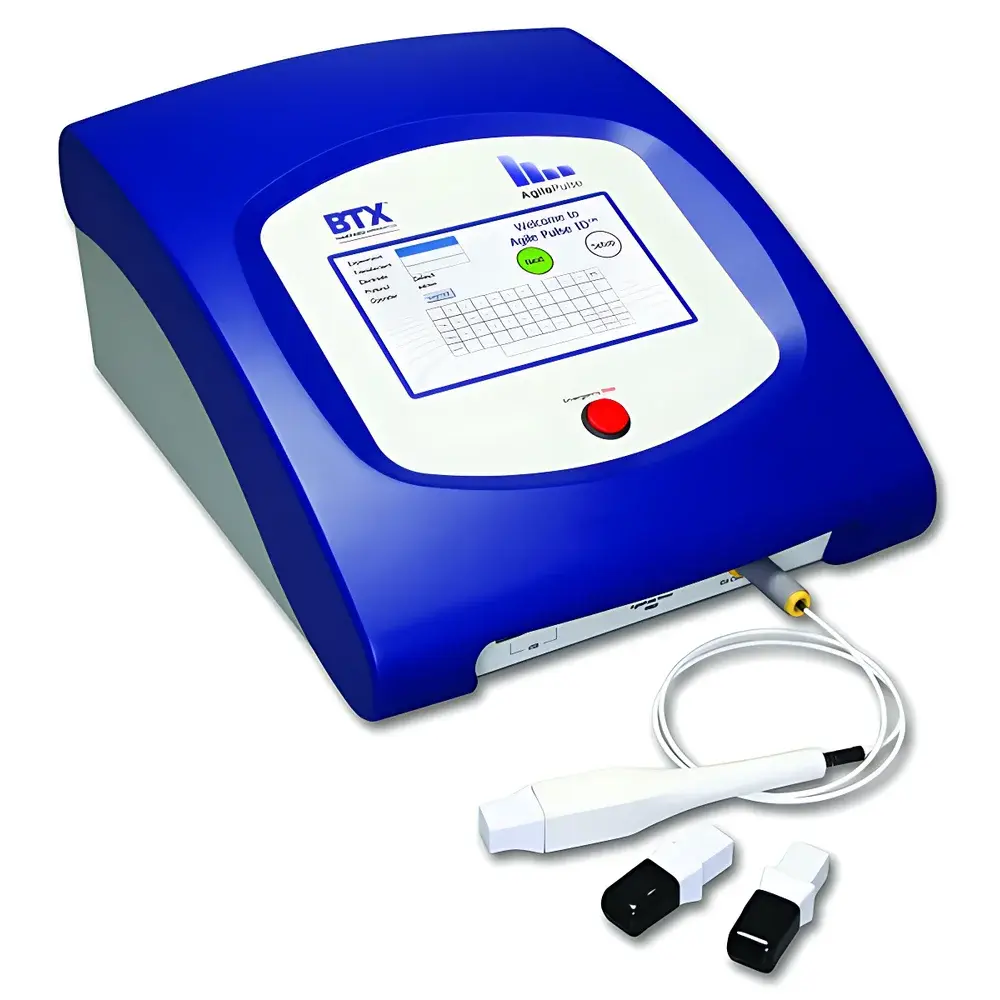
BTX Agile Pulse In Vivo In Vivo Electroporation System for DNA Vaccine Delivery
| Brand | BTX |
|---|---|
| Origin | USA |
| Model | Agile Pulse In Vivo |
| Voltage Range | 50–1000 V |
| Pulse Duration | 50 µs – 10 ms |
| Inter-Pulse Interval | 200 µs – 1 s |
| Electrode Interface | Multi-needle Matrix (ID/IM Optimized) |
| Dimensions | 31.5 × 19.75 × 39.25 cm |
| Weight | 12.25 kg |
Overview
The BTX Agile Pulse In Vivo Electroporation System is an engineered platform designed specifically for preclinical in vivo DNA delivery and immunization studies. It operates on the principle of reversible electroporation—applying precisely controlled electrical pulses to transiently increase cell membrane permeability, thereby facilitating intracellular transport of plasmid DNA or other nucleic acid therapeutics. Unlike conventional bolus injection alone, this system couples hydrodynamic plasmid administration with sequenced biphasic pulse protocols (high-voltage poration followed by low-voltage electrophoretic translocation), resulting in significantly enhanced transfection efficiency and sustained antigen expression in target tissues—including dermal dendritic cells and myocytes. Its architecture supports both intradermal (ID) and intramuscular (IM) delivery modalities, with pulse parameters calibrated to tissue-specific electrical impedance profiles, enabling reproducible gene expression across diverse animal models.
Key Features
- Biphasic pulse technology: Combines short-duration high-voltage pulses (for membrane permeabilization) with extended low-voltage pulses (to drive DNA electrophoretically into the cytoplasm)
- Real-time impedance monitoring: Integrated circuitry continuously measures tissue resistance before and during pulsing, automatically adjusting voltage output to maintain consistent field strength across variable anatomical sites
- Dual-configuration multi-needle electrode support: Pre-optimized electrode arrays for ID (e.g., 3×3 micro-needle array, 1.5 mm spacing) and IM (e.g., parallel 2-needle or 4-needle configurations with 5–10 mm inter-electrode distance) applications
- Touchscreen-based graphical user interface: Intuitive navigation with visual pulse waveform preview, parameter locking, and contextual help overlays for GLP-compliant protocol execution
- Footswitch integration: Enables hands-free pulse triggering during live-animal procedures without compromising sterility or ergonomic workflow
- Onboard data logging: Stores timestamped pulse logs—including delivered voltage, current, impedance, and energy per pulse—for audit-ready documentation and retrospective analysis
- Expandable electrode compatibility: Supports third-party BTX in vivo electrodes via standardized BNC-to-Lemo adapter interface, including calvarial, intratumoral, and visceral applicators
Sample Compatibility & Compliance
The Agile Pulse In Vivo system is validated for use with standard circular or linearized plasmid DNA constructs (0.1–10 µg per injection site), as well as mRNA and siRNA formulations formulated in low-conductivity buffers (e.g., 5% dextrose, pH 7.2–7.6). It complies with IEC 61010-1 safety standards for laboratory electrical equipment and meets electromagnetic compatibility (EMC) requirements per EN 61326-1. While not a medical device, its operational parameters align with protocols referenced in FDA Guidance for Industry on DNA Vaccines (2020) and WHO Technical Report Series No. 1019 (2020) for preclinical immunogenicity assessment. All pulse programs are exportable in CSV format to support 21 CFR Part 11–compliant data archiving when paired with validated LIMS or ELN platforms.
Software & Data Management
The system firmware includes embedded non-volatile memory supporting unlimited custom protocol storage (up to 255 user-defined programs), each with independent settings for voltage, pulse count, duration, interval, and polarity. Pulse delivery events are logged with millisecond-resolution timestamps and associated impedance traces. Data export occurs via USB 2.0 port to FAT32-formatted flash drives; no proprietary software installation is required. Raw logs include columns for: Pulse Number, Applied Voltage (V), Measured Current (A), Calculated Impedance (Ω), Energy per Pulse (J), and System Status Flag (e.g., “Impedance Out of Range”, “Capacitor Charging Complete”). These records facilitate traceability in GLP-regulated studies and enable correlation between electroporation parameters and downstream immune readouts (e.g., IFN-γ ELISpot, flow cytometry phenotyping).
Applications
- Intradermal DNA vaccination: Enhanced transfection of Langerhans cells and dermal DCs for robust CD8+ T-cell priming and humoral responses
- Intramuscular DNA immunization: Sustained antigen expression in myofibers leading to prolonged antigen presentation and improved booster kinetics
- In vivo electrochemotherapy: Co-delivery of plasmid-encoded cytokines (e.g., IL-12) with chemotherapeutic agents in solid tumor models
- Non-viral gene therapy delivery: Localized transfection of therapeutic transgenes (e.g., Factor IX, dystrophin minigenes) in muscular dystrophy or hemophilia models
- Functional genomics in situ: CRISPR-Cas9 RNP delivery for somatic editing in skin, muscle, or subcutaneous adipose tissue
FAQ
Is the Agile Pulse In Vivo system compatible with rodent, non-human primate, and large animal models?
Yes—the system’s adjustable voltage range (50–1000 V), scalable pulse durations, and interchangeable electrode geometries accommodate species ranging from mice (using 1-mm needle arrays) to NHPs and swine (with extended-depth IM electrodes).
Does the system support bidirectional (reversed polarity) pulsing?
Yes—user-defined protocols may specify alternating polarity sequences to improve DNA dispersion and reduce localized electroporation damage.
Can impedance data be exported independently of pulse logs?
No—impedance values are recorded synchronously with each pulse event and are embedded within the primary CSV log file.
What maintenance is required for long-term reliability?
Annual calibration verification is recommended using the included test load resistor; no consumables or routine servicing are required beyond standard lab equipment validation protocols.
Is remote operation or network connectivity supported?
No—the system operates as a standalone instrument with local touchscreen and footswitch control only; network interfaces are intentionally omitted to ensure electromagnetic isolation in vivarium environments.




