
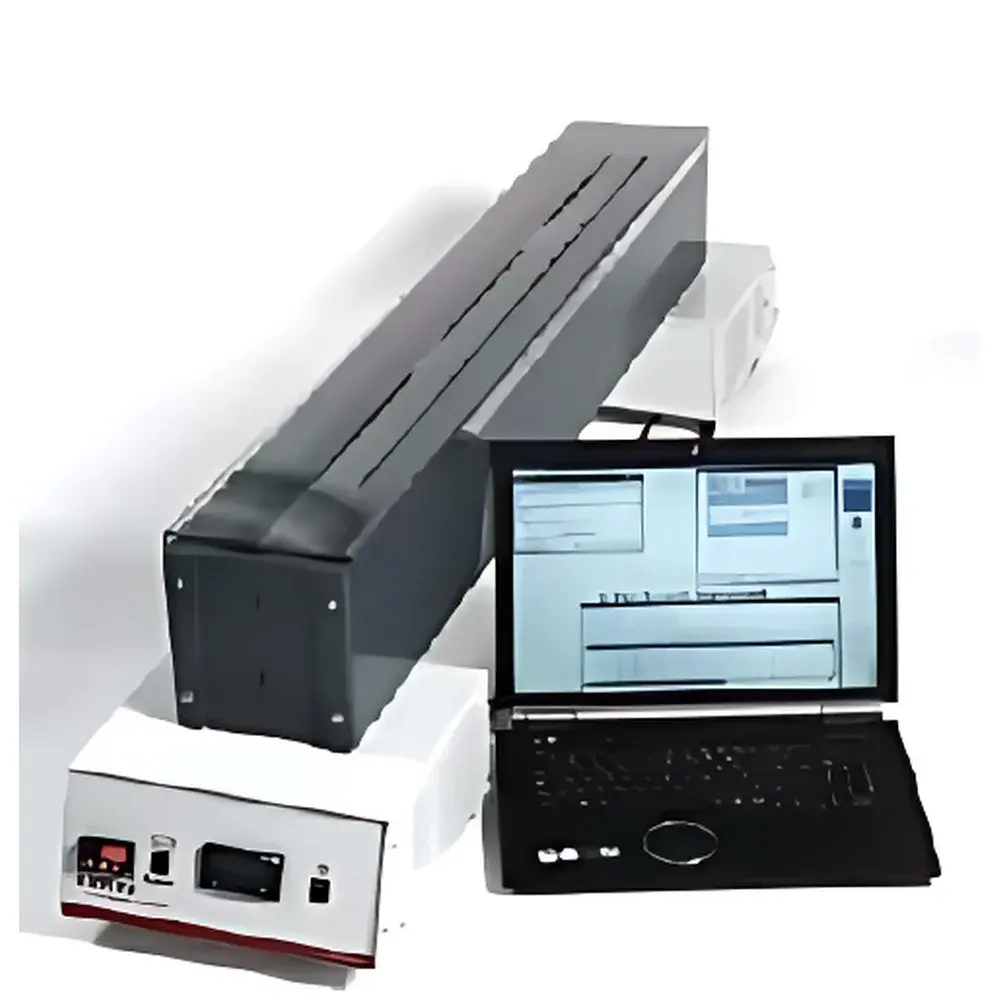
Panlab Thermal Gradient Test System for Rodent Thermoregulatory Behavior Analysis
| Brand | Panlab |
|---|---|
| Origin | Spain |
| Model | Thermal Gradient Test |
| Temperature Range | 15–55 °C |
| Gradient Length | 312.5 cm |
| Max Zones | 20 independent isothermal segments |
| Animal Capacity | 1 rat OR 2 mice |
| Position Tracking | Real-time locomotion mapping via synchronized video |
| Data Output | Dwell time per zone, total path length, latency to preferred zone, thermal preference curve |
| Compliance | Designed for GLP-compliant behavioral phenotyping |
Overview
The Panlab Thermal Gradient Test System is a precision-engineered platform for quantitative assessment of thermosensory preference and thermoregulatory behavior in rodents. Based on the principle of spatial thermal gradient exploration, the system establishes a continuous, linear temperature continuum (15–55 °C) across a 312.5 cm stainless-steel test corridor. Unlike discrete-chamber paradigms, this design enables uninterrupted, ethologically relevant locomotion, allowing subjects to self-select preferred thermal microenvironments without forced confinement or abrupt transitions. The apparatus operates under controlled ambient conditions and integrates real-time thermal profiling with high-resolution motion tracking—providing objective, temporally resolved metrics of thermal aversion, attraction, and homeostatic set-point estimation. It is widely applied in neuroscience, pain research, metabolic phenotyping, and preclinical evaluation of TRP channel modulators.
Key Features
- 312.5 cm linear aluminum-alloy test corridor with embedded Peltier-based heating/cooling elements and 20 independently controllable thermal zones
- High-stability gradient maintenance: ±0.3 °C zone-to-zone accuracy and <±0.1 °C temporal drift over 60-min sessions
- Simultaneous dual-subject capability (2 mice) or single-rat configuration with species-specific floor texture and wall height
- Integrated HD infrared camera (60 fps, 1080p) synchronized with thermal zone metadata and position coordinates
- Automated calibration protocol ensuring traceable thermal mapping via NIST-traceable PT100 sensors at 5 cm intervals
- Modular enclosure with acoustic dampening and optional light/dark cycle integration for circadian-controlled assays
Sample Compatibility & Compliance
The system supports C57BL/6, BALB/c, CD-1, Sprague-Dawley, and Wistar strains across standard age ranges (6–24 weeks). Weight limits: ≤500 g for rats; ≤40 g per mouse. All materials comply with ISO 10993-5 (cytotoxicity) and EU Directive 2010/63/EU on animal welfare. Experimental protocols align with NIH Guide for Care and Use of Laboratory Animals and AAALAC International standards. Data acquisition adheres to ALCOA+ principles (Attributable, Legible, Contemporaneous, Original, Accurate, Complete, Consistent, Enduring, Available), supporting audit readiness for GLP and GCP studies.
Software & Data Management
The included EthoVision XT Thermal Gradient Module (v16+) provides fully automated analysis: real-time zone occupancy heatmaps, dwell time histograms, velocity profiles across thermal gradients, and derivation of thermal preference curves (TPCs). Raw thermal maps and trajectory data are stored in HDF5 format with embedded metadata (timestamp, ambient RH/T, operator ID, session ID). Audit trail functionality logs all parameter modifications, user logins, and export events—fully compliant with FDA 21 CFR Part 11 requirements when configured with electronic signatures and role-based access control. Export options include CSV, MATLAB (.mat), and standardized JSON-LD for FAIR data sharing.
Applications
- Quantification of thermal nociception thresholds in inflammatory, neuropathic, and chemotherapy-induced peripheral neuropathy models
- Characterization of thermoregulatory deficits in obesity, diabetes, and hypothalamic lesion studies
- Pharmacological profiling of TRPV1, TRPM8, and TRPA1 modulators—including dose-response and time-course analyses
- Developmental thermosensation studies in juvenile and aged rodents
- Behavioral validation of genetic knockouts affecting central thermoregulation (e.g., POA, DMH, or raphe nuclei targets)
- Combined multimodal testing: integration with optogenetic stimulation or wireless EEG/EMG recording systems
FAQ
What is the minimum recommended acclimation time before initiating a thermal gradient session?
Animals must undergo ≥30 min acclimation within the enclosed test environment under baseline isothermal conditions (25 °C) prior to gradient initiation.
Can the system be used for non-rodent species such as guinea pigs or hamsters?
Yes—custom floor inserts and zone-height adjustments support guinea pigs (up to 400 g) and Syrian hamsters; validation data available upon request.
Is remote monitoring supported during long-duration experiments (e.g., 24-h thermoregulatory rhythm studies)?
Yes—the system supports unattended operation up to 72 h with automatic thermal recalibration every 4 h and cloud-synced alert notifications for hardware anomalies.
How is thermal uniformity validated across the full 312.5 cm corridor?
Pre-session validation uses a motorized thermal probe carriage (certified to ±0.05 °C) that traverses the entire length while logging spatial thermal profiles against reference RTDs.
Does the software support batch processing of multiple subjects across different experimental groups?
Yes—EthoVision XT’s Group Analysis Wizard enables statistical comparison of dwell distributions, TPC slopes, and latency metrics across up to 96 subjects per batch, with ANOVA, mixed-effects modeling, and post-hoc Tukey HSD reporting.




