
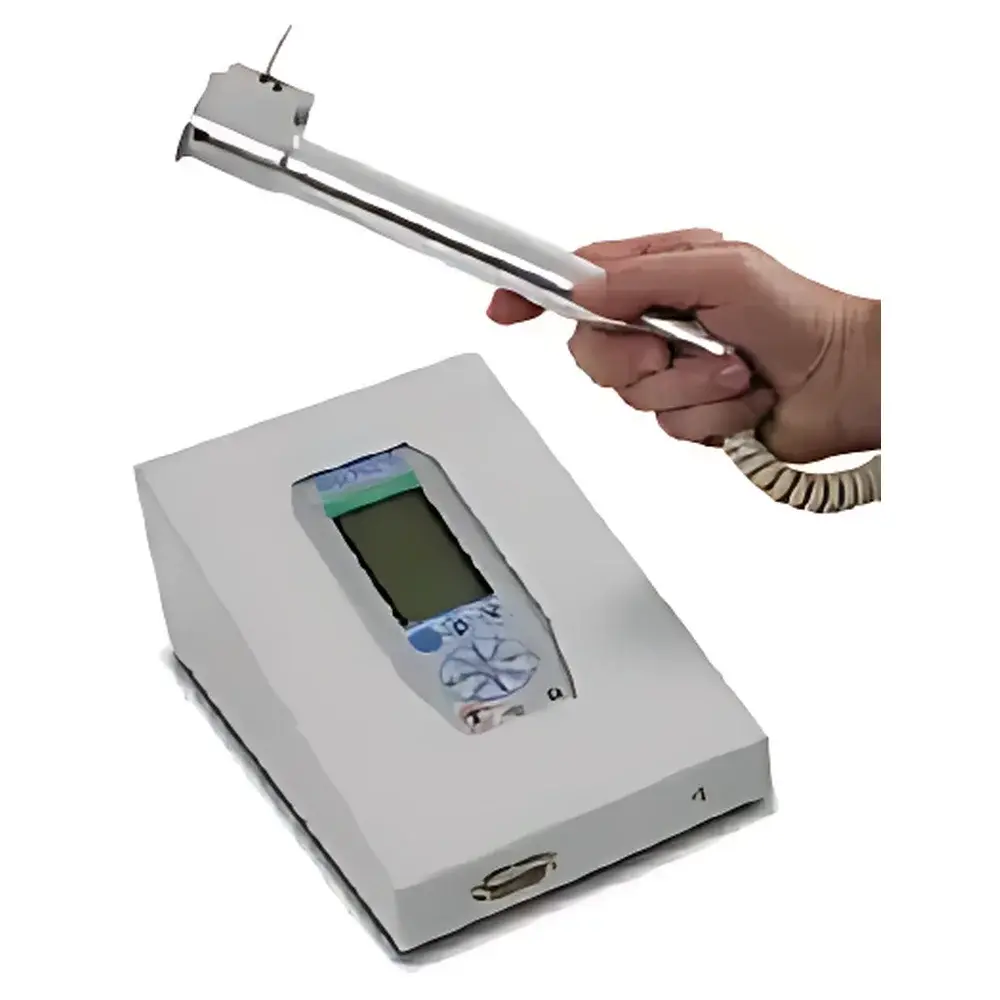
Panlab / Harvard Apparatus von Frey Anesthesiometer (Model: Touch-Test™ Electronic Von Frey Anesthesiometer)
| Brand | Panlab / Harvard Apparatus |
|---|---|
| Origin | Spain |
| Manufacturer Type | Authorized Distributor |
| Origin Category | Imported |
| Model | Touch-Test™ Electronic Von Frey Anesthesiometer |
| Measurement Range | 0–500 g (±20% overload tolerance) |
| Display Resolution | 0.1 g |
| Measurement Accuracy | ±0.2 g |
| Operating Temperature | 0–50 °C |
| Statistical Capacity | Mean, Standard Deviation, Coefficient of Variation (up to 100 animal records) |
| Compliance | ISO 9001 certified, EMC compliant |
| Interface | RS-232 serial output, optional footswitch control |
Overview
The Panlab / Harvard Apparatus Touch-Test™ Electronic Von Frey Anesthesiometer is a precision-engineered instrument designed for quantitative assessment of mechanical nociceptive thresholds in rodent models. It operates on the principle of calibrated, linearly increasing mechanical force application via a rigid stainless-steel probe tip (diameter: 0.5 mm), enabling objective determination of paw-withdrawal threshold—the minimal force at which a hindpaw reflexively withdraws from sustained tactile stimulation. Unlike traditional manual von Frey filaments—subject to inter-operator variability, filament bending hysteresis, and inconsistent contact area—the electronic anesthesiometer delivers reproducible, traceable force profiles with real-time feedback. Its load cell-based transduction system adheres to fundamental principles of Hookean force measurement and dynamic load calibration, ensuring metrological consistency across longitudinal studies and multi-site preclinical trials.
Key Features
- High-resolution force delivery (0.1 g display resolution, ±0.2 g measurement accuracy) with automatic threshold capture upon paw withdrawal
- Fixed-probe geometry ensures constant stimulation surface area (0.5 mm diameter), eliminating confounding variables associated with filament buckling or variable tip deformation
- Integrated statistical engine computes mean, standard deviation, and coefficient of variation in real time—supporting up to 100 individual animal datasets without external software
- Overload-tolerant sensor architecture (rated 0–500 g, with 20% safe overrange capacity) prevents permanent transducer drift or zero-point shift during routine handling or accidental overload
- Backlit LCD display with intuitive single-button navigation; compatible with optional footswitch for hands-free reset and trial initiation—minimizing experimenter-induced stress and improving behavioral assay fidelity
- RS-232 serial interface enables direct data streaming to Windows-based workstations running the included Touch-Test™ Data Acquisition Software (v3.2+)
Sample Compatibility & Compliance
The instrument is validated for use in Sprague-Dawley, Wistar, C57BL/6, and CD-1 mice and rats (body weight range: 15–400 g). Stimulation protocols align with IASP (International Association for the Study of Pain) guidelines for mechanosensory threshold assessment and are referenced in peer-reviewed methodologies compliant with NIH OLAW and AAALAC International standards for humane animal experimentation. Device firmware and hardware design conform to ISO 9001:2015 quality management requirements and EN 61326-1:2013 electromagnetic compatibility (EMC) specifications. While not FDA-cleared as a medical device, its metrological traceability supports GLP-compliant toxicology and pharmacodynamic studies under OECD Test Guidelines 407 and 425.
Software & Data Management
The Touch-Test™ Data Acquisition Software provides audit-trail-capable data logging with timestamped trial metadata (operator ID, animal ID, date/time, ambient temperature). Raw force-vs.-time waveforms are exportable in CSV and Excel-compatible formats. The software supports batch export, group-wise statistical comparison (unpaired t-test, one-way ANOVA with post-hoc Tukey), and automated report generation meeting internal SOP and regulatory submission requirements (e.g., FDA IND-enabling nonclinical study reports). All data files retain embedded calibration certificate references and firmware version stamps, satisfying 21 CFR Part 11 requirements for electronic records when deployed on validated IT infrastructure.
Applications
This anesthesiometer is routinely deployed in preclinical neuroscience, pain pharmacology, and neuroinflammation research. Primary use cases include longitudinal monitoring of mechanical allodynia in chronic constriction injury (CCI), spared nerve injury (SNI), and streptozotocin-induced diabetic neuropathy models; evaluation of opioid-sparing analgesic efficacy; characterization of TRP channel modulators; and validation of gene-editing interventions targeting dorsal root ganglion mechanotransduction pathways. Its high intra- and inter-session reproducibility (CV < 6% across n = 12 repeated measures in controlled cohort studies) makes it suitable for dose-response curve derivation and PK/PD modeling.
FAQ
What is the recommended calibration frequency for the load cell?
Calibration is performed at factory using NIST-traceable deadweight standards. Users should verify zero-point stability daily and perform full two-point calibration (0 g and 250 g) weekly—or after any physical impact—to maintain ±0.2 g accuracy.
Can the probe tip be sterilized between animals?
Yes. The stainless-steel probe is autoclavable (121 °C, 15 psi, 20 min) and compatible with 70% ethanol wipe disinfection. Tip replacement kits are available to ensure consistent geometry over extended use.
Is the device compatible with third-party behavioral tracking systems?
While no native API exists, the RS-232 TTL-level output allows synchronization with external triggers (e.g., EthoVision XT, ANY-maze) via custom LabVIEW or Python scripts using standard serial event polling.
Does the statistical module support outlier detection algorithms?
The onboard processor implements Grubbs’ test (α = 0.05) for single-outlier identification per animal dataset prior to mean calculation—configurable via software settings.
What environmental conditions must be maintained during testing?
Testing should occur in a quiet, temperature-controlled room (22 ± 2 °C), with animals acclimated for ≥30 min on elevated wire-mesh flooring to ensure unimpeded paw access and minimize thermal or auditory confounds.




