
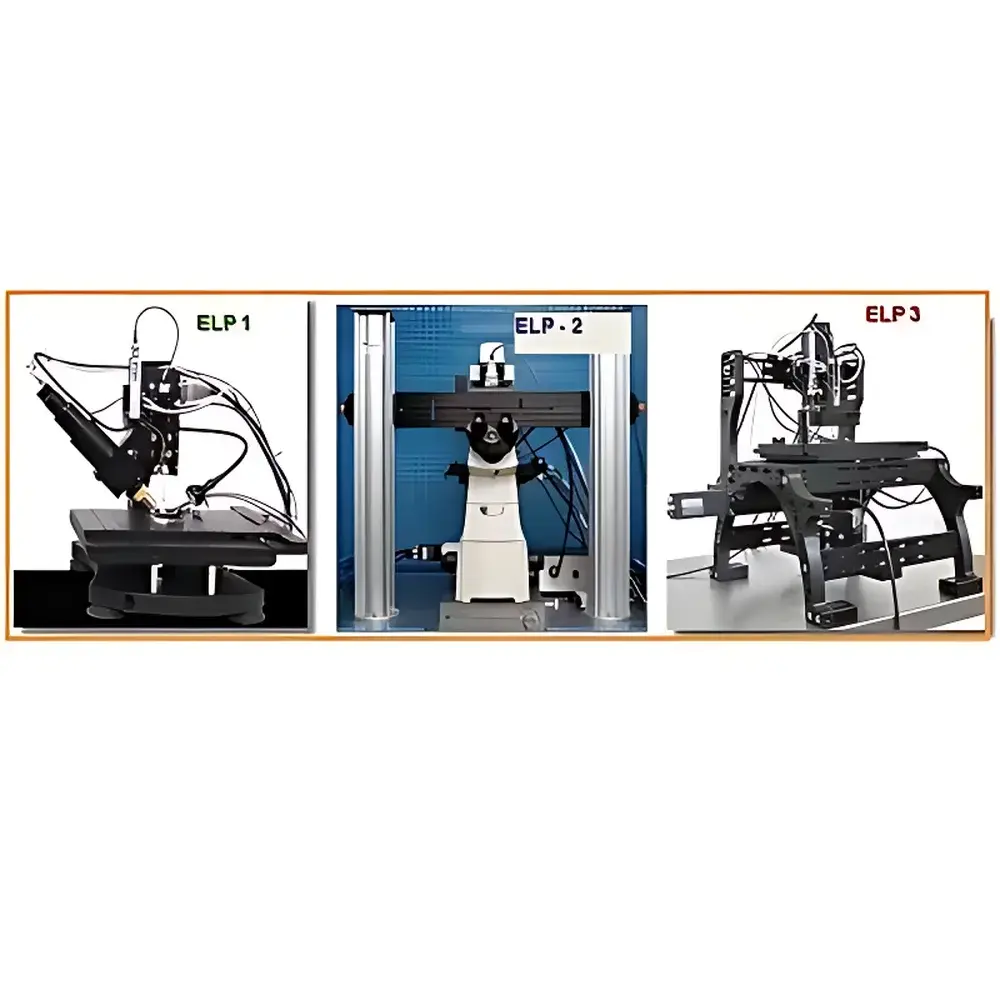
HEKA ElProScan Scanning Electrochemical Microscope
| Brand | HEKA |
|---|---|
| Origin | Germany |
| Model | ElProScan |
| Type | Integrated Scanning Electrochemical Microscope (SECM) with Dual Potentiostat, Piezoelectric Positioning, and pA–2 A Current Range |
| Current Measurement Range | 1 pA to 2 A |
| Noise Floor | < 1 pA (RMS) |
| Positioning Control | Closed-loop piezoelectric XYZ stage |
| Scan Modes | Constant-height, constant-current, shear-force feedback, template-based 3D array scanning |
| Pulse Protocol | Programmable multi-step electrochemical pulse sequences applied independently at tip and substrate |
| Software Architecture | Real-time deterministic control OS with integrated electrochemical experiment sequencing, data acquisition, and 3D visualization |
| Compliance | Designed for GLP/GMP-adjacent research environments |
Overview
The HEKA ElProScan Scanning Electrochemical Microscope is a high-precision, integrated platform engineered for quantitative spatial mapping of electrochemical activity at solid–liquid interfaces. Operating on the core principle of scanning electrochemical microscopy (SECM), the ElProScan employs an ultra-microelectrode (UME) tip scanned in three dimensions above a conductive or catalytically active sample surface immersed in electrolyte. Unlike conventional SECM systems limited to amperometric tip-current monitoring, the ElProScan implements true dual-channel electrochemical control: independent, synchronized potentiostatic/galvanostatic protocols can be executed simultaneously at both the tip and the substrate. This enables direct correlation between local interfacial kinetics (e.g., electron transfer, mass transport, catalytic turnover) and topographic or functional heterogeneity—without requiring post-hoc alignment or sequential measurement.
Key Features
- True dual-potentiostat architecture with fully independent voltage/current control at tip and substrate electrodes, supporting concurrent chronoamperometry, cyclic voltammetry, pulse voltammetry, and impedance spectroscopy.
- Closed-loop piezoelectric XYZ positioning system with sub-nanometer resolution and real-time feedback compensation—ensuring positional fidelity during long-duration scans under variable hydrodynamic or thermal conditions.
- Ultra-low-noise current measurement capability spanning 12 orders of magnitude (1 pA to 2 A), achieved via selectable gain stages and embedded pA-range preamplifiers with <1 pA RMS noise floor.
- Real-time deterministic operating system enabling isovelocity scanning, dynamic slope compensation, and hardware-synchronized pulse triggering—critical for reproducible transient electrochemical imaging.
- Shear-force feedback integration for non-contact topography acquisition in viscous or particulate-containing electrolytes, eliminating mechanical contact artifacts while preserving electrochemical integrity.
- Programmable Pulse Protocol (PPP) engine allowing user-defined multi-step electrochemical sequences—including simultaneous tip polarization and substrate perturbation—for localized surface modification (e.g., electrodeposition, electropolymerization, enzymatic immobilization).
Sample Compatibility & Compliance
The ElProScan accommodates a broad range of electrochemically relevant samples: single-crystal electrodes, thin-film catalysts, biological membranes, conducting polymers, corrosion-prone alloys, and enzyme-modified biosensors. Its open-cell design supports standard three-electrode configurations and custom electrochemical cells (e.g., microfluidic flow cells, gas-diffusion electrodes). All hardware and software components are designed to meet requirements for traceable, auditable research workflows. The system supports optional FDA 21 CFR Part 11–compliant configuration with electronic signatures, full audit trails, role-based access control, and immutable experimental metadata logging—making it suitable for regulated development environments aligned with ICH-GCP, ISO/IEC 17025, and ASTM E2914 standards.
Software & Data Management
Control and analysis are unified within HEKA’s ElProScan Suite—a native 64-bit application built on a real-time deterministic kernel. The interface provides synchronized visualization of topography, current maps, and time-resolved electrochemical waveforms across all scan points. Users define experiments via hierarchical protocol trees: from basic approach curves and line scans to complex 3D volumetric acquisitions with conditional branching (e.g., “if tip current exceeds threshold X, initiate deposition pulse on substrate”). Raw data are stored in HDF5 format with embedded calibration metadata, enabling interoperability with MATLAB, Python (via h5py), and third-party electrochemical analysis tools. Batch processing pipelines support automated background subtraction, diffusion-layer correction, and kinetic parameter fitting using finite-element modeling libraries.
Applications
- Quantitative imaging of heterogeneous electrocatalyst surfaces (e.g., Pt/C, NiFe LDH) to resolve active site distribution and local Tafel behavior.
- In situ monitoring of metal electrodeposition and dissolution dynamics at grain boundaries and defect sites.
- Mapping of enzymatic activity gradients across immobilized glucose oxidase or laccase layers with spatial resolution down to 500 nm.
- Localized electropolymerization of polyaniline or PEDOT for patterned conductive microstructures.
- Corrosion science applications including real-time detection of anodic dissolution hotspots and passive film breakdown events.
- Electrochemical impedance tomography (EIT) via multi-frequency SECM scanning for subsurface conductivity profiling.
FAQ
What distinguishes ElProScan from conventional SECM systems?
ElProScan uniquely combines dual-channel potentiostatic control, closed-loop piezoelectric positioning, and programmable pulse sequencing—enabling simultaneous electrochemical interrogation and functional modification at the tip and substrate, beyond passive current mapping.
Can ElProScan operate as a standalone bipotentiostat?
Yes—the dual-channel potentiostat module functions independently of the scanning stage, supporting classical bulk electrochemical measurements (CV, CA, EIS) with full 1 pA–2 A range and low-noise performance.
Is shear-force feedback compatible with all electrolyte types?
Shear-force operation is validated in aqueous and organic electrolytes with viscosities up to 20 cP; performance in highly viscous or particulate-laden media may require optimized cantilever tuning and calibration.
Does the system support automated calibration routines?
Yes—integrated software modules guide users through tip radius estimation, approach curve fitting, diffusion-controlled current calibration, and stage linearity verification using NIST-traceable reference standards.
What level of technical support and documentation is provided?
HEKA supplies comprehensive English-language documentation including hardware schematics, firmware source references (for advanced customization), application notes covering >35 peer-reviewed use cases, and remote diagnostic support via secure VNC with encrypted session logging.




