
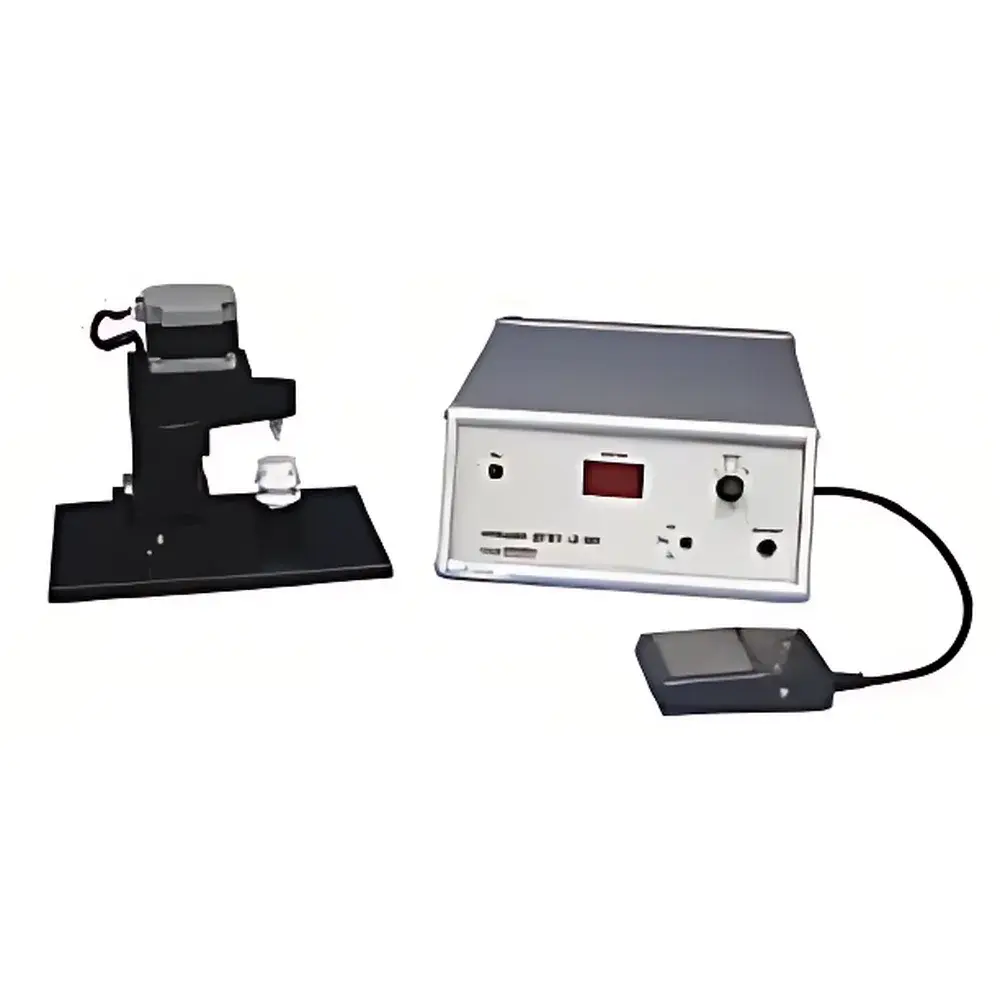
Panlab LE7306 Paw Pressure Meter for Rodent Nociception Testing
| Brand | Panlab |
|---|---|
| Origin | Spain |
| Model | LE7306 |
| Device Type | Electronic Dynamic Pressure Stimulator for Hindpaw Withdrawal Threshold Measurement |
| Compliance Context | Designed for preclinical pain research in accordance with IASP guidelines and standard rodent behavioral assay protocols (e.g., Randall–Selitto test) |
Overview
The Panlab LE7306 Paw Pressure Meter is a precision-engineered, electronically controlled dynamic pressure stimulator designed for quantitative assessment of mechanical nociceptive thresholds in rodents—primarily rats and mice. It operates on the validated Randall–Selitto principle, which quantifies the force threshold at which an animal withdraws its hindpaw in response to gradually increasing mechanical pressure applied to the dorsal surface of the paw. This assay provides a reliable, non-invasive, and stimulus-intensity-controlled method for evaluating hypersensitivity in models of inflammatory, neuropathic, or post-surgical pain. The instrument employs a calibrated load cell and closed-loop motorized actuation system to deliver linearly increasing force (in grams-force or newtons) with high reproducibility and minimal inter-operator variability. Its design emphasizes experimental consistency, operator ergonomics, and compatibility with standard vivarium workflows.
Key Features
- Real-time digital display of applied force (gF or N), updated at ≥10 Hz sampling rate for precise endpoint detection
- Motor-driven, continuously variable pressure ramp (0–500 gF typical range; configurable slope via software or front-panel controls)
- Dedicated footswitch interface enabling hands-free initiation and termination of stimulation cycles—critical for minimizing handling stress and ensuring timing fidelity
- Integrated control unit with zeroing, tare, and sensor calibration functions; supports automatic baseline stabilization prior to each trial
- Adjustable motor speed control (0.1–5.0 gF/s range) to accommodate different experimental paradigms—including rapid screening vs. high-resolution threshold mapping
- Compact, modular architecture with detachable stimulation probe and reinforced stainless-steel base plate for stable placement on stereotaxic frames or benchtop surfaces
Sample Compatibility & Compliance
The LE7306 is optimized for use with adult Sprague-Dawley, Wistar, and C57BL/6 rodents (150–300 g body weight). It accommodates both restrained and lightly restrained protocols—compatible with standard acrylic restraint tubes or custom-designed holding fixtures. The device conforms to widely accepted preclinical pain assessment standards outlined by the International Association for the Study of Pain (IASP) and aligns with methodology described in peer-reviewed literature (e.g., Pain, Journal of Neuroscience Methods). While not a regulated medical device, its operational parameters support GLP-aligned data collection when used within institutional animal care and use committee (IACUC)-approved protocols. All mechanical components meet CE marking requirements for laboratory equipment safety (2014/30/EU EMC Directive and 2014/35/EU Low Voltage Directive).
Software & Data Management
The LE7306 operates as a standalone instrument but integrates seamlessly with Panlab’s BioSENIOR v5.x acquisition suite via RS-232 or USB-to-serial interface. This enables synchronized timestamped recording of force profiles alongside concurrent video capture, EMG, or thermal imaging data. Raw force-time traces are exportable in CSV and MATLAB-compatible formats. Audit-trail functionality (user login, session ID, parameter logs) satisfies basic data integrity requirements for publication-ready datasets. Although not FDA 21 CFR Part 11 compliant out-of-the-box, the system supports manual documentation practices required under AAALAC-accredited facilities and NIH-funded grant reporting.
Applications
- Longitudinal evaluation of mechanical allodynia and hyperalgesia in chronic constriction injury (CCI), spared nerve injury (SNI), and complete Freund’s adjuvant (CFA) models
- Pharmacodynamic profiling of analgesics—including NSAIDs, gabapentinoids, opioid receptor modulators, and novel biologics—in dose–response and time–course studies
- Validation of genetic knockouts or transgenic lines exhibiting altered nociceptive processing
- Assessment of central sensitization following spinal cord injury or intrathecal drug administration
- Training platform for standardizing pain behavior scoring across multi-investigator laboratories
FAQ
What species and strains are compatible with the LE7306?
Rats (Sprague-Dawley, Wistar, Long-Evans) and mice (C57BL/6, BALB/c) are routinely used; optimal performance requires subjects ≥6 weeks old and within standard weight ranges for their strain.
Does the device support automated threshold calculation?
No—the LE7306 delivers controlled stimulation and displays real-time force, but withdrawal reflex detection remains observer-determined per IASP criteria; optional video synchronization aids blinded endpoint scoring.
Can the pressure probe be sterilized between animals?
Yes—the stainless-steel probe tip is autoclavable (121°C, 15 psi, 20 min); full probe assembly disassembly instructions are provided in the technical manual.
Is technical support available outside Spain?
Panlab maintains authorized service partners in North America, EMEA, and APAC regions; firmware updates and calibration certificates are distributed through regional distributors.
How is force calibration verified?
Users perform daily verification using NIST-traceable test weights (supplied with initial shipment); annual recalibration by an ISO/IEC 17025-accredited lab is recommended for longitudinal studies.






