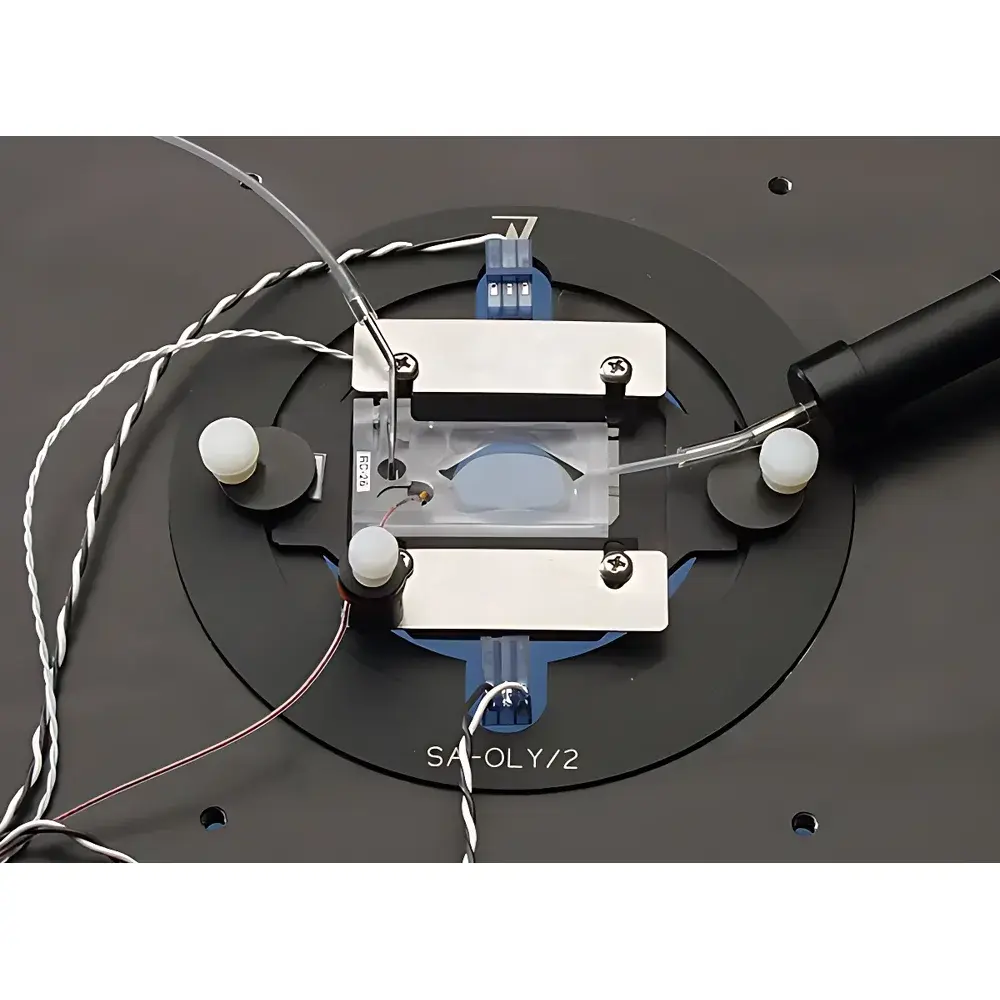
Warner Instruments RC20/RC30/RC40/RC50 Perfusion Chamber for Cellular Imaging & Electrophysiological Recording
| Brand | Warner Instruments |
|---|---|
| Origin | USA |
| Model Series | RC20, RC30, RC40, RC50 |
| Chamber Type | Open- or Closed-configuration Perfusion Bath |
| Compatibility | Patch-clamp, Ussing, Field Stimulation, Microincubation, Oocyte, and Tissue Applications |
| Fluid Volume Range | 20 µL to >300 µL |
| Mounting Interface | Standard Microscope Stage Adapters (Nikon, Olympus, Zeiss, Leica) |
| Thermal Control Support | Compatible with Warner TC-344B, TC-324B, and Dual-Channel PID Controllers |
| Gas Control Ready | Integrated ports for O₂/CO₂/N₂ blending and humidified gas delivery |
Overview
The Warner Instruments RC20, RC30, RC40, and RC50 Perfusion Chambers are precision-engineered platforms designed to maintain physiologically relevant microenvironments for live-cell imaging and concurrent electrophysiological recording. These chambers operate on the principle of laminar, low-shear perfusion—delivering continuous, temperature-stabilized, gas-equilibrated extracellular solution across adherent or suspended cells while minimizing mechanical disturbance and thermal drift. Each model is constructed from optically transparent, biocompatible polycarbonate or quartz-glass substrates with precisely machined fluidic pathways, enabling high-resolution DIC, phase-contrast, fluorescence, and confocal microscopy without optical aberration. The RC-series supports both open-bath (e.g., for patch-clamp) and closed-chamber (e.g., for Ussing or CO₂-sensitive assays) configurations, and integrates seamlessly with Warner’s family of temperature controllers, gravity-fed or pressure-driven perfusion systems, and gas-mixing manifolds—ensuring experimental reproducibility under defined physiological conditions (37 °C, pH 7.4, 5% CO₂, 95% O₂, osmolarity 290–310 mOsm/kg).
Key Features
- Modular design with interchangeable base plates and lid assemblies to support multiple experimental paradigms—including whole-cell patch-clamp, field stimulation, transepithelial resistance (TER) measurement, and oocyte voltage-clamp.
- Low dead-volume fluidics (as low as 20 µL in RC20) with rapid solution exchange (<500 ms for 90% solution turnover), critical for kinetic studies of ligand-gated ion channels and receptor desensitization.
- Integrated grounding and shielding options to minimize electromagnetic interference during high-gain voltage-clamp recordings.
- Standardized dovetail and threaded mounting interfaces compatible with motorized microscope stages and nanopositioners (e.g., Ludl, Prior, Sutter).
- Thermal isolation architecture with dual-layer insulation and optional Peltier-based pre-cooling to suppress convective currents during long-duration time-lapse imaging.
- Gas-permeable or gas-tight sealing options; all models include dedicated inlet/outlet ports for humidified gas delivery and inline pH/O₂ monitoring.
Sample Compatibility & Compliance
The RC-series accommodates a broad spectrum of biological specimens: primary neurons, cardiomyocytes, HEK293 and CHO cell lines, intestinal/airway epithelia, Xenopus oocytes, brain slices (up to 400 µm), and ex vivo tissue preparations. Chamber geometries comply with ASTM E2918-13 (standard guide for electrophysiological assay validation) and support GLP-compliant workflows when paired with Warner’s FDA 21 CFR Part 11–enabled data acquisition software (e.g., pCLAMP 11+ with audit trail configuration). All materials meet USP Class VI biocompatibility requirements and are autoclavable or ethanol-sterilizable. Electrical safety conforms to IEC 61010-1 for laboratory equipment used in life science applications.
Software & Data Management
Warner perfusion chambers interface natively with industry-standard electrophysiology and imaging platforms—including Molecular Devices Axon Digidata series, HEKA EPC10/20 amplifiers, and Andor iXon cameras—via TTL synchronization and analog voltage triggering. Chamber control parameters (flow rate, temperature setpoint, gas composition) can be logged alongside electrophysiological traces using Warner’s WinFluor-compatible acquisition modules or third-party Python/Matlab APIs. Full metadata tagging (chamber ID, solution batch, calibration timestamp) is supported for traceable experiment reconstruction. When deployed in regulated environments, system logs—including user access, parameter changes, and hardware status—meet ALCOA+ (Attributable, Legible, Contemporaneous, Original, Accurate, Complete, Consistent, Enduring, Available) data integrity standards.
Applications
- Real-time correlation of calcium dynamics (via GCaMP or Fura-2) with action potential firing in iPSC-derived neurons.
- High-fidelity measurement of epithelial sodium channel (ENaC) activity under variable Na⁺/amiloride gradients in polarized MDCK monolayers.
- Pharmacological profiling of hERG potassium channel blockers using temperature-controlled, CO₂-buffered Ringer’s solution in HEK293-hERG cells.
- Optogenetic stimulation combined with simultaneous patch-clamp recording in ChR2-transfected hippocampal slices.
- Long-term (>6 hr) functional assessment of mitochondrial membrane potential in cardiomyocytes under controlled metabolic stress (e.g., hypoxia/reoxygenation).
FAQ
Which RC model is recommended for single-cell patch-clamp with high-magnification water-immersion objectives?
The RC20 or RC30 with quartz bottom and low-profile lid minimizes working distance constraints and provides optimal optical clarity for 60×/100× water-dipping lenses.
Can the RC40 chamber be used for Ussing-type transepithelial measurements?
Yes—the RC40 features dual-compartment geometry with Ag/AgCl electrode ports and integrated voltage-sensing electrodes, fully compatible with standard Ussing chamber protocols per ISO 17025-accredited labs.
Is custom machining available for non-standard electrode placements or microfluidic integration?
Warner Instruments offers OEM engineering services including bespoke electrode arrays, integrated microvalves, and laser-drilled microchannel networks—subject to NDA and minimum order volume.
How is temperature uniformity validated across the RC50’s large-volume bath (350 µL)?
Each RC50 undergoes factory calibration using calibrated thermistor arrays; spatial uniformity is verified to ±0.1 °C at steady state when used with TC-344B dual-zone controller and recirculating coolant.
Do Warner perfusion chambers support automated liquid handling integration?
Yes—TTL-triggered solenoid valve control and analog flow feedback outputs enable synchronization with Hamilton STAR, Tecan Fluent, or Opentrons OT-2 robotic workstations for high-throughput electrophysiology screening.