
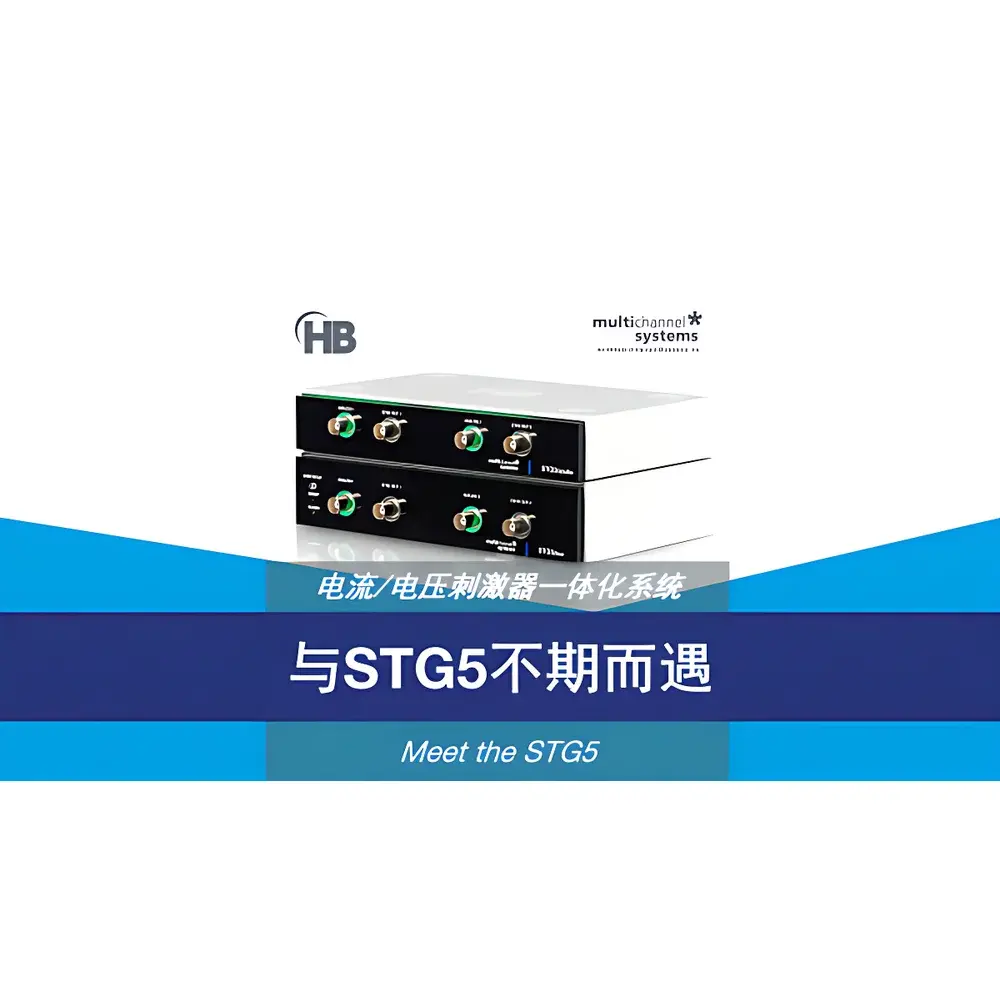
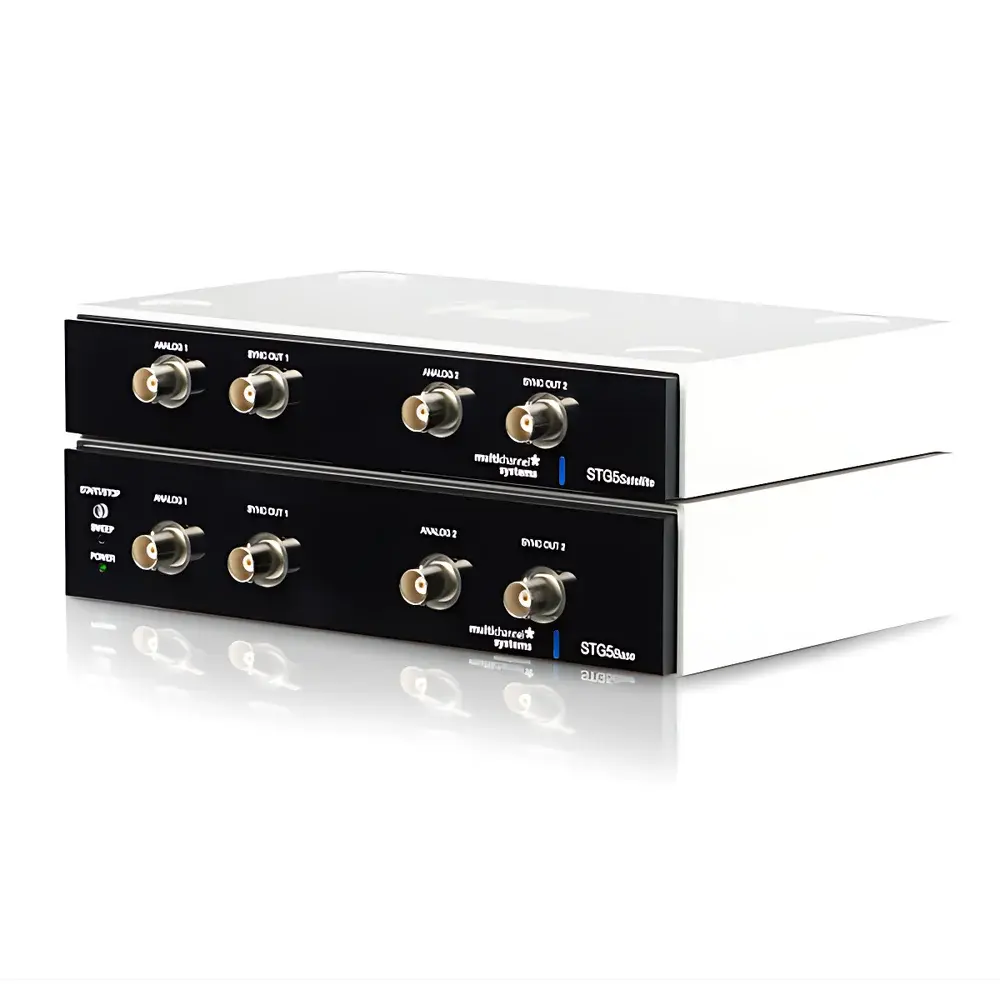
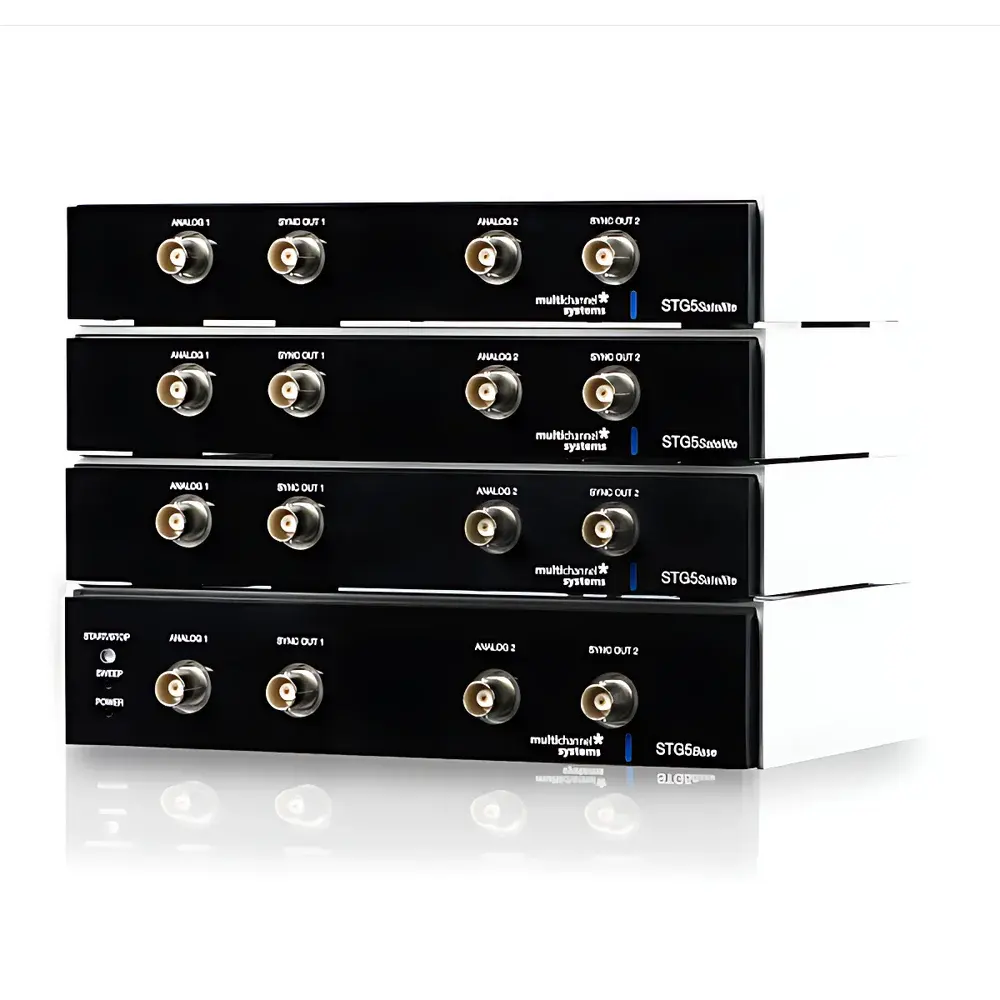
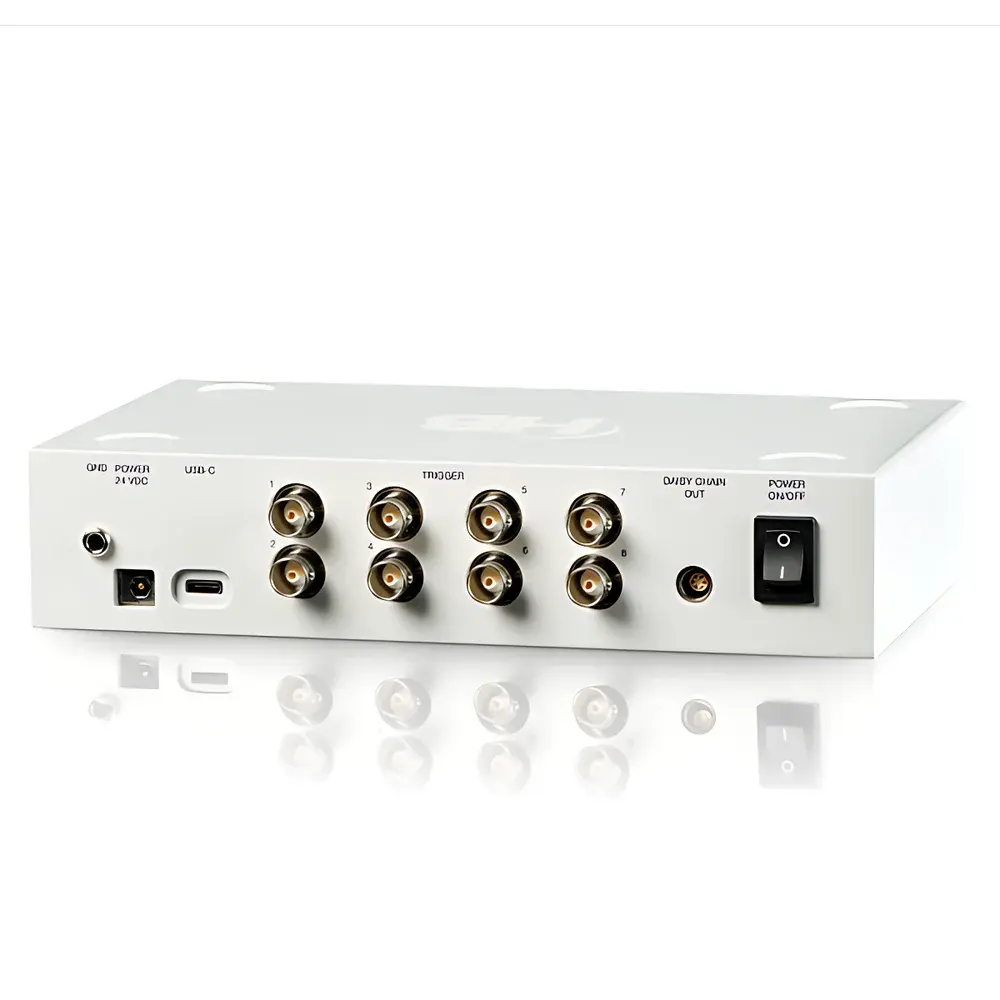
Multi Channel Systems STG5 Integrated Current/Voltage Electrical Stimulator System
| Brand | Multi Channel Systems |
|---|---|
| Origin | Germany |
| Manufacturer Type | Manufacturer |
| Origin Category | Imported |
| Model | STG5 |
| Instrument Type | Multichannel |
| Stimulation Mode | Current & Voltage |
| Output Range | −8 V to +8 V @ max. ±20 mA |
| selectable current ranges | 160 µA, 1.6 mA, and 16 mA |
| Output Accuracy | 250 µV (voltage), 6.25 nA–625 nA (current) |
| Output Frequency | up to 100 kHz |
| Dimensions | Base Unit: 325 mm × 310 mm × 47 mm |
| Satellite Unit | 325 mm × 310 mm × 37 mm |
Overview
The Multi Channel Systems STG5 Integrated Current/Voltage Electrical Stimulator System is a high-precision, modular electrophysiology instrument engineered for rigorous in vitro and ex vivo neurophysiological, cardiac, and cellular stimulation experiments. Based on digitally controlled, galvanically isolated output stages, the STG5 implements true dual-mode operation—supporting both voltage-controlled and current-controlled stimulation within a single hardware platform. Its architecture adheres to core electrophysiological measurement principles: voltage stimulation maintains a defined potential across a load (e.g., electrode-tissue interface), while current stimulation delivers a precise charge per unit time, essential for artifact-free recording during patch-clamp or extracellular field potential measurements. Designed for compatibility with standard electrophysiology rigs—including upright/dual-stage microscopes, Faraday cages, and headstages—the STG5 enables sub-millisecond temporal fidelity and nanoscale amplitude resolution, making it suitable for demanding applications such as spike-triggered stimulation, closed-loop optogenetic-electrical hybrid protocols, and high-frequency burst paradigms.
Key Features
- True integrated current/voltage stimulation: seamless mode switching via MC_Stimulus III software—no hardware reconfiguration required.
- Modular “base + satellite” topology: start with a 2-channel base unit and expand vertically to 8 independent channels using up to three satellite units—all maintaining full electrical isolation between channels.
- Ultra-fast transient response: <2 µs rise time (10%–90%), enabling faithful reproduction of complex waveforms at frequencies up to 100 kHz.
- High-resolution temporal control: 5 µs pulse timing resolution supports precise inter-stimulus intervals and jitter-free synchronization with acquisition systems (e.g., via TTL/PCIe triggers).
- Four-decade programmable current range: 4.5 nA to 16 mA per channel; aggregate output capacity reaches 128 mA when all channels operate in parallel (subject to thermal derating per IEC 60601-2-10 compliance guidelines).
- No external isolation amplifiers needed: each channel features reinforced galvanic isolation (>1 kV DC), eliminating crosstalk and ensuring safety in multi-electrode array (MEA) and slice recording configurations.
Sample Compatibility & Compliance
The STG5 is validated for use with standard electrophysiological preparations including acute brain slices, dissociated neuronal cultures, cardiomyocyte monolayers, and peripheral nerve explants. Its output impedance and compliance voltage are optimized for interfacing with Ag/AgCl electrodes, platinum-iridium microwires, and commercial MEA substrates (e.g., Axion Biosystems Maestro, Alpha MED Scientific MULTI-CHANNEL SYSTEMS chips). The system conforms to IEC 61000-4 electromagnetic compatibility standards and meets essential safety requirements under IEC 60601-1 (Medical Electrical Equipment) and IEC 60601-2-10 (Particular Requirements for Nerve and Muscle Stimulators). All firmware and software components support audit trail functionality and user-access controls aligned with GLP and GMP documentation practices.
Software & Data Management
MC_Stimulus III is a native Windows application providing deterministic real-time stimulus generation, waveform sequencing, and hardware synchronization. It supports import/export of stimulus protocols in HDF5 and MATLAB-compatible .mat formats, facilitating integration into custom analysis pipelines. The software implements role-based user permissions, electronic signatures, and full parameter logging—including timestamped amplitude, duration, polarity, and inter-trial intervals—to satisfy FDA 21 CFR Part 11 requirements for regulated preclinical studies. Stimulus sequences can be triggered externally via TTL, analog voltage, or PCIe-based event signals, enabling tight coupling with imaging systems (e.g., two-photon calcium imaging) or data acquisition platforms (e.g., National Instruments PXI, Spike2, or Open Ephys).
Applications
- High-fidelity synaptic plasticity induction (e.g., LTP/LTD protocols requiring precise charge delivery and sub-millisecond timing).
- Cardiac pacing and arrhythmia modeling in stem-cell-derived cardiomyocyte clusters or Langendorff-perfused hearts.
- Functional validation of optogenetic actuators (e.g., ChR2, Chronos) using co-stimulation paradigms with simultaneous optical and electrical inputs.
- Neuromodulation studies in organotypic slice cultures, including deep-brain stimulation waveform optimization.
- Preclinical safety pharmacology assays assessing compound effects on neuronal excitability and network synchrony.
FAQ
Can the STG5 deliver both current and voltage stimulation simultaneously on different channels?
Yes—each channel operates independently; you may configure some channels in voltage mode and others in current mode concurrently.
Is MC_Stimulus III compatible with third-party acquisition software like Spike2 or PatchMaster?
Yes—via standardized DLL interfaces and hardware trigger I/O, enabling bidirectional synchronization without proprietary lock-in.
What is the maximum safe continuous output power per channel?
At 16 mA and ±8 V compliance, maximum continuous dissipation is limited to 128 mW per channel under forced-air cooling, in accordance with IEC 60601-2-10 thermal safety thresholds.
Does the STG5 support arbitrary waveform generation (AWG) beyond square/pulse patterns?
Yes—MC_Stimulus III supports user-defined waveforms (up to 65,536 points) with linear interpolation and real-time amplitude modulation.
How is calibration traceability maintained across units and over time?
Each STG5 ships with NIST-traceable calibration certificates; annual recalibration services are available directly from Multi Channel Systems’ ISO/IEC 17025-accredited service lab in Reutlingen, Germany.



