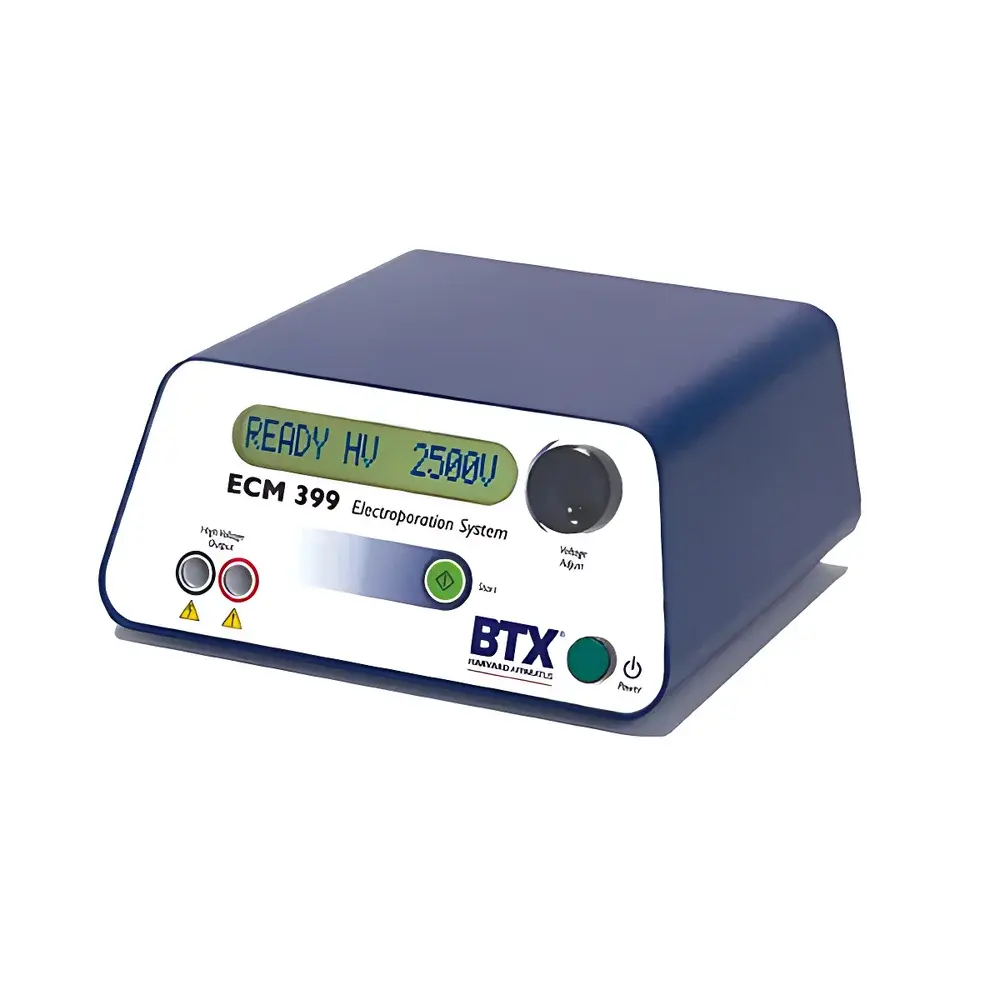
BTX ECM399 Electroporator
| Brand | BTX |
|---|---|
| Origin | USA |
| Manufacturer Type | Authorized Distributor |
| Product Origin | Imported |
| Model | ECM 399 |
| Pricing | Upon Request |
Overview
The BTX ECM399 Electroporator is a benchtop, microprocessor-controlled exponential decay waveform electroporation system engineered for reproducible and scalable nucleic acid or molecule delivery into prokaryotic and eukaryotic cells. Designed in accordance with fundamental principles of electroporation—where transient membrane permeabilization is induced by controlled electric field pulses—the ECM399 delivers precise, user-defined voltage pulses with exponential decay profiles to optimize transfection efficiency while minimizing cellular damage. Its dual-mode architecture (high-voltage and low-voltage) supports standardized transformation protocols for bacterial and yeast systems (e.g., E. coli, S. cerevisiae) as well as selected adherent and suspension mammalian cell lines under optimized conditions. As a legacy instrument developed by BTX, a pioneer in electroporation technology since 1983 and now part of Harvard Bioscience, the ECM399 reflects decades of empirical protocol refinement and hardware robustness validated across academic, teaching, and core facility laboratories.
Key Features
- Dual operational modes: High-voltage mode (10–2500 V, 10 V increments) for microbial transformation; Low-voltage mode (2–500 V, 2 V increments) for select mammalian cell applications.
- Real-time digital monitoring via high-resolution LCD display showing peak voltage output, pulse status, and system readiness.
- Integrated arc suppression circuitry and short-circuit protection to ensure operator safety and equipment longevity during repeated pulse cycling.
- Fixed resistance values (150 Ω in HV mode; 151 Ω in LV mode) paired with selectable capacitance (36 µF in HV mode; 1050 µF in LV mode) enable consistent pulse time constants (τ = R × C) critical for protocol reproducibility.
- Compact, integrated chassis design facilitates portability between teaching labs, shared instrumentation suites, and biosafety cabinets without requiring external power conditioning or cooling.
- Compatible with standard electroporation cuvettes (e.g., 0.1 cm, 0.2 cm, and 1.0 cm gap widths), PEP electrodes, 35 mm culture dish electrodes, and BTX safety workstations for containment-compliant operation.
Sample Compatibility & Compliance
The ECM399 supports routine transformation of plasmid DNA into chemically competent or electrocompetent Escherichia coli, Bacillus subtilis, and Saccharomyces cerevisiae, achieving efficiencies routinely exceeding 1 × 10⁹ CFU/µg pUC19 under optimized settings. In low-voltage mode, it has been employed in published protocols for transient transfection of NIH/3T3, CHO-K1, and primary rat cardiomyocytes—always requiring empirical optimization of field strength, pulse duration, and post-pulse recovery conditions. While not certified for clinical or GMP manufacturing use, the instrument’s design aligns with general laboratory safety standards (ANSI/UL 61010-1, IEC 61010-1) and supports GLP-aligned documentation when used with traceable calibration logs and procedural SOPs. It does not include FDA 21 CFR Part 11-compliant audit trail functionality, making it suitable for research and educational environments where regulatory-grade electronic records are not mandated.
Software & Data Management
The ECM399 operates as a standalone hardware platform with no embedded software stack, network interface, or data export capability. All parameter entry and execution occur via front-panel controls and real-time LCD feedback. This architecture eliminates software dependencies, firmware updates, or cybersecurity vulnerabilities—enhancing reliability in resource-constrained or regulated teaching environments. Users maintain full experimental traceability through manual logbooks or LIMS-integrated recordkeeping. For laboratories requiring automated protocol storage or integration with lab information systems, BTX offers optional external control modules (e.g., ECM 830 with RS-232/USB interface) — though these are not applicable to the ECM399 model.
Applications
- Routine plasmid transformation in bacterial and yeast cloning workflows.
- Transient transfection of suspension and adherent mammalian cell lines in functional genomics and protein expression studies.
- Delivery of siRNA, CRISPR ribonucleoprotein complexes (RNPs), and small molecules in early-stage mechanistic assays.
- Electrofusion of somatic cells for hybridoma generation and developmental biology studies (when paired with BTX fusion electrodes).
- Undergraduate and graduate laboratory instruction in molecular biology, biotechnology, and cell physiology due to intuitive interface and predictable performance.
FAQ
Does the ECM399 support square-wave or capacitance-variable pulse delivery?
No. The ECM399 generates only exponential decay waveforms with fixed internal resistance and two discrete capacitance values. It does not offer programmable pulse width, square-wave output, or variable capacitance selection.
Can the ECM399 be calibrated or serviced in the field?
Voltage calibration requires factory-level metrology using NIST-traceable high-voltage probes. BTX recommends annual verification by authorized service centers; no user-accessible calibration routines are provided.
Is the ECM399 compatible with electroporation buffers containing glycerol or sucrose?
Yes—standard electroporation buffers (e.g., 10% glycerol in 10 mM HEPES, pH 7.4) are fully supported. However, buffer conductivity must remain within 5–15 mS/cm to prevent arcing; users should verify conductivity prior to use.
What safety certifications does the ECM399 carry?
It complies with UL 61010-1 and IEC 61010-1 for electrical safety in laboratory equipment. CE marking is not applicable, as the device is distributed exclusively for research use in North America and select international markets under distributor agreements.
Are consumables such as cuvettes or electrodes included with purchase?
No. Electrodes, cuvettes, and safety accessories (e.g., PEP electrodes, 35 mm dish electrodes, BTX Safety Workstation) are sold separately and selected based on application-specific requirements.