
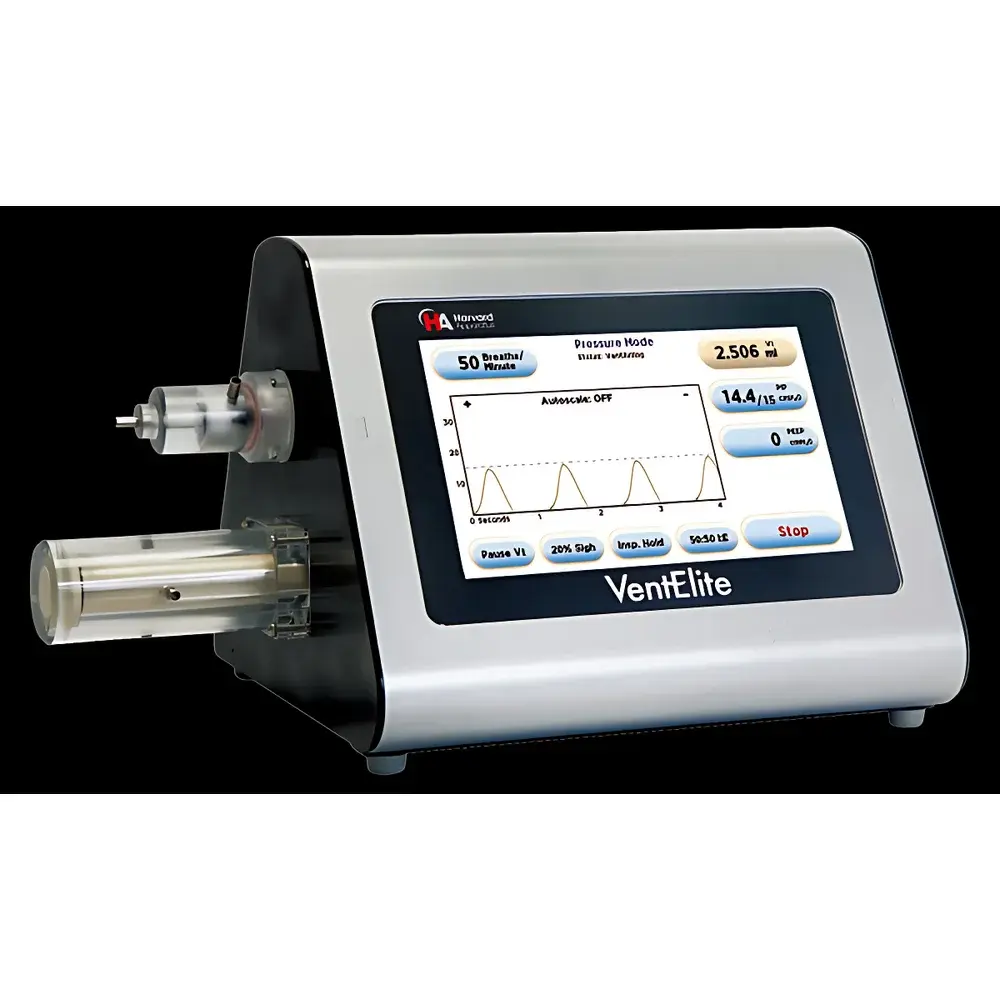
Harvard Apparatus VentElite Small Animal Ventilator
| Brand | Harvard Apparatus |
|---|---|
| Origin | USA |
| Manufacturer Type | Authorized Distributor |
| Origin Category | Imported |
| Model | VentElite |
| Breathing Rate Range | 10–300 bpm |
| Tidal Volume Range | 0.05–5 mL |
| Inspiratory | Expiratory Ratio (I:E): 20–80% |
| Operating Voltage | 15 V DC, 25 W |
| Tidal Volume Resolution | 0.1 µL |
| Dimensions | 31.8 × 20.3 × 17.8 cm |
| Weight Range Supported | 10 g – 1 kg |
Overview
The Harvard Apparatus VentElite is a precision-engineered small animal ventilator designed for controlled mechanical ventilation in preclinical research settings. Based on proven positive-pressure ventilation principles, the VentElite delivers highly accurate and repeatable tidal volumes across a broad physiological range—enabling reliable respiratory support during acute surgical procedures, pharmacological studies, neurophysiological recordings, and critical care modeling in rodents and other small mammals. Its architecture integrates closed-loop flow sensing with digital pressure regulation to maintain consistent inspiratory and expiratory profiles, minimizing ventilator-induced lung injury (VILI) risk while supporting compliance with GLP-compliant experimental protocols.
Key Features
- High-resolution tidal volume control down to 0.1 µL, enabling precise ventilation of neonatal mice (≥10 g) and juvenile rats up to 1 kg.
- Adjustable breathing frequency from 10 to 300 breaths per minute (bpm), accommodating both bradypneic and tachypneic physiological states observed in hypothermic, anesthetized, or pharmacologically modulated subjects.
- Programmable inspiratory-to-expiratory (I:E) ratio between 20% and 80%, facilitating simulation of obstructive, restrictive, or mixed pulmonary pathologies.
- Compact footprint (31.8 × 20.3 × 17.8 cm) and low-power 15 V DC operation (25 W max) ensure compatibility with laminar flow hoods, stereotaxic rigs, and multi-instrument electrophysiology setups.
- Integrated real-time pressure monitoring and audible/visual alarm thresholds for high- and low-pressure events, enhancing operator awareness during long-duration experiments.
- Designed and validated in collaboration with Harvard Medical School physiologists; reflects over 75 years of iterative refinement in small animal respiratory instrumentation.
Sample Compatibility & Compliance
The VentElite supports mechanical ventilation across a defined weight spectrum of 10 g to 1 kg—covering C57BL/6 neonates (P0–P7), adult BALB/c mice (20–35 g), Sprague-Dawley rats (100–500 g), guinea pigs, and young ferrets. It is compatible with standard rodent tracheostomy tubes (e.g., 14–22 G) and custom intubation adapters. The device conforms to IEC 61000-6-2 (EMC immunity) and IEC 61000-6-4 (EMC emissions) standards. While not classified as a medical device under FDA 21 CFR Part 820, its operational parameters align with ISO 80601-2-80:2018 requirements for ventilatory support equipment used in laboratory animal science. Data logging functionality supports audit-ready documentation for GLP and AAALAC-accredited facilities.
Software & Data Management
The VentElite operates via front-panel push-button interface with LED status indicators—no external PC required for basic operation. Optional USB connectivity enables integration with third-party acquisition systems (e.g., LabChart, Spike2, or custom Python-based DAQ platforms) for synchronized recording of ventilator parameters (pressure, flow, cycle timing) alongside physiological signals (ECG, EEG, EMG). All parameter changes are timestamped and stored in non-volatile memory, supporting traceability in regulated environments. Exportable CSV logs include breath-by-breath metrics (peak inspiratory pressure, expiratory time, minute volume), facilitating post-hoc analysis in MATLAB or R.
Applications
- Acute in vivo electrophysiology: Stable ventilation during intracranial recordings or optogenetic stimulation without respiratory artifact contamination.
- Pulmonary drug delivery studies: Coordinated aerosol administration with synchronized inspiration using programmable I:E ratios.
- Ischemia-reperfusion models: Precise control of PaCO₂ via minute ventilation modulation to assess cerebrovascular reactivity.
- Developmental physiology: Long-term ventilation of postnatal day 0–3 mouse pups in thermoregulated chambers.
- Toxicology screening: Assessment of respiratory depression following opioid or sedative administration.
- Respiratory phenotyping in transgenic models: Quantitative comparison of baseline and challenge-induced breathing patterns in genetically modified strains.
FAQ
What species and weight ranges are supported by the VentElite?
The VentElite is validated for use with mammals weighing 10 g to 1 kg—including neonatal and adult mice, rats, guinea pigs, hamsters, and young ferrets.
Does the VentElite support pressure-controlled or volume-controlled ventilation modes?
It operates primarily in volume-controlled mode with pressure-limiting safety features; target tidal volume and respiratory rate are user-defined, while peak inspiratory pressure is continuously monitored and capped.
Is the device compliant with FDA or CE regulatory frameworks?
As a research-use-only (RUO) instrument, it carries CE marking under the EU Directive 2014/30/EU (EMC) and is supplied with technical documentation suitable for institutional biosafety and animal care committee review.
Can tidal volume be calibrated in-house?
Yes—built-in calibration routine supports verification against NIST-traceable syringe pumps or dry-calibration gas meters using standard ISO 8596 methodology.
What maintenance is required for long-term reliability?
Annual verification of flow sensor linearity and pressure transducer drift is recommended; disposable breathing circuits and bacterial/viral filters should be replaced between subjects per institutional IACUC guidelines.




