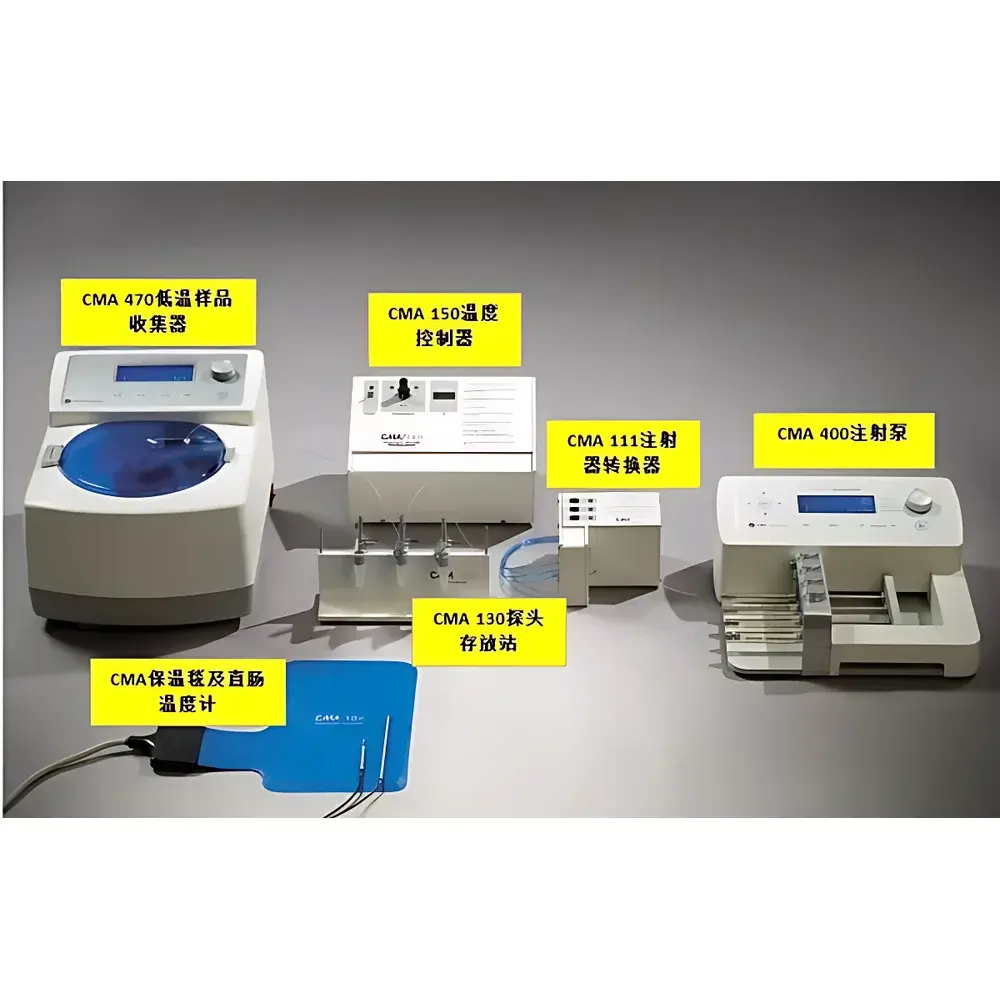
CMA Complete Microdialysis System with Refrigerated Fraction Collection
| Brand | Harvard Apparatus |
|---|---|
| Origin | Sweden |
| Manufacturer Type | Authorized Distributor |
| Origin Category | Imported |
| Model | CMA Complete Microdialysis System with Collection of Cooled Fractions |
| Pricing | Available Upon Request |
Overview
The CMA Complete Microdialysis System with Refrigerated Fraction Collection is a fully integrated, research-grade platform engineered for in vivo and in vitro neurochemical sampling in preclinical models. Built upon the established CMA (Carnegie Medicine AB) microdialysis architecture—now distributed globally by Harvard Apparatus—the system enables real-time, minimally invasive monitoring of extracellular neurotransmitters, metabolites, peptides, and pharmacokinetic analytes in awake, freely moving or anesthetized rodents. The core principle relies on passive diffusion across a semi-permeable membrane (typically 20–100 kDa MWCO) implanted intracerebrally or in peripheral tissues, where analyte concentration in the dialysate reflects interstitial fluid composition under near-physiological conditions. This system is explicitly designed for high-fidelity temporal resolution, low background contamination, and sample integrity preservation—critical for sensitive downstream analyses including HPLC-ECD, LC-MS/MS, ELISA, and enzymatic assays.
Key Features
- Refrigerated fraction collection at 4 °C via the CMA 470 Fraction Collector (P/N 8002770), ensuring thermal stability of labile analytes such as dopamine, serotonin, glutamate, and cytokines during extended sampling periods (up to 72 h).
- Integrated temperature management using the CMA 150 Temperature Controller (P/N 8315010 for mice / 8315000 for rats), featuring real-time rectal thermistor feedback, heated surgical blanket control, and closed-loop regulation to maintain normothermia during anesthesia—a prerequisite for physiologically relevant neurochemical data.
- Dedicated in vitro calibration and probe handling station (CMA 130, P/N 8309101) supporting probe integrity verification, flow-rate validation, and stereotaxic alignment compatibility for precise in vivo implantation planning.
- Automated syringe selection and switching via the CMA 111 Syringe Selector (P/N 8301111), enabling programmable perfusion rate changes, multi-analyte sequential sampling, and unattended operation across multiple experimental phases.
- All modules conform to IEC 61000-6-3 (EMC) and IEC 61000-6-2 (immunity) standards; electrical safety complies with IEC 60601-1 for laboratory medical devices.
Sample Compatibility & Compliance
The system supports standard microdialysis probes (e.g., CMA 7, CMA 12, CMA 71) with membrane lengths from 1 to 6 mm and diameters of 0.24–0.35 mm. Compatible perfusates include artificial cerebrospinal fluid (aCSF), Ringer’s solution, and customized isotonic buffers. Dialysate volumes per fraction range from 1–50 µL, collected directly into chilled polypropylene vials (e.g., 0.5 mL or 1.5 mL tubes). The platform meets essential requirements for GLP-compliant preclinical studies: full audit trail capability (when paired with validated third-party acquisition software), traceable calibration records, and hardware-level temperature logging synchronized with fraction timing. While not FDA-cleared for human use, the system adheres to ISO 13485-aligned manufacturing practices per its Swedish origin and is routinely deployed in academic, pharmaceutical, and contract research organization (CRO) settings supporting IND-enabling toxicology and PK/PD studies.
Software & Data Management
The CMA system operates without proprietary closed-software lock-in; instead, it interfaces via analog/digital I/O (0–10 V, TTL) and RS-232 with industry-standard acquisition platforms—including LabChart (ADInstruments), PowerLab, MATLAB-based custom scripts, or SCADA systems. Fraction collection timing, temperature setpoints, and syringe actuation events are timestamped with millisecond precision and exportable in CSV or HDF5 formats. When integrated with compliant data systems, full 21 CFR Part 11 functionality—including electronic signatures, user access tiers, and immutable audit logs—can be implemented at the host software layer. All hardware modules retain non-volatile configuration memory and support cold-start recovery without recalibration.
Applications
- Real-time monitoring of monoamine dynamics (dopamine, norepinephrine) in behavioral paradigms (e.g., fear conditioning, operant responding).
- Pharmacokinetic/pharmacodynamic (PK/PD) profiling of CNS-penetrant compounds across blood-brain barrier interfaces.
- Inflammatory biomarker tracking (e.g., IL-1β, TNF-α) in models of neuroinflammation or sepsis-associated encephalopathy.
- Metabolic flux analysis via lactate/pyruvate/glucose ratios in ischemic stroke or traumatic brain injury models.
- In vitro probe recovery calibration using retrodialysis-by-drug or no-net-flux methods under controlled temperature and flow conditions.
FAQ
Is the CMA 470 Fraction Collector compatible with non-CMA microdialysis probes?
Yes—the CMA 470 accepts standard 0.5 mL and 1.5 mL microcentrifuge tubes and supports customizable fraction timing and volume thresholds independent of probe brand, provided tubing connections adhere to standard Luer-lock or PEEK fitting specifications.
Can the CMA 150 Temperature Controller be used outside of rodent surgery?
While optimized for murine and rat thermoregulation, the CMA 150’s PID-controlled heating output and high-sensitivity rectal probe (±0.1 °C accuracy) are adaptable to other small mammals (e.g., guinea pigs, hamsters) when appropriate sensor sizing and blanket coverage are applied.
Does the system include validation documentation for GxP environments?
Harvard Apparatus provides IQ/OQ documentation templates aligned with ASTM E2500 and ISO/IEC 17025 guidelines; final PQ execution and system-specific risk assessments remain the responsibility of the end-user laboratory per their internal quality management system.