
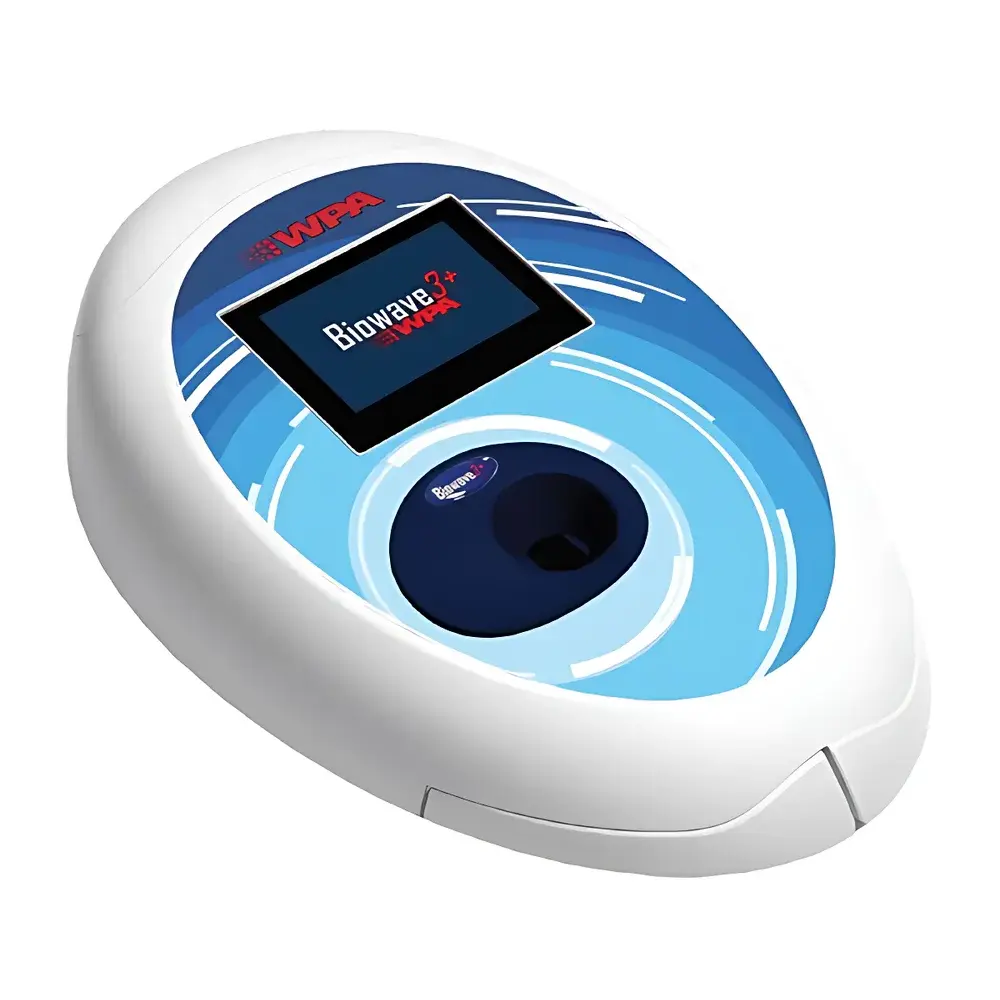
Biochrom Biowave 3+ UV-Vis Spectrophotometer
| Brand | Biochrom |
|---|---|
| Origin | USA |
| Model | Biowave 3+ |
| Optical Design | Single-beam |
| Detector | CCD Array |
| Wavelength Range | 190–1100 nm |
| Wavelength Accuracy | ±2 nm |
| Spectral Bandwidth | 3 nm |
| Stray Light | <0.5% T at 340 nm |
| Absorbance Range | –0.3 to 2.5 A |
| Built-in Applications | Nucleic Acid Quantification, Protein Assays (UV280, Bradford, Lowry, Biuret), Fluorescent Dye Labeling Efficiency, OD600 Cell Density, Melting Temperature (Tm) Analysis |
Overview
The Biochrom Biowave 3+ UV-Vis Spectrophotometer is a dedicated single-beam spectrophotometric platform engineered for precision and reproducibility in life science laboratories. Operating on the fundamental principle of absorbance-based photometry—measuring the attenuation of monochromatic light as it passes through a sample—the instrument delivers quantitative optical density data across a broad spectral range (190–1100 nm). Its xenon lamp source ensures stable, high-intensity output without warm-up delay or lamp replacement cycles typical of tungsten-halogen or deuterium systems. The integrated CCD array detector enables rapid full-spectrum acquisition with high signal-to-noise ratio and consistent pixel-level sensitivity. Designed explicitly for nucleic acid and protein characterization workflows, the Biowave 3+ supports both conventional cuvette-based measurements and microvolume analysis down to 0.8 µL using optional pathlength-adjustable pedestals—eliminating dilution errors and conserving precious biological samples.
Key Features
- Full-spectrum acquisition (190–1100 nm) in under 1 second using a high-resolution CCD array detector
- Pre-programmed, validated methods for A260/A280 nucleic acid purity assessment, direct UV protein quantification (A280), and colorimetric assays including Bradford, Lowry, Biuret, and BSA standard curves
- Automated OD600 cell density measurement with real-time growth curve plotting and kinetic monitoring capability
- Thermal denaturation (Tm) analysis module for nucleic acid duplex stability evaluation via temperature-controlled absorbance scanning
- Intuitive 7-inch capacitive color touchscreen interface with gesture navigation and on-device method storage (up to 100 user-defined protocols)
- USB host port for direct export of CSV/Excel-compatible data files; optional Bluetooth 4.2 or thermal printer integration for GLP-compliant documentation
Sample Compatibility & Compliance
The Biowave 3+ accommodates standard 10-mm square cuvettes (quartz, glass, or plastic), semi-micro and micro-volume pedestals (including adjustable-pathlength options), and disposable capillary cells. All pre-installed assay protocols align with widely adopted life science standards—including ISO 15195:2018 (clinical laboratory testing—requirements for reference measurement procedures), USP (spectrophotometric absorption), and ASTM E275-22 (standard practices for ultraviolet-visible spectrophotometry). Instrument firmware supports audit trail logging (user ID, timestamp, parameter changes, result exports) compliant with FDA 21 CFR Part 11 requirements when paired with Biochrom’s optional secure software license. Routine performance verification follows manufacturer-recommended wavelength and photometric accuracy checks traceable to NIST-traceable standards.
Software & Data Management
The embedded operating system provides native support for all core spectroscopic functions—wavelength scanning, kinetics, multi-wavelength quantitation, and standard curve generation—with no external PC dependency. Data files are stored internally (8 GB onboard memory) and exported via USB flash drive in tab-delimited or Excel-ready formats. Optional Biochrom Connect software (Windows/macOS) enables remote instrument control, advanced curve fitting (e.g., sigmoidal Tm modeling), batch report generation, and centralized fleet management across multiple Biowave units. All software modules maintain full version control, digital signature validation, and encrypted local database storage to meet GLP/GMP documentation integrity requirements.
Applications
- Quantitative determination of dsDNA, ssDNA, RNA, and oligonucleotides using extinction coefficients and A260 normalization
- Protein concentration estimation via aromatic amino acid absorbance (A280) or dye-binding assays with built-in calibration against BSA or IgG standards
- Labeling efficiency calculation for fluorescent dyes (e.g., Cy3/Cy5, Alexa Fluor) by dual-wavelength ratio analysis
- Microbial culture monitoring via OD600 with auto-zeroing and turbidity correction algorithms
- Thermal melt profiling of DNA/RNA hybrids and protein unfolding transitions using programmed temperature ramps (when used with compatible external heating blocks)
- Enzyme kinetics (e.g., NADH/NADPH oxidation/reduction) with time-resolved absorbance tracking at user-defined intervals
FAQ
What is the minimum sample volume supported by the Biowave 3+?
The instrument achieves reliable measurements with as little as 0.8 µL when equipped with the optional microvolume pedestal.
Does the Biowave 3+ comply with regulatory data integrity standards?
Yes—when configured with Biochrom Connect software and enabled audit trail settings, it satisfies core elements of FDA 21 CFR Part 11 and EU Annex 11 for electronic records and signatures.
Can the Biowave 3+ perform kinetic assays over extended time periods?
Yes—it supports continuous data acquisition for up to 24 hours with programmable interval timing (100 ms to 60 min per point) and automatic file segmentation.
Is wavelength calibration traceable to national standards?
All factory calibrations are performed using NIST-traceable holmium oxide and didymium filters; users may perform routine verification using supplied reference standards.
How does the Biowave 3+ handle stray light correction in low-transmittance measurements?
Stray light is minimized optically (<0.5% T at 340 nm) and mathematically compensated in absorbance calculations using a proprietary baseline interpolation algorithm applied during spectrum processing.




