Panlab MAZESOFT-8 Eight-Arm Radial Maze Behavioral Analysis Software
| Brand | Panlab |
|---|---|
| Origin | Spain |
| Model | MAZESOFT-8 |
| Hardware Interface | PCI-7200 I/O board required |
| Licensing | USB hardware key (dongle) |
| Data Output | Excel-compatible CSV format |
| Experimental Zone Definition | 17 detection zones (1 central hub + 8 arms × 2 segments: proximal & distal) |
| Sensor Input | TTL-compatible photobeam sensors (8 arms × 2 beams/arm) |
| Control Output | Relay-driven gate actuation (manual or software-triggered) |
| Documentation | Digital user manual (ISO-compliant installation media) |
Overview
MAZESOFT-8 is a dedicated behavioral analysis software platform engineered for precise, reproducible execution and quantification of eight-arm radial maze experiments in rodent models. Built upon the industry-standard PCI-7200 digital I/O interface board, the system operates on a deterministic real-time acquisition architecture—ensuring sub-millisecond timing fidelity between photobeam break events and timestamped zone entry/exit logging. The software implements a validated spatial memory paradigm grounded in the theoretical framework of Olton’s radial arm maze design, enabling concurrent assessment of working memory (within-trial revisits) and reference memory (arm-specific reward contingencies). Its core functionality centers on high-resolution spatiotemporal tracking via TTL-synchronized photodetector arrays, with each of the eight arms segmented into proximal and distal zones—allowing granular discrimination between exploratory approach and goal-directed arm completion. All behavioral events—including beam breaks, gate state transitions, and user-defined annotations—are time-stamped to microsecond resolution and stored in a structured binary log file, ensuring auditability and traceability under GLP-compliant experimental workflows.
Key Features
- Modular experimental protocol designer supporting customizable trial duration, inter-trial intervals, reward scheduling, and gate logic sequences
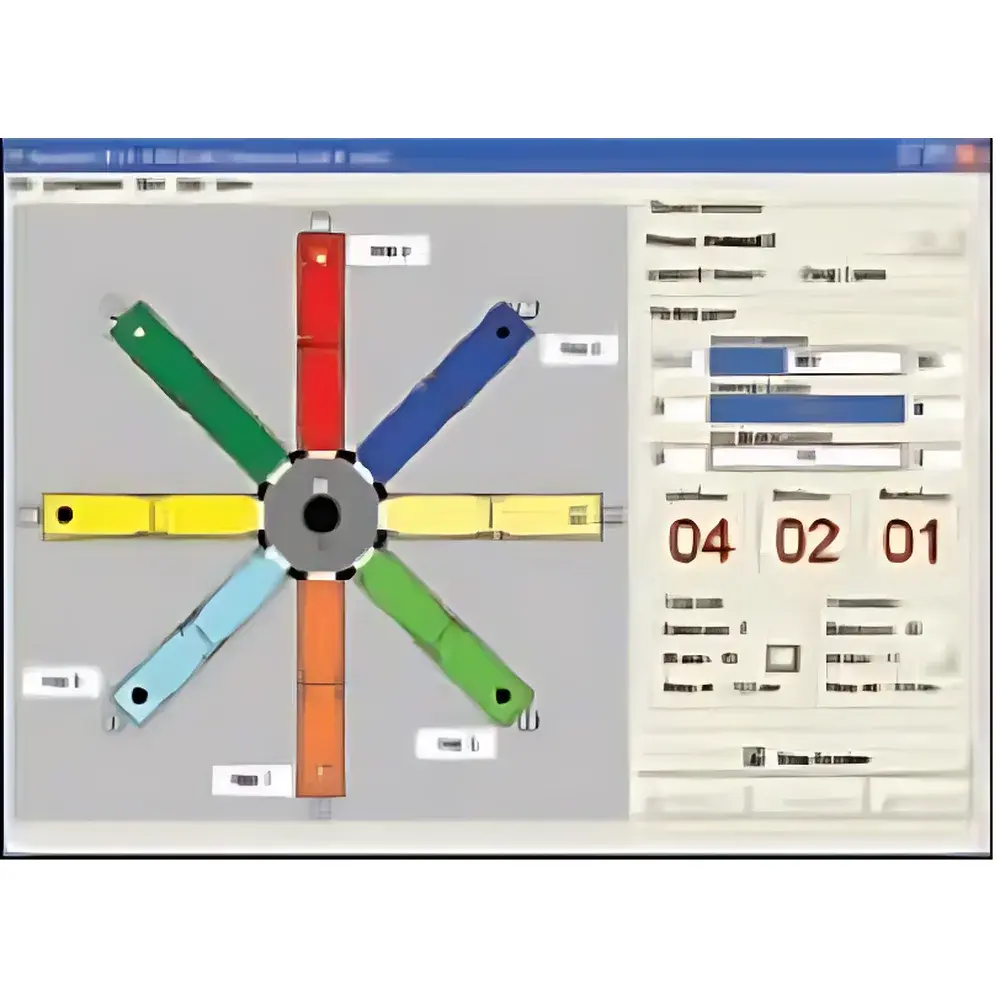
- Real-time visual feedback interface displaying live animal position across all 17 defined zones (1 center + 16 arm segments), updated at 100 Hz refresh rate
- Dual-mode gate control: software-initiated relay output for automated door actuation or manual override via on-screen toggle buttons with hardware interlock verification
- Configurable metadata tagging system permitting structured annotation using user-defined fields (e.g., subject ID, experimenter initials, drug dose, session number, environmental condition)
- Automated memory error classification: algorithmic detection and categorization of working memory errors (re-entry into previously visited arms within same trial) and reference memory errors (entry into never-baited arms)
- Export engine generating ISO 8601–compliant timestamped CSV files compatible with Microsoft Excel, GraphPad Prism, R, and Python pandas workflows
Sample Compatibility & Compliance
MAZESOFT-8 is validated for use with standard acrylic or aluminum eight-arm radial mazes (arm length: 50–60 cm; arm width: 10 cm; central platform diameter: 25 cm) housing adult Sprague-Dawley or C57BL/6 mice and rats. Sensor placement follows ASTM E3094-17 guidelines for photobeam-based behavioral tracking systems, requiring ≥2 mm beam diameter and ≤10 ms response latency. The software architecture complies with NIH Guide for the Care and Use of Laboratory Animals (2011) data integrity requirements and supports ALAAC-accredited facility documentation standards. Audit trail functionality records all user actions—including protocol modifications, data exports, and session deletions—with immutable timestamps and operator IDs, satisfying FDA 21 CFR Part 11 electronic record retention criteria when deployed on validated Windows OS environments.
Software & Data Management
The application runs natively on Windows 10/11 (64-bit) and requires the Panlab-provided USB hardware security key for license enforcement. All raw event logs are stored in encrypted binary format (.mz8) with SHA-256 checksum validation; conversion to human-readable CSV is performed only upon explicit user export request. Metadata fields are enforced as mandatory during session initialization, preventing orphaned datasets. Version-controlled configuration templates (.mzt files) allow laboratory-wide standardization of protocols across multiple workstations. Integrated backup scheduler supports automatic offsite synchronization via SMB or SFTP to institutional NAS repositories, with configurable retention policies aligned with institutional IRB data stewardship mandates.
Applications
- Pharmacological screening of cognitive enhancers or neurotoxicants targeting hippocampal-prefrontal circuitry
- Longitudinal assessment of age-related spatial memory decline in transgenic Alzheimer’s disease models
- Validation of optogenetic or chemogenetic manipulations on working memory maintenance
- Neurodevelopmental studies evaluating prenatal exposure effects on executive function maturation
- Behavioral phenotyping of knockout/knockin strains in standardized NIH Toolbox-compatible paradigms
- Preclinical evaluation of non-invasive brain stimulation parameters on spatial learning consolidation
FAQ
What hardware is mandatory for MAZESOFT-8 operation?
The PCI-7200 digital I/O board (or its PCIe equivalent, the PL-7200), Panlab-certified photobeam sensor kits, and the USB hardware key are mandatory. Legacy ISA or parallel-port interfaces are unsupported.
Can MAZESOFT-8 be used with mazes having fewer than eight arms?
No—the software is hard-coded for eight-arm geometry and 17-zone topology. Protocol logic, error algorithms, and visualization modules assume full eight-arm configuration.
Does the software support automated video tracking integration?
No—MAZESOFT-8 relies exclusively on discrete photobeam event detection. It does not process video streams or perform computer vision-based pose estimation.
Is raw timestamped event data accessible for custom analysis?
Yes—binary .mz8 files contain all unprocessed photobeam triggers, gate states, and user annotations. A documented C++ SDK is available under NDA for third-party parsing and statistical modeling.
How is data integrity verified during long-duration experiments?
The system performs continuous CRC-32 validation of RAM buffers and writes journaling logs to prevent corruption during power loss or OS interruption. Each session file includes embedded hardware clock drift compensation coefficients.