
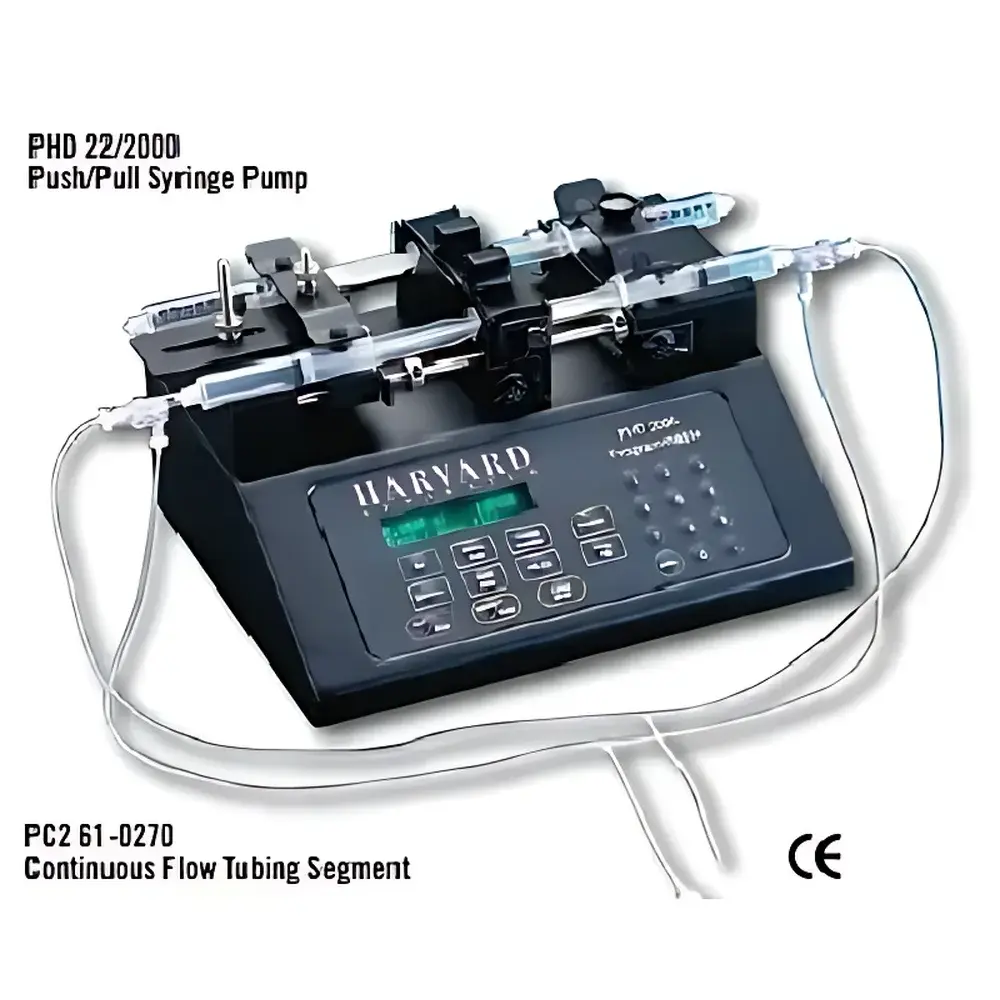
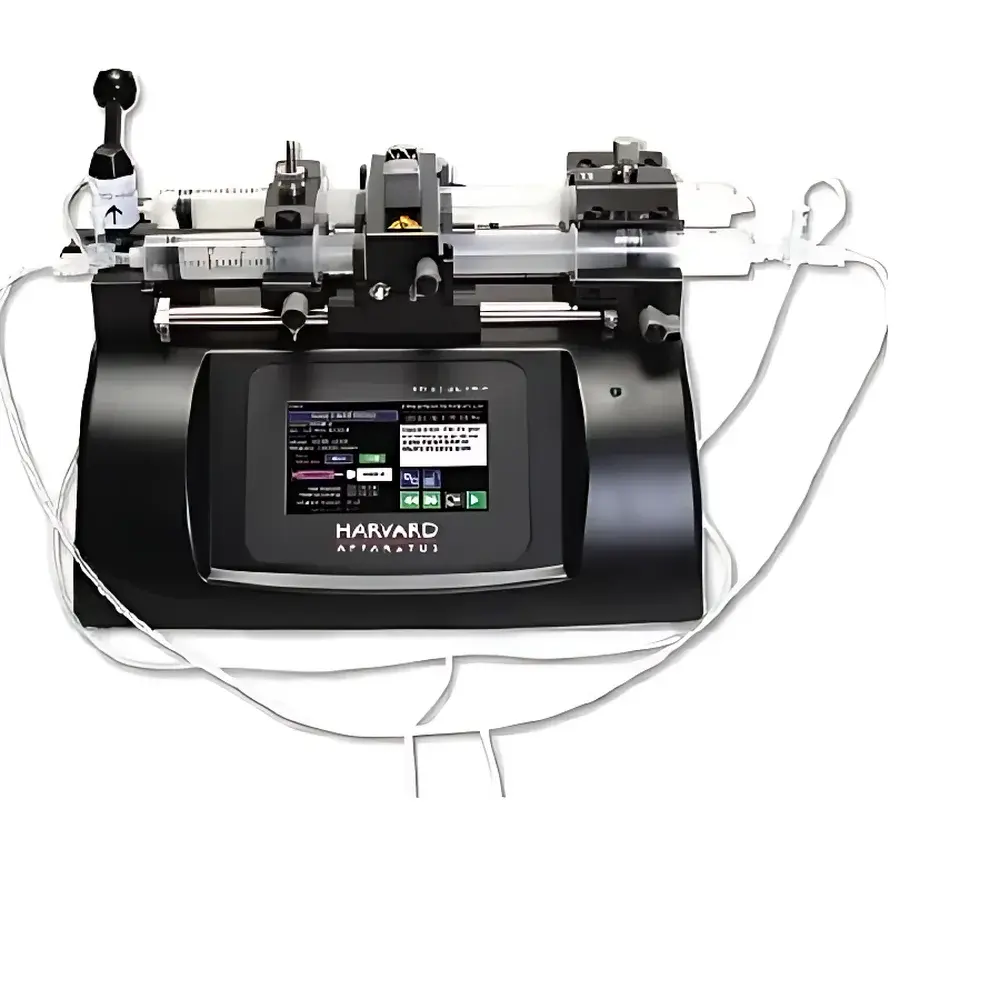
Harvard Apparatus PHD ULTRA Push/Pull Infusion/Withdrawal Pump
| Brand | Harvard Apparatus |
|---|---|
| Origin | USA |
| Model | PHD ULTRA Push/Pull Infusion/Withdrawal Pump |
| Syringe Capacity | 0.5 µL – 140 mL (full stroke limited to 50 mL) |
| Minimum Flow Rate | 1.50 pL/min |
| Maximum Flow Rate | 216.0 mL/min |
| Maximum Linear Force | 34 kg |
| Interface | USB + RS-232 |
| Syringe Mounting | 4 syringes (2 per side, push/pull configuration) |
Overview
The Harvard Apparatus PHD ULTRA Push/Pull Infusion/Withdrawal Pump is a high-precision, dual-channel programmable syringe pump engineered for bidirectional fluid handling in demanding laboratory and preclinical research environments. Unlike conventional single-direction infusion pumps, the PHD ULTRA implements synchronized push-pull actuation—enabling simultaneous, coordinated delivery and retraction of fluids from paired syringes. This architecture eliminates dead-volume accumulation, minimizes pulsatility, and supports true zero-net-displacement protocols essential for microdialysis, closed-loop perfusion systems, in vivo electrophysiology, and precise solvent exchange in cryo-EM sample preparation. Its core mechanism relies on stepper-motor-driven lead-screw translation with optical encoder feedback, ensuring repeatable positioning accuracy within ±0.35% of full-scale travel. The pump operates across an exceptionally broad dynamic range—from picoliter-per-minute dosing for nanoliter-scale neuroinjection to milliliter-per-minute flow for rapid buffer exchange—without hardware reconfiguration.
Key Features
- Dual independent drive channels supporting simultaneous push and pull operations with real-time synchronization and phase offset programming.
- Four-syringe mounting capacity (two per side), accommodating standard Luer-lock or threaded syringes from 0.5 µL to 140 mL volume; full-stroke operation validated up to 50 mL for maximal volumetric fidelity.
- Ultra-low flow capability down to 1.50 pL/min (at 0.5 µL syringe, 1 µm/s plunger speed), enabled by sub-micron step resolution and low-backlash mechanical transmission.
- High-force linear actuation (34 kg maximum thrust) ensures stable operation with high-viscosity media (e.g., polymer solutions, cell-laden hydrogels) and resistance-prone tubing configurations.
- Native USB 2.0 and RS-232 interfaces support direct integration into automated workflows; firmware-compatible with Harvard’s PumpControl software and third-party LabVIEW, MATLAB, and Python (pySerial) environments.
- Front-panel touchscreen interface with graphical flow profile editor, real-time status monitoring, and non-volatile method storage for GLP-compliant protocol recall.
Sample Compatibility & Compliance
The PHD ULTRA accommodates all commercially available glass, plastic, and stainless-steel syringes conforming to ISO 7886-1 (syringes for medical use) and ASTM D3418 (thermal transitions of polymers). It supports chemically aggressive solvents (e.g., DMSO, chloroform, acetonitrile) when used with compatible syringe barrels and PTFE/NBR seals. The pump meets IEC 61000-6-2 (electromagnetic immunity) and IEC 61000-6-3 (emissions) standards. Its firmware architecture supports audit-trail-enabled operation compliant with FDA 21 CFR Part 11 requirements when deployed with Harvard’s validated PumpControl v4.x software suite and appropriate system configuration controls.
Software & Data Management
PumpControl software provides comprehensive method development, execution logging, and data export in CSV and HDF5 formats. Each executed protocol records timestamped plunger position, flow rate, direction, error flags, and environmental temperature (via optional external sensor input). All parameter changes are logged with user ID, timestamp, and reason code—enabling full traceability for regulatory submissions. Remote control via TCP/IP (with optional Ethernet adapter) allows integration into centralized lab automation platforms. Scripting APIs support conditional logic (e.g., “pause if pressure exceeds threshold” when paired with external transducers) and event-triggered sequencing.
Applications
- Microdialysis sampling and analyte calibration in awake, freely moving rodent models.
- Controlled reagent addition in stopped-flow kinetics and enzyme assay platforms.
- Bidirectional perfusion of organ-on-chip devices with physiological flow reversal mimicking vascular shear stress patterns.
- Automated serial sectioning workflows requiring precise cryoprotectant infiltration and solvent exchange.
- Calibration of mass spectrometry infusion sources and nanospray ionization emitters.
- Delivery of viral vectors or CRISPR ribonucleoprotein complexes in stereotaxic neurosurgery setups.
FAQ
What is the difference between “full stroke” and “partial stroke” operation for 140 mL syringes?
Full stroke refers to complete plunger travel from base to tip seal; for 140 mL syringes, mechanical interference limits usable travel to ~50 mL equivalent. Partial stroke mode permits larger syringes but sacrifices volumetric linearity and requires custom calibration.
Can the PHD ULTRA be used in GMP-regulated bioprocessing environments?
Yes—when configured with PumpControl v4.x in audit-trail mode, validated IQ/OQ documentation, and electronic signature enforcement, it satisfies ALCOA+ data integrity principles for Phase I–III clinical manufacturing support.
Is there built-in pressure monitoring or overload protection?
No native pressure sensing; however, the pump detects motor stall events and halts execution upon exceeding torque thresholds. Integration with external pressure transducers (e.g., Harvard’s PHD Pressure Module) enables closed-loop pressure regulation.
How is flow accuracy verified across the full operating range?
Harvard Apparatus provides NIST-traceable gravimetric calibration reports per unit, covering at least five flow points per syringe size (0.5 µL, 10 µL, 1 mL, 10 mL, 50 mL) using Class S1 analytical balances and certified temperature-controlled environments.



