
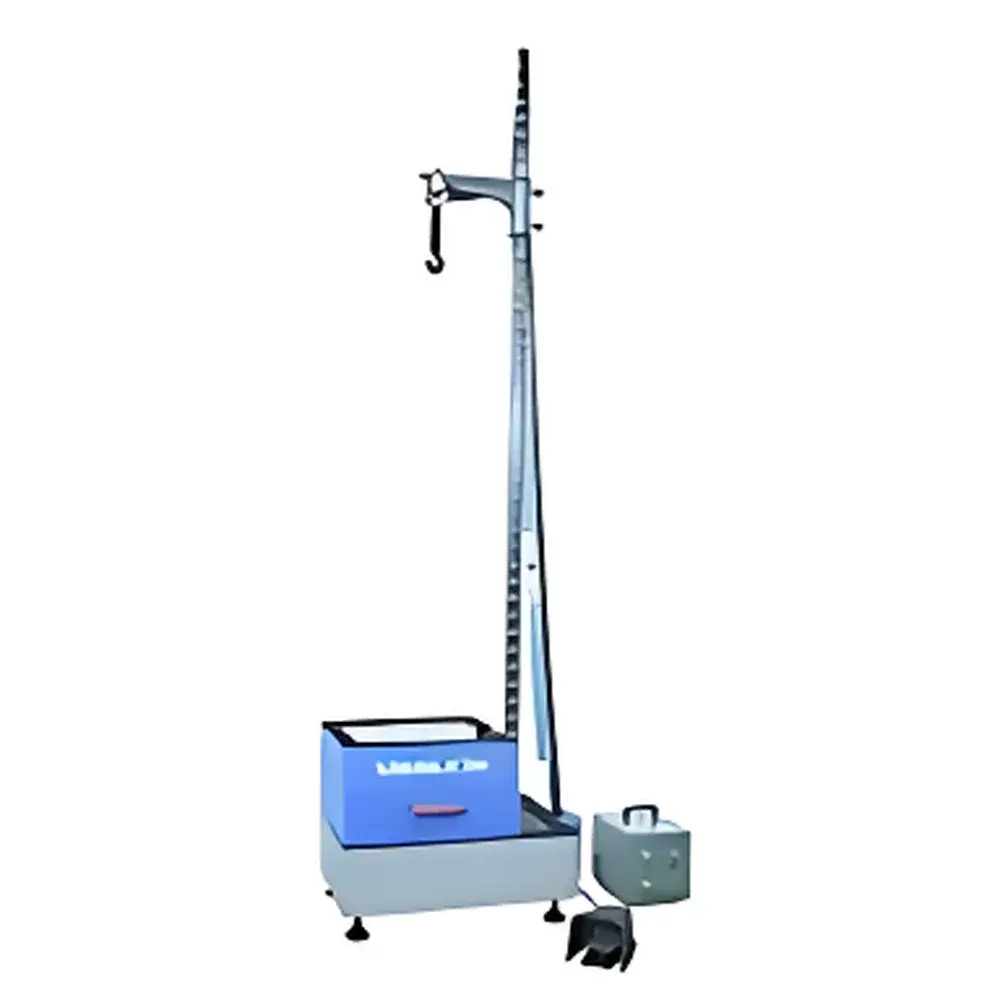
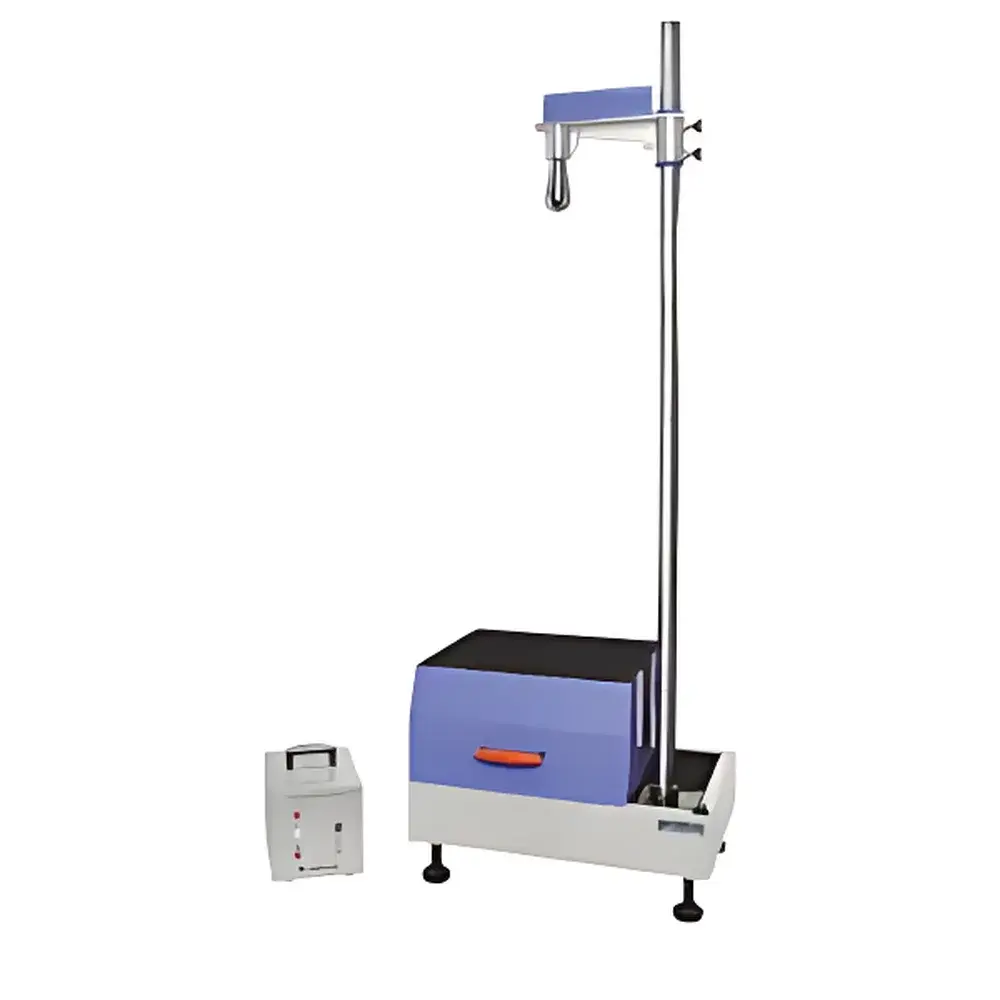
Yasuda No.183 Falling Ball & Dart Impact Tester
| Brand | Yasuda |
|---|---|
| Origin | Japan |
| Model | No.183 |
| Instrument Type | Falling Ball / Falling Dart Impact Tester |
| Drop Height Range (Ball Mode) | 50–2000 mm (50 mm increments) |
| Drop Height Range (Dart Mode) | 100–2000 mm |
| Standard Weights (Ball) | Customizable per specification |
| Standard Weights (Dart) | 1 kg, 3 kg, 9 kg (cylindrical flat-bottom) |
| Anvil Types | Flat anvil, V-notch anvil |
| Height Adjustment | Manual mechanical scale with vernier readout |
| Release Mechanism | Electromagnetic solenoid release with anti-rebound ratchet lock |
| Compliance Standards | JIS K5400, K5600-5-3, K6718, K6745, K7211, K6724, K6743, ISO 6272, GB/T 14485 |
| Power Supply | AC 100 V, 1φ, 3 A (Ball mode) |
| Host Dimensions (approx.) | W700 × D500 × H1870 mm (Ball), W800 × D800 × H3000 mm (Dart) |
| Weight | 130 kg (Ball), 200 kg (Dart) |
| Included Accessories | Leveling pendulum device (1 pc), foot-operated switch, operator control panel (W200 × D280 × H215 mm, ~7 kg) |
Overview
The Yasuda No.183 Falling Ball & Dart Impact Tester is a dual-mode, precision-engineered mechanical impact testing system designed for standardized evaluation of impact resistance in rigid polymeric materials, coatings, pipes, and fittings. Operating on the fundamental principle of gravitational potential energy conversion—where a calibrated mass is elevated to a defined height and released under controlled free-fall—the instrument quantifies material failure thresholds through visual or threshold-based assessment of crack initiation, fracture propagation, or complete penetration. Unlike high-speed servo-hydraulic systems, the No.183 relies on deterministic mechanical release and repeatable drop kinematics, making it especially suitable for routine QC laboratories requiring traceable, standards-compliant pass/fail or semi-quantitative impact performance data. Its dual configuration supports both spherical impactor (ball mode) per JIS K5400/ISO 6272 for coatings and thin plastic sheets, and cylindrical/conical dart impact (dart mode) per JIS K6724/K6743 for rigid PVC piping systems—enabling cross-material comparability within a single platform architecture.
Key Features
- Dual operational modes: Interchangeable falling ball and falling dart configurations, each with dedicated anvil assemblies and weight sets to satisfy distinct standard requirements.
- Precision-height adjustment mechanism with 50 mm incremental stops and vernier-assisted fine positioning (±0.5 mm repeatability), ensuring strict adherence to JIS and ISO height tolerances.
- Electromagnetic solenoid release system with integrated anti-rebound ratchet lock, eliminating secondary impacts and guaranteeing single-event energy delivery per test cycle.
- Modular anvil support: Flat anvil for sheet specimens (e.g., automotive coatings, laminates); V-groove anvil for pipe section testing per JIS K6724, enabling stable radial orientation and consistent impact point registration.
- Robust steel frame construction with vibration-damped base plate, minimizing environmental interference and supporting long-term calibration stability across daily use cycles.
- Foot-switch actuated operation with illuminated control panel, facilitating hands-free release and ergonomic workflow integration in production-line or lab environments.
Sample Compatibility & Compliance
The No.183 accommodates a broad range of specimen geometries and mechanical classes: flat panels (up to 200 × 200 mm), molded pipe segments (DN15–DN110), injection-molded fittings, and coated metal substrates. Specimen clamping is achieved via adjustable mechanical fixtures compatible with standard JIS test frames. All mechanical components—including drop tube alignment, anvil parallelism, and weight concentricity—are verified against JIS Z 8401 (accuracy of measuring instruments) and ISO/IEC 17025 traceability guidelines. The system meets essential regulatory expectations for GLP-compliant testing environments: mechanical interlocks prevent unintended release; height settings are physically indexed and documented; and all weights bear engraved certification markings aligned with JIS B 7501 mass standards. While the instrument itself does not generate electronic audit trails, its mechanical design facilitates full manual test record integrity—supporting FDA 21 CFR Part 11-aligned paper-based SOP execution when paired with controlled logbooks and witnessed calibration certificates.
Software & Data Management
The Yasuda No.183 is a fully mechanical, non-digital impact tester—intentionally engineered without embedded microprocessors, sensors, or proprietary software. This architecture eliminates firmware dependencies, cybersecurity vulnerabilities, and software validation overhead, aligning with lean QC workflows where test definition, execution, and interpretation remain human-directed per written procedures. All test parameters—including drop height, weight selection, anvil type, and specimen conditioning status—are recorded manually in standardized test reports compliant with ISO/IEC 17025 clause 7.8. Laboratories may integrate the No.183 into broader LIMS ecosystems by assigning unique test IDs, linking physical test records to digital batch histories, and archiving calibration certificates (e.g., annual weight verification per JIS B 7501, annual height gauge calibration per JIS B 7512). Optional third-party digital documentation kits—including barcode-scanned test cards and PDF report templates mapped to JIS/ISO clause numbering—are available through authorized distributors to support hybrid paper-digital compliance strategies.
Applications
- Evaluation of coating adhesion and brittleness on automotive body panels (per JIS K5600-5-3).
- Impact resistance screening of ABS/PC blends used in consumer electronics housings (per JIS K7211).
- Quality conformance testing of rigid PVC drainage pipes per JIS K6724—particularly critical for municipal infrastructure procurement.
- Comparative assessment of UV-stabilized vs. non-stabilized polyolefin films in packaging R&D (per ISO 6272).
- Failure mode analysis of thermoset composites under low-velocity impact conditions in academic materials labs.
- Supplier qualification audits where mechanical reproducibility and standards transparency outweigh high-throughput automation requirements.
FAQ
Is the No.183 compliant with ASTM D256 or ISO 180? Why or why not?
No. The No.183 implements free-fall impact principles defined in JIS and ISO 6272—not pendulum-based Charpy/Izod methods covered by ASTM D256 or ISO 180. Its design intent is surface deformation and penetration assessment, not notched-bar fracture energy quantification.
Can the same weight set be used interchangeably between ball and dart modes?
No. Ball-mode weights are spherical and magnetically retained; dart-mode weights are cylindrical or conical with threaded mounting interfaces. Cross-use would compromise impact geometry, energy distribution, and standard compliance.
What maintenance intervals are recommended for electromagnetic release calibration?
Yasuda recommends annual verification of solenoid timing consistency (≤ ±2 ms deviation from nominal release latency) using oscilloscope-based trigger analysis, alongside biannual inspection of coil insulation resistance (>10 MΩ at 500 V DC) per JIS C 0920.
Does the system include CE marking or UL certification?
The No.183 is supplied as a Class I electrical appliance conforming to JIS C 61000-6-2/6-4 EMI immunity/emission limits. CE marking is not applied, as the unit is imported under Japanese PSE regulatory framework; UL listing is available only upon special-order factory retrofit with NRTL-reviewed control circuit modifications.
How is height measurement traceability established during calibration?
Height verification uses a certified stainless-steel tape measure (JIS B 7512 Class II) referenced to a granite surface plate (JIS B 7513 Grade 0), with readings taken at three axial points along the drop guide to confirm vertical alignment within 0.1 mm/m tolerance.



