
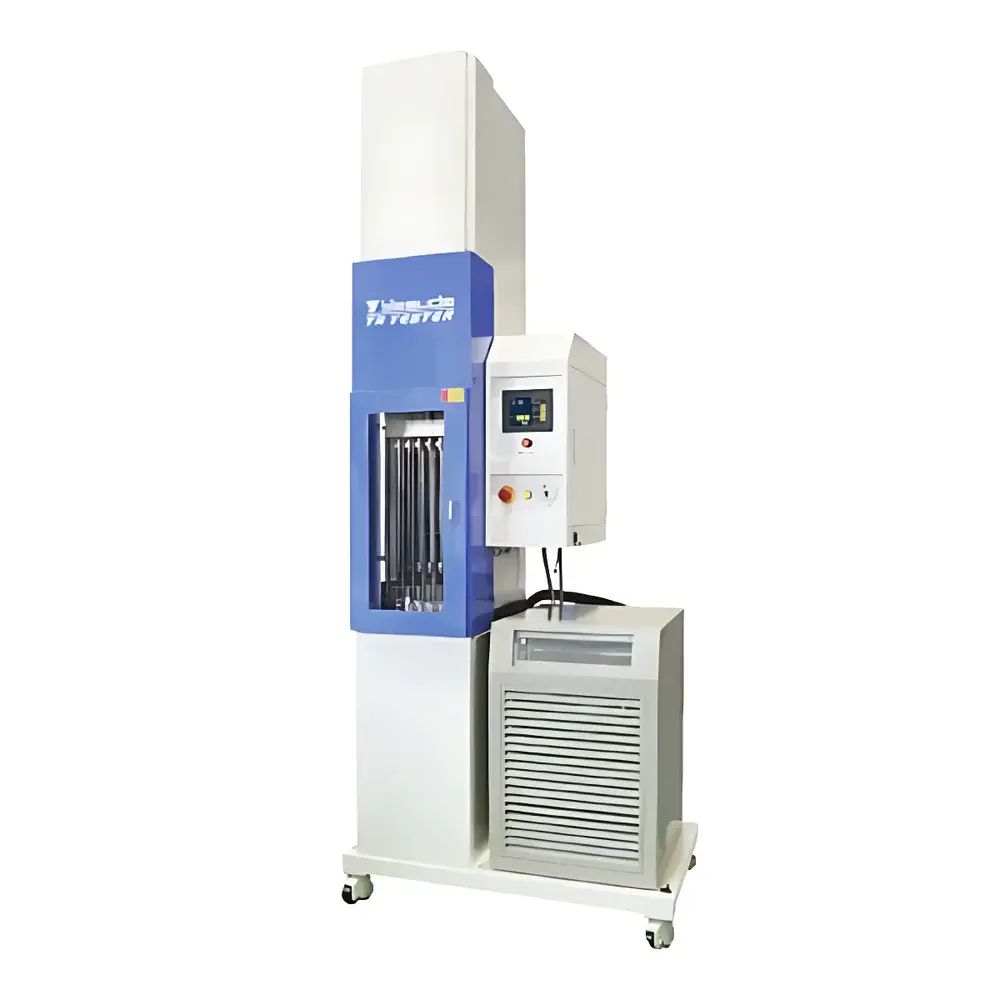
Yasuda No.145-L Low-Temperature Tensile Rebound (TR) Testing Machine
| Brand | Yasuda |
|---|---|
| Origin | Japan |
| Model | No.145-L |
| Temperature Range | −70 °C to +30 °C (standard) |
| Specimen Dimensions | Parallel section width 2.0 ± 0.2 mm, length 50.0 ± 0.2 mm or 100.0 ± 0.2 mm, thickness 2.0 ± 0.2 mm, grip separation 50 mm or 100 mm |
| Displacement Measurement | Optical scale sensor, resolution ±0.1 mm, max travel 200 mm |
| Heating Rate | 1 °C/min |
| Thermal Medium Volume | ~27 L |
| Power Supply | AC 200 V, 3-phase, 30 A, 50/60 Hz |
| Safety Features | Interlocked safety enclosure, O-ring chucks |
| Footprint (4-station) | W1110 × D830 × H1870 mm, ~320 kg |
| Footprint (6-station) | W1170 × D830 × H1870 mm, ~370 kg |
| Compliance | JIS K6261, ASTM D1329, ISO 2921 |
Overview
The Yasuda No.145-L Low-Temperature Tensile Rebound (TR) Testing Machine is a precision-engineered instrument designed for the quantitative evaluation of elastic recovery behavior in vulcanized and thermoplastic elastomers under controlled cryogenic conditions. Based on the fundamental principle of tensile deformation followed by thermal relaxation, the system measures the temperature at which a pre-stretched, frozen specimen recovers to a defined contraction ratio—commonly expressed as the TR10, TR30, or TR70 value—during controlled warming. This methodology directly correlates with low-temperature flexibility, crack resistance, and service performance in automotive seals, aerospace gaskets, and cold-climate industrial hoses. The instrument operates within a thermally stabilized bath using either mechanical refrigeration (−70 °C baseline) or optional liquid nitrogen integration (down to −100 °C), enabling strict adherence to standardized test protocols mandated by JIS K6261, ASTM D1329, and ISO 2921.
Key Features
- Modular multi-station configuration: selectable 4- or 6-specimen test frames, supporting parallel throughput without cross-contamination or thermal interference.
- Cryogenic thermal control system with dual-mode capability: standard compressor-based cooling (−70 °C to +30 °C) and optional liquid nitrogen interface for extended low-temperature validation.
- High-fidelity optical displacement sensing: non-contact linear scale sensor with ±0.1 mm resolution and 200 mm maximum travel, ensuring traceable dimensional tracking during contraction.
- Precision-machined specimen fixtures: O-ring chucks with calibrated grip separation (50 mm or 100 mm), accommodating standardized dumbbell specimens per ISO 2921 geometry (parallel width 2.0 ± 0.2 mm, thickness 2.0 ± 0.2 mm, length 50.0/100.0 ± 0.2 mm).
- Thermal medium management: 27 L capacity heat-transfer bath with programmable heating rate of 1 °C/min, minimizing thermal gradients across specimen arrays.
- Integrated safety architecture: interlocked transparent safety enclosure, emergency stop circuitry, and fail-safe thermal cutoffs compliant with IEC 61000-6-2 and ISO 13857.
Sample Compatibility & Compliance
The No.145-L accommodates standard ISO 2921 Type 1 dumbbell specimens prepared from cured rubber compounds, including natural rubber (NR), styrene-butadiene rubber (SBR), nitrile rubber (NBR), ethylene propylene diene monomer (EPDM), and thermoplastic elastomers (TPEs). Specimen preparation tools—including dual-purpose cutting dies (50 mm and 100 mm lengths) and alignment jigs—are supplied to ensure geometric consistency. All operational parameters and data acquisition workflows are fully aligned with the procedural requirements of JIS K6261 (Japanese Industrial Standard), ASTM D1329 (American Society for Testing and Materials), and ISO 2921 (International Organization for Standardization). The system supports audit-ready documentation for GLP-compliant laboratories and satisfies traceability requirements under ISO/IEC 17025:2017 for testing laboratories.
Software & Data Management
Windows-based proprietary software provides real-time monitoring of temperature ramp profiles, displacement curves, and contraction ratio calculations. Raw sensor data (time, temperature, position) is logged at user-defined intervals (default: 1 Hz) and exported in CSV format for post-processing in third-party statistical packages. The software enforces test sequence integrity through password-protected method templates, electronic signature logging, and immutable audit trails meeting FDA 21 CFR Part 11 requirements for electronic records and signatures. Calibration history, maintenance logs, and operator annotations are embedded within each test file to support regulatory inspections and internal quality audits.
Applications
- Low-temperature resilience screening of elastomeric sealing systems for automotive door modules and HVAC components.
- Quality control of rubber compounds used in cryogenic fluid handling systems (e.g., LNG transfer hoses, liquid oxygen gaskets).
- R&D evaluation of novel polymer blends targeting improved winter-grade performance in tires and track treads.
- Validation of aging effects on elastic memory following thermal cycling between −70 °C and ambient conditions.
- Comparative benchmarking of TR values across supplier-sourced elastomer lots prior to production release.
FAQ
What is the minimum achievable temperature with the standard configuration?
The base system achieves −70 °C using integrated mechanical refrigeration. With optional liquid nitrogen coupling, operation down to −100 °C is supported.
Can the instrument measure TR50 or other non-standard contraction ratios?
Yes—the software allows user-defined contraction thresholds (e.g., TR50, TR90) and automatically calculates corresponding recovery temperatures from the full displacement vs. temperature curve.
Is calibration certification included with shipment?
Each unit ships with NIST-traceable calibration certificates for temperature sensors and displacement transducers, valid for 12 months from date of manufacture.
How is thermal uniformity across multiple stations verified?
Independent PT100 sensors are embedded at each station’s specimen plane; the control system performs real-time differential compensation to maintain ≤±0.3 °C inter-station deviation during ramping.
Does the system support automated specimen loading?
No—specimen mounting is manual to preserve geometric fidelity and avoid unintended pre-strain; however, ergonomic jigs and alignment guides minimize operator variability.



